
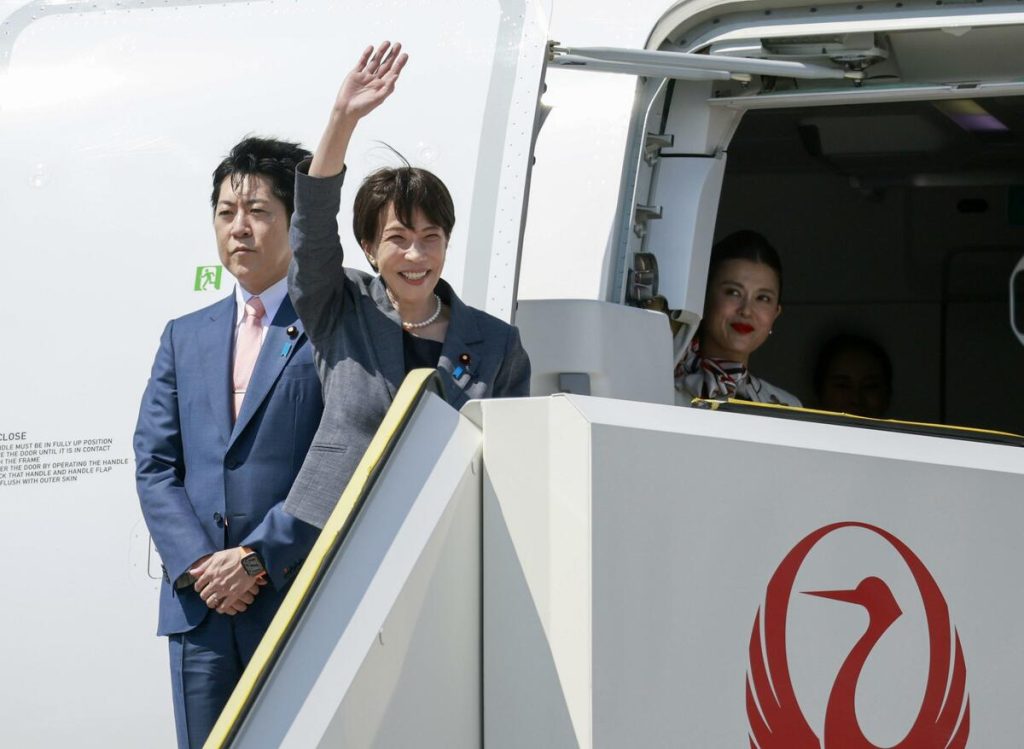
TOKYO – Japanese Prime Minister Sanae Takaichi departed Saturday for her first trip to Europe since taking office in October, hoping to work with other leaders to address what has become the world’s worst energy crisis since the 1970s.
Takaichi will visit Britain and Italy before attending the three-day Group of Seven summit beginning Monday in the French resort town of Evian-les-Bains. Energy security, critical mineral supply chains and geopolitical tensions are expected to top the agenda.
The summit will bring together the leaders of the G7 nations and invited partners, including Ukrainian President Volodymyr Zelenskyy and Brazilian President Luiz Inacio Lula da Silva.
Japanese officials are also arranging bilateral meetings and informal talks on the sidelines.
“I’d like to demonstrate that the G7 is working together in unity and is leading international efforts to address global challenges,” Takaichi told reporters at her official residence before leaving for Tokyo’s Haneda airport.
“On energy security, I plan to put forward three proposals…and as for critical minerals, I’m thinking about proposing a joint initiative that would help G7 countries to establish stockpiling systems and link those systems together through coordinated cooperation.”
Takaichi plans to use the summit to stress the importance of stable energy markets amid heightened tensions in the Middle East and disruptions to shipping through the Strait of Hormuz, a vital route for global oil supplies.
She is also expected to emphasize the need to ensure freedom of navigation in vital sea lanes.
According to Japanese government sources, Takaichi will call for greater international cooperation through the Partnership on Wide Energy and Resources Resilience Asia, a Japanese-backed financing framework aimed at helping Asian countries to secure stable energy supplies.
Japan’s three principles for energy security call for free and transparent trade, support for strategic petroleum reserves and closer coordination between energy-producing and energy-consuming nations in countering coercive moves.
Economic security is expected to be another major theme of her trip. Takaichi is likely to raise concerns over China’s export restrictions on rare earths and other critical minerals and call for stronger cooperation among like-minded countries to build more resilient supply chains.
Tokyo-Beijing relations have deteriorated since Takaichi, known as a security hawk, suggested in parliament in November that an attack on Taiwan could prompt a response by Japan’s defense forces.
On the sidelines of the summit, she is seeking a meeting with U.S. President Donald Trump, although bilateral talks had yet to be confirmed as of Friday.
Chaired by France this year, the G7 also includes Britain, Canada, Germany, Italy, Japan and the United States, along with the European Union.
Before the G7 summit, Takaichi will meet British Prime Minister Keir Starmer in London on Sunday.
The two leaders are expected to issue a joint statement on economic security and discuss cooperation on offshore wind power and next-generation nuclear energy technologies.
She will then travel to Rome for talks with Italian Prime Minister Giorgia Meloni on Monday. The leaders are expected to agree on closer cooperation in strategic industries, including semiconductors and space development.
In both meetings, Takaichi is set to reaffirm Japan’s commitment to a joint next-generation fighter jet program involving the three countries and seek to accelerate progress on the project.
She is scheduled to return to Japan on Thursday.