
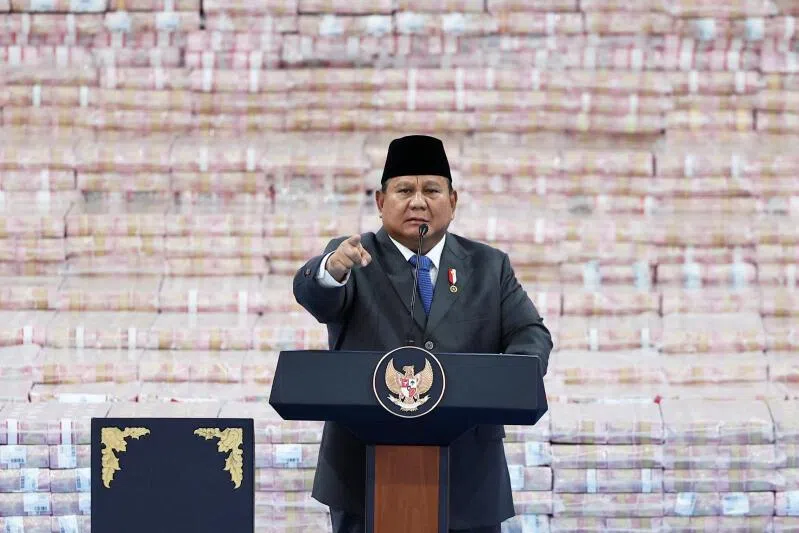
JAKARTA – Indonesian President Prabowo Subianto departs Jakarta on the evening of April 12 for Moscow to meet his Russian counterpart amid the ongoing conflicts in the Middle East that show no signs of abating.
Mr Prabowo and President Vladimir Putin are expected to hold bilateral talks that focus on the potential procurement of Russian energy products and raw materials for Indonesia’s fertiliser production.
The South-east Asian nation is taking proactive steps to ensure its national energy resilience and secure the agricultural materials it needs.
“President Prabowo will discuss the global geopolitical situation with President Putin, particularly regarding (the) energy situation, such as fuel volatility amid conflicts in the Middle East. This is something very strategic for Indonesia,” Mr Angga Raka Prabowo, head of the Government Communication Agency (Bakom), told The Straits Times on the night of April 12. “It (Mr Prabowo’s trip to Russia) may open up opportunities for other cooperation,” Mr Angga, who is also Vice-Minister of Communication and Digital Affairs, added.
Separately, another senior government official told ST that Indonesia may also seek to source raw materials from Russia to produce fertilisers. Russia is one of the world’s largest exporters of potassium, a foundational raw material for making fertilisers.
In recent weeks, Indonesia has faced a combination of a domestic spike in demand for fuel, due to the Hari Raya travel season, and severe external pressures over the ongoing Middle East conflict, which has pushed global oil prices above US$100 a barrel.
The country is making efforts to ensure that its national fuel stocks are safe and stable. Its state-owned oil and gas company, Pertamina, must secure reserves above the mandated minimum of 21 days, according to government regulation.
Indonesia’s oil refineries in Balikpapan, Balongan, Cilacap, Dumai and Plaju have been operating at maximum capacity while depot storage limits are maximised.
To cool demand and stretch existing supplies, the government enacted a strict rationing policy on April 1, capping the purchase of fuel by private motorists.
With the Strait of Hormuz, through which roughly 20 per cent of the world’s oil passes, facing a blockade in the Iran war, Pertamina has rapidly pivoted its crude oil procurement strategy. Indonesia is reducing its reliance on Middle Eastern crude oil and sourcing oil imports from Africa, the Americas and other non-conflict regions, Pertamina chief executive Simon Aloysius Mantiri told reporters in March. To permanently reduce reliance on imported fossil fuel, the Indonesian government has also allocated more crude palm oil to be used in biofuel. It plans to raise the palm oil and diesel blend to 50 per cent from the current 40 per cent starting from July 1.
Mr Prabowo’s last trip to Russia was on Dec 10, 2025, when he met Mr Putin at the Kremlin in an effort to improve Indonesia’s strategic partnership with Russia, including discussions that emphasised tangible economic cooperation.
Mr Putin had expressed strong interest in investing in Indonesia’s offshore energy, expanding hydrocarbon supplies and collaborating in pharmaceuticals and shipbuilding. Russian state-backed energy giant Rosneft also reaffirmed its commitment to the delayed Tuban oil refinery project in Indonesia’s East Java province, pledging substantial capital to accelerate construction and bolster Indonesia’s domestic fuel security.
Before the Kremlin summit, Mr Prabowo had attended the St Petersburg International Economic Forum in June 2025, a critical platform where a deepened bilateral partnership between the two countries was officially showcased.
Mr Prabowo delivered a keynote speech at the forum, where he argued that free market capitalism had failed to create opportunities for the working class, adding that among his administration’s main priorities were food self-sufficiency, energy dependence, educational enhancement and accelerated industrialisation.
His current trip to Moscow to secure energy and fertiliser is a direct execution of the self-sufficiency mandates he mentioned at the forum in 2025.
This continuous engagement stresses Jakarta’s non-aligned, active foreign policy and Moscow’s growing focus on the Indo-Pacific, home to more than half of the global population and which generates roughly 60 per cent of the global gross domestic product.
Increasingly, the region has become the focus of geopolitical competition. While the United States historically maintains a dominant security role in the Indo-Pacific, China has rapidly expanded its economic and military influence as well.
At the Dec 10 summit in the Kremlin, Mr Prabowo highlighted the warm relationship between Indonesia and Russia, and formally invited Mr Putin to visit Indonesia in 2026 or 2027. The Russian leader accepted the invitation, signalling a mutual desire to sustain the two countries’ positive diplomatic momentum.