
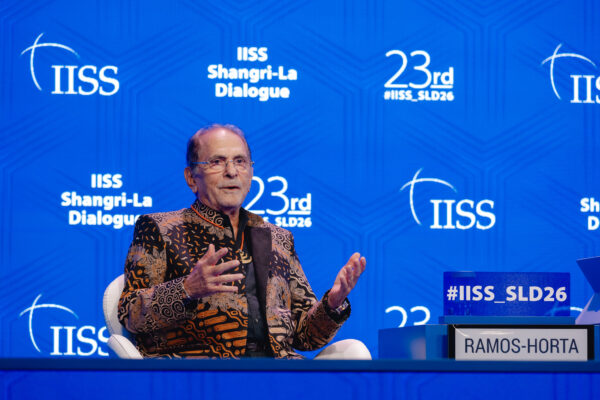
The wars in Ukraine, Gaza, and Iran have been a painful reminder of what a rare and difficult thing it is for conflicting parties to reconcile. When President José Ramos-Horta of Timor-Leste spoke at the Shangri-La Dialogue in Singapore on May 30 about what the world needs to do to achieve peace, his words carried particular weight given his country’s own history.
Just nine days after East Timor declared independence from Portuguese colonial rule in 1975, Indonesia invaded the new country and occupied it for 24 years, until October 1999. This occupation, and the resulting Indonesia-Timor conflict, led to large-scale civilian casualties. The fact that Indonesia and Timor-Leste managed to reconcile after this painful period is a true feat of diplomacy.
A key mechanism by which this reconciliation was achieved was the Indonesia–Timor-Leste Commission of Truth and Friendship (CTF), a truth commission established jointly by the governments of Indonesia and Timor-Leste. The CTF was tasked with finding out the conclusive truth behind the acts of violence that occurred around the independence referendum held in East Timor in 1999.
Where previous truth commissions were established within individual countries – such as Chile’s National Commission for Truth and Reconciliation, which investigated the abuses of the military dictatorship which ruled Chile from 1973 to 1990 – the CTF was the first truth commission in history to be established by two states.
The strong leadership, political will, and commitment displayed by both nations’ presidents and foreign ministers were key to the CTF’s success. The official launch of the CTF in August 2005 was preceded by a series of intense meetings between Ramos Horta, who was then the foreign minister of Timor-Leste, and his Indonesian counterpart, Dr. Hassan Wirayuda, who also made joint diplomatic statements on the issue in the United Nations in New York. Timor-Leste’s President Xanana Gusmão participated in the final reading of the text prior to the signing.
At the heart of the CTF was the common long-term goal of working toward a future of peaceful co-existence between the two nations. “The present generation owes the future generation to mend all broken relationships and lay a strong foundation for a future that shines and is full of hope,” noted the CTF Report, which was aptly titled “Per Memoriam Ad Spem” (meaning “Through Memory Towards Hope”).
However, as the Report documented, the difficult task of reaching an agreement on the conclusive truth required a shared commitment to overcoming obstacles such as short-term narrow interests and rigidity in perspective. The Report emphasized that “it requires moral courage, humility and wisdom to be able to release oneself from emotional ties and keep a distance from the violent events that took place in East Timor in 1999, in order to take a more objective and enlightened approach to build a better future between the two nations.”
As Ramos-Horta put it at the Shangri-La Dialogue last month:
[Timor-Leste’s] independence was built through years of patient, practical diplomacy that gradually turned old wounds into new bonds. We never demonized the other side, we did not disrespect their faith… We show that history need not imprison our hearts and minds, history must not imprison nations, wise leadership and dialogue can turn conflict into coexistence, and coexistence into friendship and trust.
He further echoed this sentiment in Jakarta on June 2, saying, “Reconciliation is not an act of forgetting the past. It is an act of courage to build the future.”
The Commission embodied a transitional justice approach, emphasizing institutional accountability, reconciliation, and forward-looking cooperation, while acknowledging the complex historical, political, and social challenges at play. The CTF also emphasized restorative justice, highlighting institutional responsibility rather than pursuing criminal prosecution. The experience of the CTF provides important lessons on balancing victims’ rights, domestic political considerations, and international diplomacy. The work of the CTF contributed toward peacebuilding efforts in Timor-Leste as the new nation establishes its presence in the region.
An important lesson of the CTF is that the past must be accepted and agreed upon by both sides before they can begin a new chapter of their shared history. It is difficult to build a sustainable friendship between parties that have clashing narratives about their shared past. This also means that no reconciliation can be reached without considerable sacrifice and courage from all relevant parties, as they need to accept painful truths and to take responsibility for their past wrongs. It is only then that a shared historical record as painful as that of Indonesia and Timor-Leste can form the basis for a peaceful and prosperous future for the two countries and their people.
Naturally, the CTF is imperfect. It has received criticism, especially from NGOs. for prioritizing state and institutional responsibility over individual accountability, for its limited direct engagement with victims, and for focusing more on diplomatic and political objectives over substantive justice. Nevertheless, it embodies a landmark in transitional justice, balancing the acknowledgement of human rights violations with diplomatic reconciliation.
At the Shangri-La Dialogue, Ramos-Horta drew a parallel between Timor-Leste’s experience and ASEAN’s, noting that ASEAN, too, was born from the ashes of war. He said, “Its success was not that it eliminated differences. It did something more modest, and perhaps more profound: it planted a Banyan tree, and under its foliage leaders gathered and plotted the end of wars.” Ramos-Horta added that ASEAN “affirmed principles that sound simple but were revolutionary when practiced: mutual respect; relentless, persistent negotiations leading to peaceful settlement of disputes; renunciation of the threat or use of force; and effective cooperation.”
These revolutionary principles, embodied by both ASEAN and the CTF, may be just what the world needs to move forward from the present violence and build a future full of hope.
This essay was first published in the Asian Peace Programme (APP) web page. The APP is housed in the National University of Singapore (NUS).