
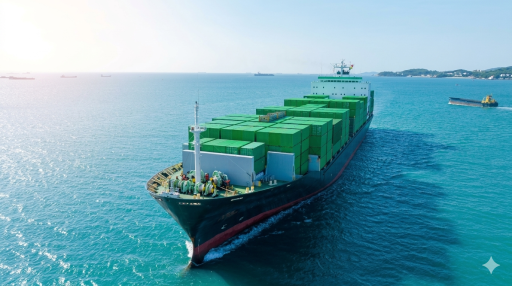
The global maritime industry is accelerating its shift toward low-emission operations, with Estonia identifying Indonesia as a strategic partner as environmental regulations tighten and competition in green shipping intensifies.
Speaking in Tallinn, Estonia’s Deputy Minister for Maritime and Water Resources, Kristjan Truu, stressed that the shift toward greener shipping is no longer optional but an inevitable transformation driven by the dual need of reducing emissions and remaining competitive in global shipping.
“We can see that all parties are currently moving toward a green transition to reduce emissions. This is the main goal,” he said, addressing Indonesian journalists on Tuesday, April 7, 2026.
Estonia’s position: a transition leader, not yet low-emission
While Estonia’s Ministry of Climate positions the country as a leader in green shipping innovation, it has not yet achieved a fully low-emission maritime sector.
As with most countries, global shipping continues to generate a significant share of emissions, according to the International Maritime Organization (IMO), and still relies heavily on conventional fuels. Achieving net-zero targets will therefore require substantial structural changes across the industry.
Rather than being fully low-emission today, Estonia is better understood as a transition leader: developing the infrastructure, regulatory frameworks, and international partnerships needed to reach near-zero maritime emissions in the future.
Policy momentum driving global change
According to Truu, the push toward greener maritime operations is being reinforced by major policy frameworks such as the European Union’s Clean Industrial Deal, which aims to balance industrial competitiveness with the adoption of climate-neutral technologies.
These frameworks are shaping long-term industry direction, embedding sustainability as a core pillar of maritime operations worldwide rather than a peripheral objective.
Estonia’s green shipping model
Estonia has already begun implementing concrete solutions. A flagship initiative is the Estonia–Finland green shipping corridor, a cross-border effort to establish a fully sustainable maritime transport chain.
The project integrates renewable-powered ports with cleaner vessel operations, allowing ships to receive energy directly from port infrastructure powered by electricity and renewable sources, enabling the use of green fuels.
“From the port, energy is supplied to ships, and the vessels sail using green fuels,” Truu explained, adding that Estonia is also working with partners such as Sweden to expand similar initiatives.
Indonesia seen as a strategic partner
Truu highlighted Indonesia’s strategic role in the global maritime ecosystem and underscored the urgency for the country to align with emerging international standards. He pointed to the International Maritime Organization’s net-zero framework introduced in 2025 as a key driver of industry transformation.
Estonia is planning a visit to Indonesia to explore cooperation opportunities, facilitate knowledge exchange, and deepen maritime partnerships in support of the green transition.
Industry shift accelerates under regulation and cost pressure
Echoing this outlook, Kaupo Läänerand, Chief Commercial & Strategy Officer at ShoreLink, noted that European regulations are already reshaping industry behavior.
He explained that the European Union now requires ports within its core network to provide shore-based electricity, pushing shipowners to adopt cleaner energy solutions during docking.
“The European Union requires electricity to come from shore power, meaning that all ports within its core network must use shore-based electricity,” he said on Tuesday.
At the same time, rising global fuel costs are reinforcing the shift, encouraging maritime operators to reduce dependence on conventional fuels in favor of electrification and port-supplied energy.
“It can be said that a major shift in mindset is taking place. As you can see, electrification is part of the net-zero framework for the future, and this is the technology that can truly reduce emissions to near zero,” he concluded.