
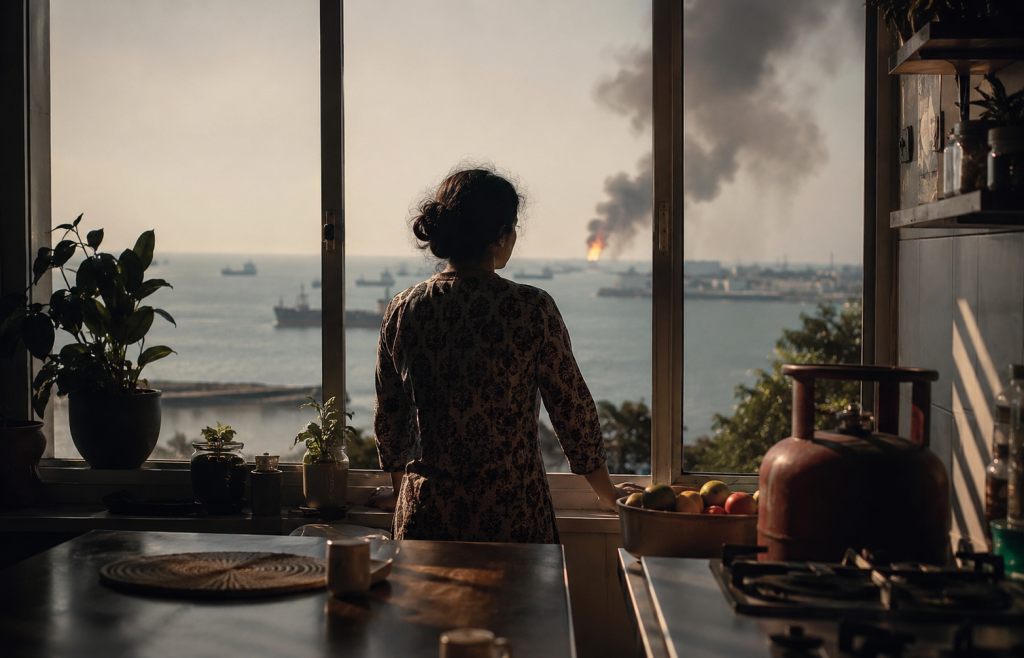
Every honeymoon inevitably ends the exact same way. You walk into your own kitchen a few days after the trip and realize the room service is gone.
The illusion of infinite resources vanishes. The credit card bills arrive. Difficult daily choices replace holiday itineraries. The actual, demanding work of a marriage officially begins.
That exact transition crossed my mind while reading Prime Minister Narendra Modi’s speech last week.
Weddings alone cater to nearly half of the annual demand for gold in India. While average Indian weddings demand significant gold, wealthy households routinely see two to three kilos on display, with the ultra-rich buying several more. Every region has its own version of this ritual: the Bengali bride’s kasu mala, the Punjabi chooda stacked alongside gold bangles, and the South Indian temple jewelry that weighs down a bride’s neck with generations of accumulated intention. The bride, adorned with gold on her wedding, holds a subtle financial strength, an unspoken power. She commands assets of her own that remain separate from her husband. This tradition functioned as a transfer of security, passed from one generation to another through a metal that does not rust and does not lose value.
Last week, the prime minister stood in Hyderabad and asked us to stop buying it for a year.
I have been turning that request over in my head for days. The economics behind the request are sound and genuinely urgent, yet the true weight of his words lies in what they reveal about India’s current reality. A war between two countries we share no border with has walked, without knocking, into the most intimate corners of Indian life: the kitchen, the jewelry box, and the honeymoon itinerary. The Prime Minister, a leader who understands optics as well as any politician alive, felt it necessary to say so out loud.
That level of candor only surfaces when things are genuinely serious.
Here is what “serious” actually looks like in numbers.
India imports about 60% of its LPG consumption, and out of those imports, roughly 90% arrive through the Strait of Hormuz. The cooking gas cylinder sitting in the corner of kitchens across this country, from Srinagar to Kanyakumari, depends almost entirely on a 33-kilometer waterway that Iran has actively disrupted since February 28. The government issued a Natural Gas Control Order in March under the Essential Commodities Act. Fertilizer plants were told they would receive about 70% of their previous supply. Refineries took a cut of about 35%. These reductions inevitably bleed out of policy documents and into the real economy. A seventy percent fertilizer supply means lower farm yields. Lower yields force food prices upward. The disruption in the Gulf arrives, eventually, at the price of dal.
India’s gold imports increased by more than 24% in 2025-26 and touched a record $71.98 billion. Hold that figure alongside another metric: India spent $174.9 billion on crude and petroleum products in the financial year ended March 2026, representing 22% of total imports. Oil and gold together account for nearly a third of everything this country spends on imports. Both of those lines are under simultaneous pressure from the exact same geopolitical source right now.
Even a partial 30% to 50% reduction in gold imports could conservatively save India between $20 billion and $36 billion annually in foreign exchange outflows. Modi’s appeal is completely rational. The arithmetic is clear. The striking element is the admission embedded inside the numbers: India’s comfortable cushion of cheap energy and freely flowing imports has become dangerously thin.
Modi also asked Indians to avoid luxury vacations and destination weddings abroad for at least a year. This detail received less attention than the gold appeal, but it functions as a much stronger geopolitical signal. The destination wedding abroad became, over the last decade, a cultural institution for India’s aspirational class. The celebration serves as a public announcement confirming a family has reached the kind of wealth required to fly 200 guests to Portugal. The photographs look like film. The mehendi happens on a cliff. About 32.7 million Indians traveled abroad in 2025, including more than 14 million leisure travelers. Asking that demographic to stay home for a year forces them to pause a lifestyle they considered permanent.
The market understood the severity before most people did. Shares of Indian jewelry companies fell by as much as 10%. The stock of Tata Group-owned jeweler Titan fell nearly 6% in early trade. Shares of IndiGo fell 2.8%. Stock markets process national mood faster than any newspaper. The collective read was clear: this crisis is real, and it will last a while.
Here is the inescapable reality. India had options. For years, the country possessed alternatives to the dependency that recently forced the prime minister to go on national television and ask people to carpool and postpone their weddings.
The IMEC corridor, connecting India to Europe through the Gulf and terminating at the port of Haifa in Israel, was announced at the G20 summit in New Delhi in September 2023. India signed it. The port at the end of that corridor is already owned and operated by an Indian company; Adani acquired Haifa Port in January 2023 for approximately $1.18 billion. The infrastructure for India’s energy independence, or at least its energy dignity, exists partially in a port in northern Israel that Indian cavalrymen liberated in 1918 and an Indian billionaire bought 105 years later.
Israeli officials view the current situation as a rare window of opportunity and are working to accelerate IMEC, arguing that such a corridor significantly reduces Iran’s leverage over the global economy. They have made this argument for two years. The exact war causing India’s crisis is simultaneously creating the political urgency to build the road out of it. There is a grim logic to that timing.
The honeymoon India enjoyed, a long and comfortable era where energy was cheap, the Strait stayed open, and the world held still long enough to keep all foreign friendships intact without choosing between them, is definitively over.
What follows is the harder part. The part requiring decisions rather than deferments, infrastructure rather than diplomacy, and the willingness to admit the comfortable middle is no longer available as a permanent address.
The cooking gas is expensive. The rupee remains under pressure. The jewellery shops are quietly worried. Somewhere in the back of every Indian family’s wedding planning conversation this year, a new variable has appeared: whether the world will cooperate with their timeline.
It probably will not. It rarely does. That reality simply resembles adulthood arriving a little late, at a national scale.
-Ankit
Ankit Gawande, a writer based in India, with a deep interest in the lesser-known historical connections between India and the Jewish world. His writing spans long-form essays, cultural commentary, and historical narrative. He brings a researcher’s curiosity and a storyteller’s eye to subjects that often live at the margins of mainstream discourse.