
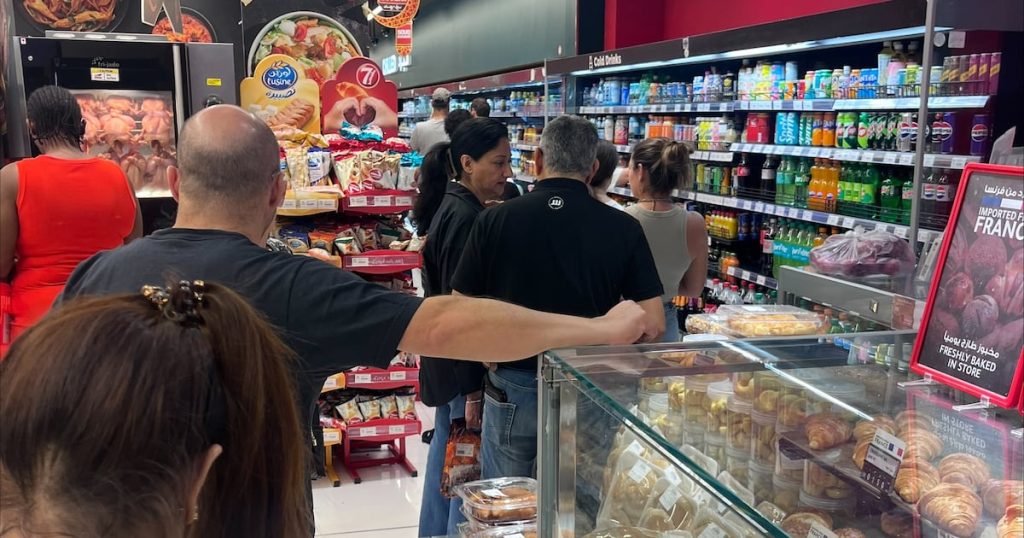
Leading UAE supermarkets grappling with the challenges of the Iran war are facing a “complex and constantly moving picture” as they seek to keep shelves full and limit rises in food price.
Prolonged disruption to key shipping routes in the Strait of Hormuz has led to lengthy delivery times and pushed up fuel and insurance costs as a recent escalation in the near five-month conflict causes further upheaval.
Rising prices have been significant and difficult to manage over recent months, said Warwick Gird, general manager of marketing and e-commerce for Spinneys. “Ongoing freight disruptions have increased the cost of transporting many of our ingredients and finished goods into the UAE,” he told The National.”
The Iran war has exacerbated cost-of-living challenges in the Emirates and beyond. Dubai inflation hit 5.5 per cent in May, as the conflict lifted fuel, transport and imported food prices.
Mor Gird spoke of “a complex and constantly moving picture across thousands of items. Some lines have seen increases, others have been held flat, and in a number of cases we’ve absorbed cost inflation rather than pass it on.”
He said customers have experienced “temporary gaps” in availability of certain products but added that his company sought to ensure substitutes and alternatives remain available.
Mark Mortimer-Davies, chief executive of Choithrams, said there would be no quick fix but he remained hopeful market conditions would gradually return to normal.
“Supply chains do not reset overnight,” Mr Mortimer-Davies said. “Some products currently entering the region were shipped during a period of elevated freight and insurance costs, and it may take time for those costs to work through the system.
“Looking ahead, we expect conditions to gradually normalise, with greater stability in shipping schedules and logistics costs helping to support a competitive retail environment.
“Periods of heightened regional tension can lead to fluctuations in shipping schedules, longer lead times, and increased freight and insurance costs, all of which require careful planning.”
In certain critical categories that are particularly dependent on sea freight, companies have temporarily increased stock levels to help ensure continuity of supply.
2,000km road trips
Shipping and logistics are among the biggest causes of rising costs. Tobias Maier, chief executive of DHL Global Forwarding Middle East & Africa, said the situation around the Strait of Hormuz has made maritime freight supply chains more complex and significantly longer, resulting in price increases across groceries.
“Goods destined for supermarket shelves in Dubai might normally travel around 40 to 50 kilometres from Jebel Ali,” he said. “If that same cargo is rerouted via Khor Fakkan, the trucking distance can increase to around 150km, while cargo entering through Salalah in Oman may travel more than 1,250km, or via Jeddah in Saudi Arabia more than 2,000km by road, before reaching the UAE.”
Longer routes mean higher fuel consumption, additional handling and waiting times, including procedures in free zones such as Jebel Ali, as well as higher insurance and fuel costs, he added.
Being flexible has kept the supply chain moving despite significant disruption, Mr Maier said. “Early on when disruptions first started, we activated our business continuity and contingency plans, and secured additional trucking capacity to support alternative routings,” he said.
“We also put a dedicated team in place that monitors developments across roads, ports, airports, border crossings and free zones in real time. All of this allows us to adapt routing and capacity whenever it is needed. As a result, right from the start, we were able to keep supply chains running across the GCC.”
Assessing risks
The intermittent reopening and subsequent reclosure of the Strait of Hormuz creates “a short window where limited movement was technically possible, but risk levels, insurance premiums, and operational uncertainty remained high”, said Mr Gird.
“Our freight partners are keeping containers and future sailings committed to safer east‑coast and regional ports for the time being, rather than repeatedly rerouting freight in response.
“While containers are still not flowing normally through Hormuz and some vessels remain delayed in the wider Gulf, our day‑to‑day store operations will be relying primarily on corridors that sit outside that chokepoint.”
Spinneys expects volatility to last for “some time” and that “insurance and freight markets will remain elevated even once a more durable reopening is agreed”.
Sourcing strategies
In the meantime, Choithrams has been expanding its sourcing base to mitigate some of the disruption, said Mr Mortimer-Davies. “We participated in discussions co-ordinated by a UAE diplomat aimed at strengthening overseas sourcing partnerships and identifying new supply opportunities,” he said.
At Viva Supermarket, chief executive Andy Adcock describes compounding pressures across operations. “The biggest challenges have been shipment delays caused by port congestion, vessel diversions and extended clearance timelines, which have reduced visibility and predictability across our inbound network,” he told The National. “At the same time, freight costs have risen significantly, creating additional pressure on supply chain economics.”
Those pressures have fallen hardest on lower-value products. “We are also seeing a shift across the industry where higher logistics costs are putting pressure on the viability of certain low-value products, which can affect the overall availability of some everyday items,” Mr Adcock said.
Viva has closely monitored essential categories including biscuits, oats, rice, snacks and bottled water – products particularly sensitive to elevated freight costs, which can disproportionately affect the economics of replenishment.
Three-month buffer
Firas Nasir, chief executive of Organic Foods & Cafe and co-chief information officer of the Gulf Japan Food Fund, said the business entered the disruption period with a buffer in place. “While we currently maintain around three months of stock for imported shelf-stable products, we are closely monitoring developments that could affect freight routes, insurance costs, energy prices and supplier costs,” he told The National.
Organic Foods operates with more than 400 vendor partners domestically and globally, and has the flexibility to switch between logistics modes. “In the event of disruption, we have the ability to remap sourcing and logistics by adjusting between air, sea and land transport depending on where the disruption occurs,” Mr Nasir said.
The conflict has accelerated a strategic pivot that was already under way, “towards greater local sourcing and supply chain diversification”, he added. “The businesses least exposed to disruption have been the ones that built domestic supplier relationships before it became urgent.”