
Dubai is reshaping its transport map in a multi-billion investment push, with Jumeirah Golf Estates emerging as one of the city’s most important public transport hubs.
The area will have two Metro lines, an Etihad Rail station (the only one announced in Dubai so far although more are expected), bus links and proximity to the 311 motorway all in a single location.
The district with championship golf courses and luxury residential units is in sharp focus after Dubai last week announced plans for a new Dh34bn underground Metro line.
The Gold Line will stretch from Al Ghubaiba in old Dubai to Jumeirah Golf Estates, where it will connect to the existing Red Line station.
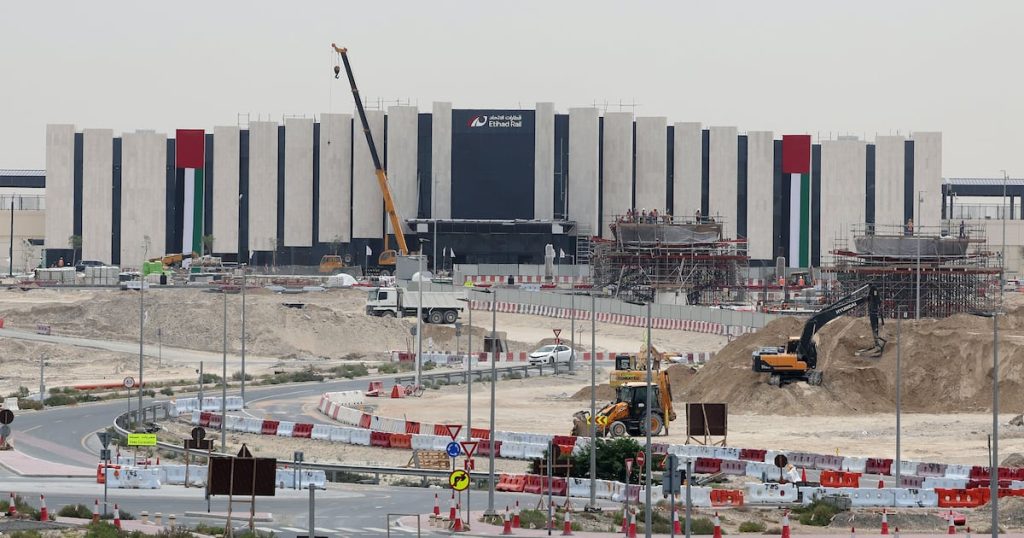
But it doesn’t end there. Just across from the Metro station, the new Etihad Rail passenger terminal is nearing completion and expected to start welcoming its first passengers this year. A footbridge is being built between the two.

A map shared by the Roads and Transport Authority last week also showed the planned high-speed line between Abu Dhabi and Dubai passing close by, underlining the importance of the area, although it is not clear if the train will stop there.
With so many public transport links, experts say the area is primed to be a major interconnector and even a destination itself.
The makings of a super-hub
“Jumeirah Golf Estates could become a ‘super hub’ linking the existing city with Expo City, Dubai South, Al Maktoum International Airport and eventually wider regional mobility through Etihad Rail,” Dr Simona Azzali, associate professor at Canadian University Dubai’s school of architecture and interior design, and a public transport expert, told The National.
“Integrating the railway station with the metro is a very smart move, as it would make train use much more accessible and likely increase passenger numbers,” she said.
Dr Azzali said what is known as first and last-mile connectivity – getting to and from the station – would be crucial.
“This is what can make the hub not only a place of transit but a real urban node integrated into everyday city life,” she said.
When The National visited the site on Tuesday, the scale of the work was clear. Construction workers are putting the finishing touches to the Etihad Rail station with trains being tested on the line.
Major work is also under way on a pedestrian connection between both stations with concrete support posts between the Etihad Rail station and Metro now in place.
While Etihad Rail did not confirm to The National the precise details of the structure, signs there state “JGE Foot Bridge” with the name of Waagner Biro Bridge Gulf displayed prominently.
Waagner Biro Bridge Gulf is part of the Waagner Biro Bridge Services company whose presence here stretches back decades. It has been involved in similar projects such as the Al Awir cycle track and pedestrian bridge. One of the first projects it was involved in was the construction of the Al Maqta Bridge in Abu Dhabi that in 1968 connected the island to the mainland by road for the first time.
Martin Tillman, a UAE-based transport expert and former director of traffic and transport at Ras Al Khaimah Municipality, told The National the project reflects a broader shift in how the city approaches mobility.
“This transport development at Jumeirah Golf Estates is extremely important as it represents the shift from corridor-based metro to a mature, layered and networked transport system in Dubai,” he said.
“Jumeirah Golf Estates brings together the Red Line, planned Gold Line and a future national Etihad Rail connection alongside buses and first and last-mile services, transforming this to a true transit-oriented development [TOD] interchange,” he said. The term TOD refers to planning that puts housing, jobs and shops within walking distance of transport centres.
These types of hubs exist internationally. Dr Azzali pointed to how stations in the Japanese capital, Tokyo, for example are urban centres “combining rail, metro, retail, offices, services and pedestrian networks”.
“The Dubai context is very different, but the principle is relevant: the station becomes a place-making device, not only a point of transfer.”
She also pointed to Los Angeles Union Station in California. It already sits within a much more established urban core, but Dr Azzali said it was still relevant because LA is historically very car-oriented.
“It is a major interchange to connect different scales of mobility and gradually reduce dependence on cars.”
Dr Azzali said the Jumeirah Golf Estates hub also reflects a focus on urban resilience, helping Dubai stay functional as it grows and deals with challenges such as congestion, climate stress and regional uncertainty.
“By making it easier for residents, workers and visitors to move across the city and between emirates, it can reduce dependence on private cars, ease pressure on the road network and help keep everyday economic life connected,” she said.
“This matters because economic life depends on predictable movement: residents getting to work, visitors reaching destinations, workers moving between employment centres and people accessing airports, business districts and new growth areas.”
Why is Jumeirah Golf Estates important?
Dubai has experienced sustained growth over the decades, with the population passing the four-million mark last year.
And plans for the Jumeirah Golf Estates area have been in the making for years. Its metro station opened in 2021 as part of the Route 2020 extension to the Expo site. Much of its capacity has yet to be fully utilised, but that may soon change.
Aerial images shows a huge tract of undeveloped land around the transport site that has already been earmarked for major development by developer Al Wasl as part of the Jumeirah Golf Estates expansion. A Mandarin Oriental hotel is also planned.
Beyond this, the hub is also positioned to serve areas such as Jumeirah Village Triangle, Al Furjan and Dubai Sports City. Other areas that will benefit from it include the Expo 2020 site and Al Maktoum International Airport, which is expected to become a major aviation hub.
“Jumeirah Golf Estates is expected to act as a gateway for a large and growing cluster of communities and reflects how Dubai is planning for the next phase of growth with a focus on integration making it easier to move between modes and across the network,” said Mr Tillman. “It could significantly reduce reliance on car-based travel.”
However, experts say that success will depend on more than infrastructure alone.
Dr Azzali sees the challenge as being whether the area becomes a fully functioning urban centre or interchange.
“The key question is whether this becomes a genuine transit-oriented node, or just a large interchange. That will depend on buses, taxis, shaded pedestrian links, parking and first- and last-mile connections to surrounding communities,” she said.