
announcements:
-
Aqib Zakaria, ChinaTalk’s chip lead, is in Hawai’i! If you’re interested in joining an Oahu ChinaTalk meetup, reach out to aqib@chinatalk.media.
-
Irene Zhang is going to Jakarta later this month and would love to meet folks there! Ping Irene@chinatalk.media to say hi.
Could the future of biotech great-power competition be decided by monkeys?
In 2020, as COVID spread, China stopped exporting research monkeys. For US vaccine developers, infectious-disease researchers, and drug-testing companies, monkeys that once went for only a few thousand dollars suddenly jumped to $20,000 or more. FDA says it now goes as high as $50,000 — if you pay peanuts, you unfortunately no longer get monkeys.
Important projects were scrapped or delayed. The shortage became serious enough that the NIH created a priority process for COVID studies needing nonhuman primates, warning that there weren’t enough monkeys to go around.
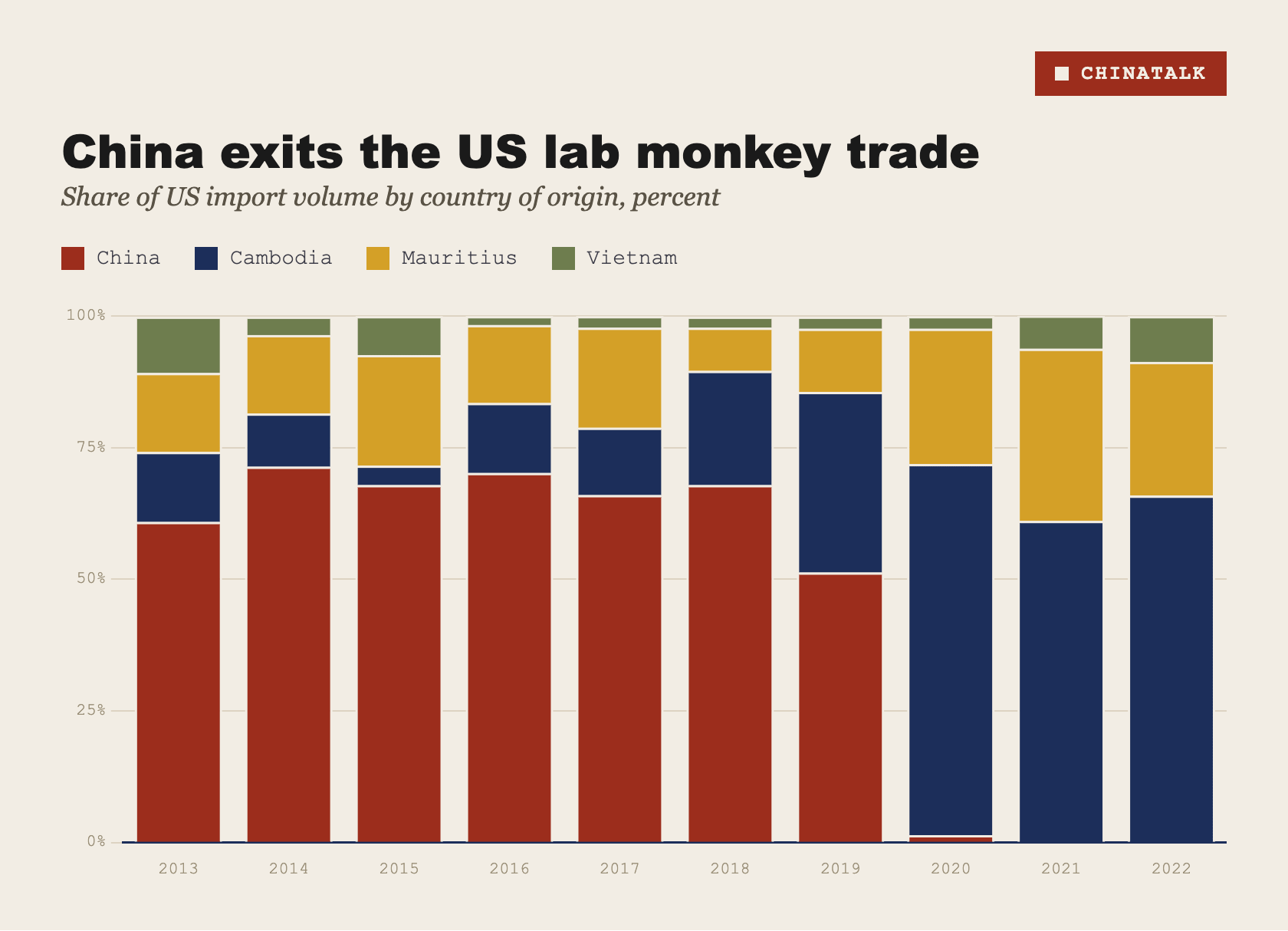
China supplied 50.7% of lab monkeys imported into the US in 2006, 69.6% in 2011, 62.8% in 2018, and 48.5% in 2019. Then China’s share collapsed to zero from 2020 onwards. A National Academies report later found that 64% of surveyed NIH-supported researchers had trouble obtaining nonhuman primates.
Monkeys, mostly macaques, still play a big role in biotech. For vaccines against dangerous pathogens, gene therapies, infectious-disease countermeasures, neurotechnology, and complex biologics, monkeys often remain the model regulators, companies, and funders want to see — especially when mice are not similar enough to people and human challenge trials are waiting to get going.
At ChinaTalk, we write about supply chains quite often. This one is different because it is alive.
In one sense, scaling it sounds easy. Put a male and female macaque together, light a few candles, and, with some luck, a new macaque is born. (If only China could do that with two Blackwells.) But achieving monkey sovereignty actually proves to be quite difficult.
This business of monkeys is not, in fact, just monkey business.
To be clear, many primate studies are expensive, anachronistic, or less useful than newer human-relevant tools. This is why the FDA Modernization Act 2.0 removed the old statutory assumption that animal studies were required to support certain drug applications. The FDA has since said alternative methods — often called New Approach Methodologies (NAMs) — can help reduce or even replace animal testing when they are scientifically valid. (Rachel Fobar at Vox makes a compelling case for phasing out a lot of unnecessary animal testing for things like monoclonal antibodies.)
But unfortunately, monkeys are still stubbornly indispensable for many aspects of biotech. The monkeys specifically relevant here are macaques — especially rhesus and cynomolgus macaques — because their immune systems, brains, organs, and disease responses are much closer to humans than mice or other small animals. And, unlike chimps, they cannot throw a grown researcher across the room.
Some research questions still require an intact, human-like organism. Sure, you can model a liver cell, a lung organoid, or an immune reaction in vitro, but that is not the same as being able to fully model how a vaccine or gene therapy behaves across a whole primate body — much of which is still a mystery to us. This is why the National Academies say there are still no alternatives that can replace monkeys for questions requiring “complete multiorgan interactions and integrated biology.”
Vaccines are the clearest example of monkey indispensability. For dangerous pathogens, macaques are often the closest thing to a human challenge trial that researchers can ethically run. Our most important bio story of the 21st century was the COVID vaccines, and every major COVID vaccine candidate that progressed to US approval was evaluated in nonhuman primates — though to varying degrees, and oftentimes in parallel or after human trials due to the urgency of COVID and issues with procuring the monkeys.
And think about diseases much deadlier than COVID. You cannot prove an Ebola vaccine works by deliberately exposing volunteers to Ebola. Under FDA’s Animal Rule, some medical countermeasures can therefore be approved based on animal efficacy studies when human trials would be unethical or infeasible. For diseases like Ebola, monkeys can be the closest thing to the efficacy trial society is willing to run, and that basic ethical prudence will keep them relevant as a human fail-safe for a long time.
The same logic applies to many other research areas, such as gene therapy and brain-computer interfaces.

China was not always the 800-pound gorilla of the monkey supply chain. For decades, India was the main supplier. It had large rhesus macaque populations, and the US relied heavily on Indian monkeys for vaccine testing and biomedical research. Then India said, “Not my circus.” In 1978, Prime Minister Morarji Desai banned rhesus monkey exports — the reasons seem to have been a mix of conservation, animal welfare, and religious reverence for monkeys.
China swung in to fill the void. It had native rhesus macaques, access to long-tailed macaques from Southeast Asia, comparable cost for land and husbandry, and a growing laboratory animal system. By the 2010s, it had become the world’s leading exporter. China accounted for ~31.3% of global live-primate exports between 2015 and 2021.
For countries doing advanced biological research with monkeys, the dependence is even greater. Research-grade monkeys need health records, pathogen screening, and paperwork that regulators and companies trust. China’s system was not perfect, but it was more reputable than many alternatives like Vietnam and Cambodia, especially because China has a vested interest in using these monkeys for its own bio-research. This is why, according to China Daily, more than 60% of the 33,818 primates the US imported in 2019 came from China.
Then China’s domestic demand went bananas. In 2015, along with its infamous biotech push, Beijing overhauled its drug-review system, speeding up approvals and helping turn China into a serious biopharma market. The combined value of China’s leading biopharma companies rose from $5 billion to $400 billion between 2016 and 2021. More Chinese companies began running more drug trials, and those trials needed monkeys.
Fast forward to January 2020: China bans wildlife trade to prevent the spread of possible zoonotic diseases. Officially, this was about blocking the possible spread of coronavirus transmission. In practice, it also allowed scarce monkeys to be redistributed at home.
Chinese companies noticed. WuXi 药明, Pharmaron 康龙化成, and JOINN 昭衍新药 all moved to secure breeding capacity. The WuXi companies became China’s largest monkey breeder after acquiring Suzhou Kanglu Biotechnology 苏州康路生物科技 in an 804 million yuan deal. This is the same Chinese pharma-services giant US lawmakers have targeted through the BIOSECURE Act — which we covered here. Monkeys give WuXi and other Chinese pharma companies another kind of leverage that people in the China Select Committee and other relevant agencies taking aim at them should keep in mind.
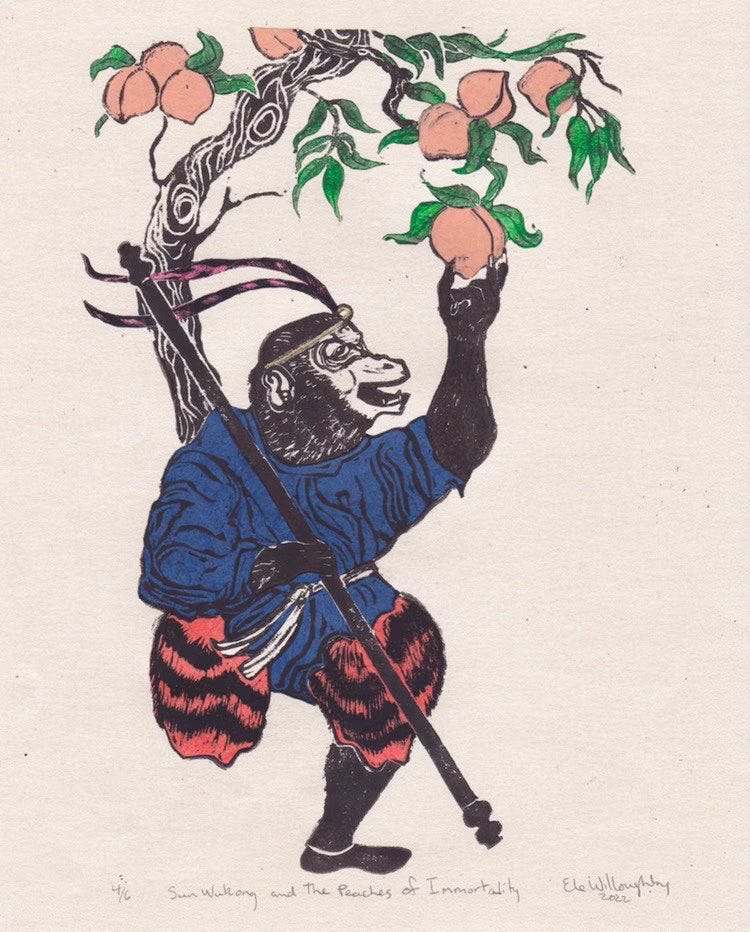
Curiously, this also does not look like an EV-style overcapacity story, where China needs foreign markets because domestic supply has outrun demand. Chinese press reports have described experimental monkeys as hot commodities, with prices rising sharply as domestic drug R&D expands. Even inside China, there often are not enough monkeys to go around, and the shortage has produced accusations of “monkey hoarding” (“囤猴”) — much like Sun Wukong hoarding peaches from the Queen Mother’s garden. This also helps explain why US imports from China did not rebound even after China’s COVID restrictions were eventually loosened.
The US has a few options.
That is basically what the US did after China’s exports collapsed. The replacement supply chain shifted toward Cambodia, Mauritius, and Vietnam, as the graph from the intro shows:
But these suppliers are not always dependable. A research monkey needs reliable records, such as where it was born, who its parents were, how old it is, what pathogens it has been exposed to, and whether it was actually raised in captivity. A wild-caught monkey falsely labeled as captive-bred can be a disaster for an unwitting company. Imagine a vaccine developer spending months and millions of dollars on a macaque challenge study, only to discover that some of the animals had unknown disease exposure. If the animals were already exposed to related pathogens, their immune responses may not reflect the vaccine being tested. Or if their ages or health histories are wrong, the comparison between vaccinated and control groups may be meaningless. If the paperwork is fraudulent, regulators may simply decide the study cannot support a clinical trial — and millions of dollars + years of effort could be wasted!
Countries like Cambodia have struggled to demonstrate reputability. In 2022, as one such example, the US Justice Department indicted Cambodian officials for allegedly capturing long-tailed macaques from the wild (à la Man with the Yellow Hat from Curious George), laundering them through breeding facilities, and exporting them as captive-bred animals. China, by contrast, built a larger and more institutionalized monkey ecosystem. China is not free of smuggling/laundering, but its major breeders and CROs have stronger incentives to keep animal standards high because they are serving China’s own biotech industry as well as foreign customers.
This is the cleaner answer in many ways, since a domestically bred monkey is easier to audit. The US can have more confidence in its age, parentage, pathogen history, and health records.
But domestic breeding is not something the US can simply scale overnight. Macaques grow and reproduce slowly. It takes a while to find a prime mate. Gestation lasts about 5.5 months, pregnancies usually produce one infant, and females generally reach sexual maturity around 3-4 years.
Say the US has 100,000 suitable monkeys (based on this broad dataset from the Animal and Plant Health Inspection Service). Roughly half are female, so 50,000. But maybe only 40% of those are actually breeding-age, healthy, fertile, socially compatible, and appropriate to breed — call it ~20,000 breeding females. If 70% produce a surviving infant in a given year, that gives you roughly 14,000 new monkeys per year. But those 14,000 infants do not help much right away. Many studies still want animals that are 3-5 years old, research-naive, and of the right sex or immune background. And only about half of the new infants are female, meaning perhaps 7,000 future breeders, who themselves will not start reproducing for another several years.
^ Mice, on the other hand, can reproduce exponentially.
There is actually quite a lot of research on how to optimize breeding yields, but the results are relatively modest, and the studies themselves are a bit depressing to read about.
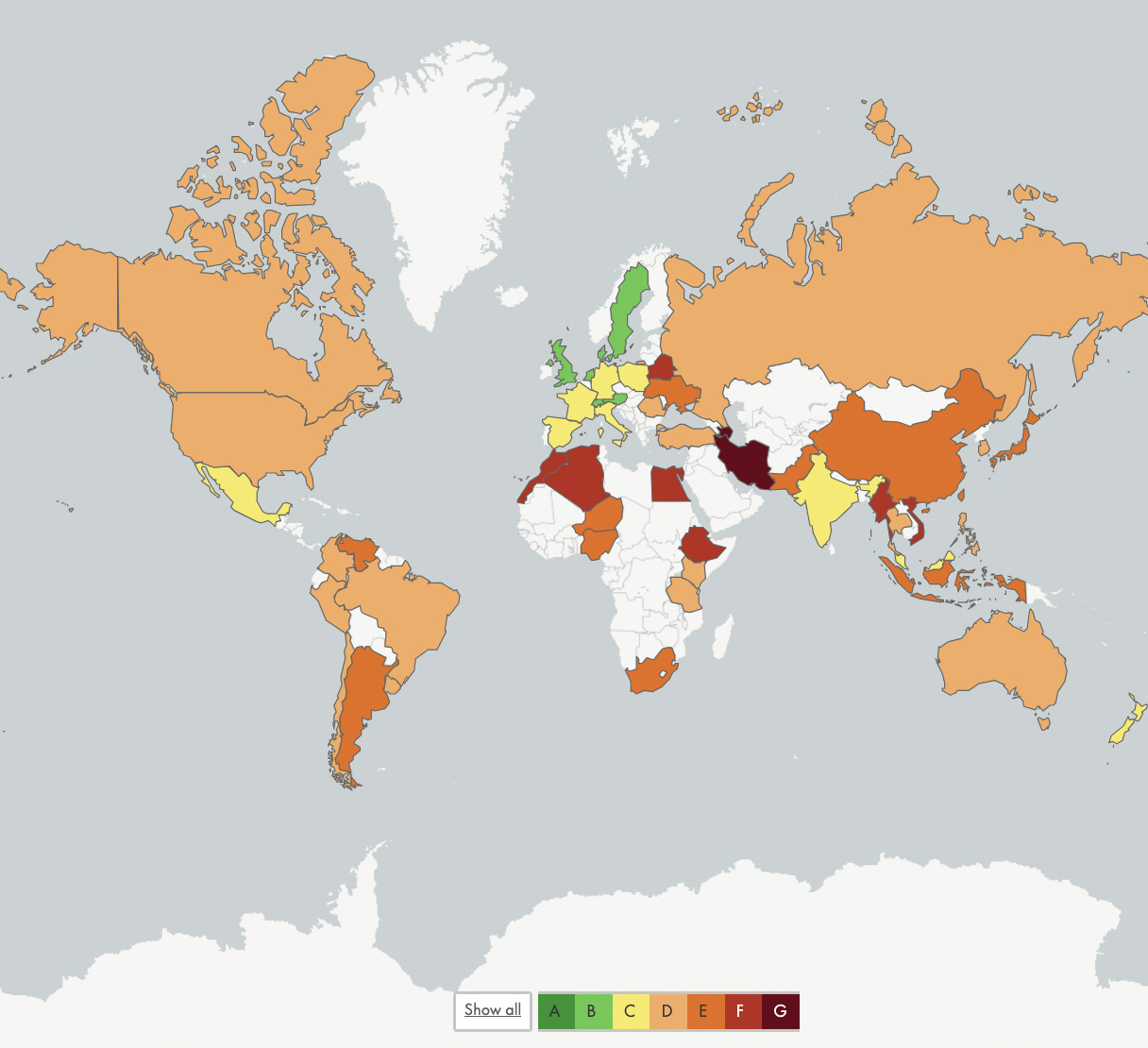
The other big issue is animal welfare. Animal rights groups are more empowered in the US than in China, and the US does seem to treat lab animals somewhat better. World Animal Protection’s Animal Protection Index gives the US an overall D and China an E. More relevantly, on animals used for scientific research, the US gets a C, while China gets a D. That’s not exactly a ringing endorsement of the US system (props to some of those European countries) but it’s something.
That is what Charles River Laboratories is trying to do. In January 2026, Charles River said it would buy K.F. Cambodia, one of its major nonhuman-primate suppliers, for about $510 million. Reuters reported that K.F. had supplied around 30% of the monkeys used by Charles River’s drug-discovery and safety-assessment unit over the previous two years.
This may be the most realistic middle path. The US cannot breed its way out of the shortage quickly, and it also cannot assume that every foreign supplier’s paperwork is trustworthy. But American companies can streamline overseas breeding capacity.
I’m sure this approach still has many shortcomings. It probably depends on host-country politics as well as animal welfare and disease control standards, and involves sending capital and leverage outside of the US. Perhaps someone with expertise in international business can weigh in in the comments?
None of the three options above seem like a great alternative. I can therefore understand why the FDA is pushing hard to figure out when monkeys are no longer necessary, but I hope doing so doesn’t lead people to conclude that this is not an actual problem.
There are already people who have stopped jumping on the bed and begun thinking seriously about this shortage. The NIH has produced extensive and relatively approachable research on the problem, so I won’t really have anything new to add here. But there are a few obvious next steps.
1) The US should know what monkeys it actually has. There is still no comprehensive mechanism for tracking nonhuman primates used in US biomedical research, nor a “central data management or reporting structure” for accurately estimating how many monkeys are needed to meet current and future research needs. When managing a bottleneck, it’s hard to monkey-do when you cannot monkey-see.
2) The US should build more domestic capacity while being honest about the timeline. A 7-10 year goal for something like 80% self-sufficiency seems reasonable to me, but the next step should involve experts weighing in for a better, more evidence-based estimate than that. Regardless of the number, the US is going to have to be serious about this for a consistent period of time that will span different administrations.
3) The US should decide ahead of time who gets scarce monkeys during an outbreak. If a new pandemic hits and ten labs, three vaccine companies, CDC, NIH, and DoW all need the same animals at once, the priority rules should not be improvised on the fly. The country should not be having a monkey bidding war in the middle of a public health emergency.
4) The US should keep funding alternatives that actually reduce monkey demand. Even though NAMs will not make monkeys disappear tomorrow, they can help kill bad candidates earlier and eliminate studies that do not really need primates. We should spend more money figuring this out.
5) The US should work more seriously with countries like Cambodia, Vietnam, and Mauritius. A pure import strategy is currently too fragile given the risk of getting bad monkeys. But hybrid models, like Charles River buying and auditing K.F. Cambodia, may be part of the answer.
6) Congress should oppose bad bills like the PRIMATE Act. The bill would prohibit most imports of nonhuman primates into the US, framing them as a biosecurity threat because they can carry pathogens like tuberculosis, herpes B virus, and Salmonella. But the biosecurity argument makes no sense. The scale of the problem is basically zero, and >99.9% of TB and Salmonella cases arise through pathways completely unrelated to monkey imports. TB only caused 572 US deaths in 2023, while CDC estimates Salmonella causes 238. There have only been about 50 documented human infections of herpes B since 1932! I care deeply about both animal welfare and biosecurity — but attempting to disguise an animal welfare bill under the guise of biosecurity makes both concepts less reputable. And the 100000x more urgent biosecurity risk is being unable to test vaccines and therapeutics quickly in the next pandemic.
7) Finally, the US should be willing to pay more for better living conditions for research monkeys. Our D rating on the Animal Protection Index is something to be ashamed of, and improving it will furthermore make the issue less politically divisive with animal welfare groups. The alternative is importing monkeys from countries where the same (or worse) ethical problems exist but are simply less visible to Americans (like Vietnam, which has an F rating). That “see no evil” approach is not ethical progress but rather outsourcing ethical discomfort.
*Special thanks to Lily for going ape and providing the majority of the monkey puns in this article