
What do marathon runners, AI experts and tennis players have in common?
In China, they have all become the target of creative housing subsidies.
Earlier this month, a social media account for the government of Nanjing — a capital city of China in imperial times — posted that it was providing housing subsidies of up to 100,000 yuan ($20,530) to participants in the city’s marathon this year.
These “exclusive runner subsidies” for buying apartments in selected properties in the Jiangsu province city would be applied on top of existing discounts.
Runners who registered for the marathon but did not participate could still get a 20,000 yuan ($4,100) subsidy and those who participated but did not finish the run could get 60,000 yuan ($12,320).
Marathons have surged in popularity across China, with nearly 600 races organised nationwide last year. (Reuters: Tingshu Wang, file)
Similar schemes have been reported in the cities of Wuxi and Yancheng in the same province, and some parts of Shaanxi province.
Separately, in central China’s Hubei province, generous subsidies have been offered to attract people who have other talents, such as top tennis players and coaches, as well as AI and humanoid robotics experts.
The ABC has attempted to contact the city authorities.
Ongoing property slump
China’s property industry has been in a prolonged downturn since 2016 when the government cracked down on debt-fuelled expansion and speculation to rein in overheated housing prices and improve affordability.
The tightening of financing rules led to mounting debt and the default of property giants such as Evergrande.
Associate professor Qiang Li, a property expert at Deakin Business School, said local governments were “pulling out all the stops” after years of stagnation.
“The situation remains pessimistic … in the first three months of 2026, in large cities in China, the sales volume actually dropped by about 10 per cent or more than 10 per cent,” he said.
Qiang Li says China’s property market is yet to bounce back. (ABC News: Kai Feng)
Data from China’s National Bureau of Statistics shows prices fell for new homes across most cities in 2025.
“There are some good signs, but still the numbers are not showing an immediate recovery,” Dr Li said.
“In the last 10 to 20 years, the prices have always gone up and this is the stage where we are experiencing some kind of correction … it’s just we are not sure that we are at the bottom yet.”
Will the incentives work?
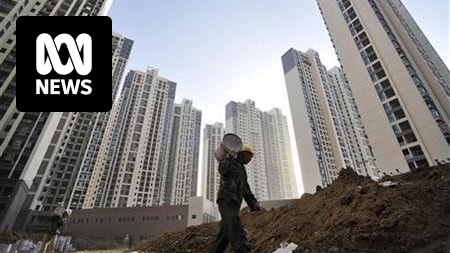
Ghost towns have emerged in China in recent years. (Reuters: Tingshu Wang)
Marathons have been increasing in popularity in China in the last few years.
In 2025, the country hosted 594 road running events, attracting more than 1.2 million full-marathon runners and more than three million half-marathon participants.
Pan Wang, an associate professor of Chinese and Asian studies at the University of New South Wales, noted that marathons were most popular among China’s middle-aged middle class, who often fought hard to secure a spot in these events.
No official data on the number of applications to the incentive programs have been released.
But Beijing’s willingness to let local governments experiment with unconventional measures suggests urgency in reviving the sector.
Dr Wang said the marathon subsidies were designed to “kill several birds with one stone”.
“Beyond boosting tourism and housing demand, they enhance city competitiveness and attract higher-income groups,” she said.
Pan Wang says Chinese local governments hope to be “killing several birds with one stone” with the subsidies. (Supplied: UNSW)
Dr Wang described the approach as “policy innovation”, noting marathon participants often had relatively strong purchasing power.
“Large sporting events can convert ‘race traffic’ into ‘property traffic,'” she said.
Dr Li agreed the measures could help smaller cities compete with top-tier hubs such as Shanghai or Shenzhen.
“This is one way for these local governments to signal to the general public, to the whole country, that our cities are actually competitive in attracting these individuals, and this is a good place to do business,” he said.
However, reports suggest some subsidies only apply to selected properties that are often in peripheral areas and struggling to find buyers.
“The gimmick value of these quirky policies outweighs the real financial benefits,” Dr Wang said.
“Rather than offering genuine discounts, their primary aim is to promote the city and stimulate the local property market.
“Because these are often ‘unsellable’ projects, the conditions are frequently less than ideal.”
She that there was no data available on how many homes had actually been sold through the schemes.
Meanwhile, Chinese sports authorities have raised concerns about excessive commercialisation.
They argue that the linking of sporting events to property promotions may distort the purpose of sports.
Could subsidies be used in Australia?
Australia is experiencing a sustained boom in property demand, in stark contrast to the prolonged downturn currently facing China. (Reuters: Hollie Adams)
Dr Li said such incentives were unlikely to be of much use in Australia’s larger cities, but could be useful for local governments in regional areas.
“The gateway cities [are] quite competitive, so offering some additional layers of these incentives wouldn’t make a lot of difference,” he said.
“But for regional towns, it could be beneficial, but the local governments will have to decide by themselves how they would manage such a program.”