
Data Cutoff: June 25, 2026
The China & Taiwan Update is a joint product from the Institute for the Study of War (ISW) and the American Enterprise Institute (AEI). The update supports the ISW–AEI Coalition Defense of Taiwan project, which assesses Chinese campaigns against Taiwan, examines alternative strategies for the United States and its allies to deter the Chinese Communist Party’s (CCP) aggression, and—if necessary—defeat the People’s Liberation Army. The update focuses on the CCP’s paths to controlling Taiwan and cross–Taiwan Strait developments.
Toplines
The PRC may be aiming to alter the status quo in the West Pacific by expanding its regular law enforcement and research activity to the waters east of Taiwan. The PRC likely aims to erode Taiwanese sovereignty and establish itself as the sole legitimate caretaker of “China’s” maritime boundaries, including those around Taiwan and its outlying islands. PRC social media account Yuyuan Tantian, which is affiliated with state broadcaster CCTV, claimed on June 20 that the PRC’s recent environmental survey and law enforcement activity suggested that the PRC may consider the area east of Taiwan to be PRC “near-shore waters.”[1] The PRC’s Ministry of Natural Resources’ (MNR) East China Sea Bureau deployed the research vessel Xiang Yang Hong 22 to conduct a “marine environmental survey” east of Taiwan from June 16 to 18.[2] Chinese Coast Guard (CCG) vessels have patrolled east of Taiwan almost continuously since June 1, according to ship tracking data from Starboard Maritime Intelligence. The PRC’s Ministry of Transport also conducted a “special maritime law enforcement operation” east of Taiwan from June 6 to 10 in response to Japanese-Philippine efforts to delimit their overlapping exclusive economic zone (EEZ) claims in the area.[3] The Philippine and Japanese claimed EEZ overlaps with PRC and Taiwanese EEZ claims, and the PRC has rejected the idea of territorial delimitation not involving all claimants.[4]
The PRC may use Japan-Philippines delimitation efforts as an excuse to extend its law enforcement and research operations beyond the first island chain. Yuyuan Tantian cited unnamed sources who claimed that although the PRC had conducted research operations east of Taiwan before, the June research and law enforcement activity would become regularized to “protect” the PRC’s maritime territory.[5] Yuyuan Tantian is the same account that first outlined the PRC’s “Kinmen model” in 2024. The term “Kinmen model” refers to ongoing CCG deployments around Taiwan’s Kinmen Island to extend the PRC’s law enforcement presence into Taiwanese waters.[6] Yuyuan Tantian’s assertion that recent PRC activity represents a new model of “nearshore governance” may reflect the PRC’s intention to regularize similar operations east of Taiwan.
Expanding the CCG’s jurisdiction around Taiwan could free up PLA Nany (PLAN) assets for other missions in the Pacific. The PRC has practiced coordinating a blockade of Taiwan during major exercises wherein the CCG is primarily responsible for covering the Taiwan Strait while the PLAN covers the eastern approaches to the island.[7] Increasing the CCG’s area of responsibility to include waters immediately east of Taiwan could allow the PLAN to divert more assets toward longer-range missions beyond the first island chain. This could allow the PRC to enhance its power projection efforts in the Pacific and normalize its military presence beyond the first island chain.
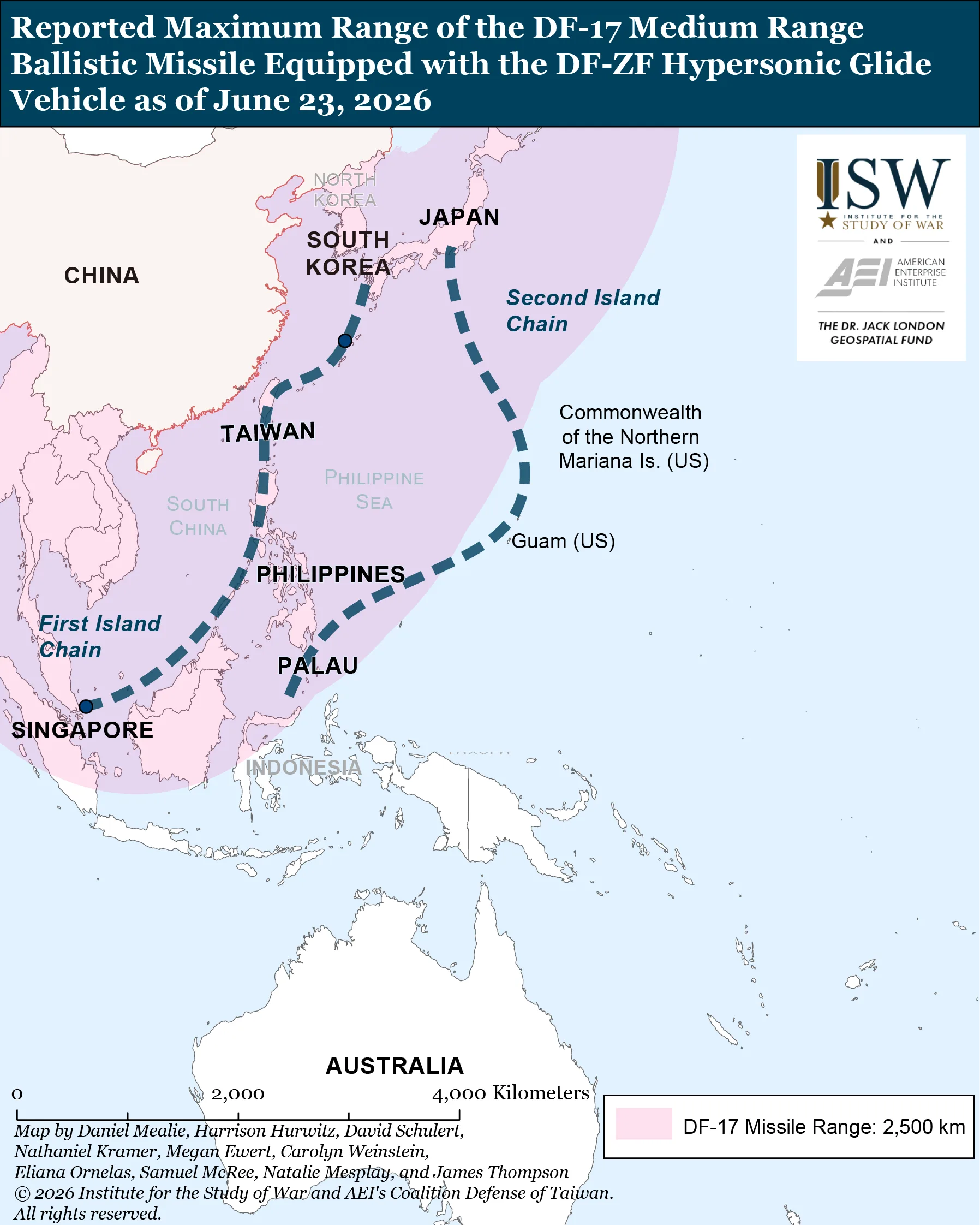
The PLA is demonstrating its hypersonic missile capabilities, possibly to indicate its intention to field such systems at scale during a conflict. The PLA could use such systems to target an enemy’s air defense network ahead of a larger precision strike to increase the latter’s effectiveness. PLA official newspaper PLA Daily published footage of the DF-17 medium-range ballistic missile (MRBM) equipped with the DF-ZF hypersonic glide vehicle (HGV) on June 22.[8] The published footage marks the first time an official PRC outlet has released imagery of the DF-17 launching the DF-ZF HGV.[9] The DF-17 was first publicly displayed during a 2019 military parade, then appeared at the PRC’s September 2025 military parade.[10] The DF-17 has a range of between 1,800 and 2,500 kilometers according to US-based think tank Center for Strategic and International Studies (CSIS), allowing it to strike targets up to the second island chain.[11] The PRC’s decision to release the first official footage of a DF-17 launch could indicate that the system is approaching full operational capability after a lengthy testing phase.
The DF-17 is unique among PLA missile capabilities because of the HGV’s in-flight maneuverability and low flight trajectory compared to traditional ballistic missiles.[12] These attributes, along with the DF-17’s ability to travel up to Mach 10, significantly complicate efforts to detect and intercept the missile before it reaches its target.[13] The PLA could use the DF-17’s survivability as a vanguard ahead of a larger missile attack to strike critical radar and air defense systems to increase the efficacy of its less sophisticated missiles.[14] The footage PLA Daily released also demonstrated the PLA’s ability to conduct DF-17 launches from road-mobile launchers placed in remote locations, possibly to practice missile launches in the face of adversary counter-strikes.[15]
The PRC may have released the footage to demonstrate that an air-missile war in the Pacific will be of a fundamentally different character than what has transpired in the Middle East between the United States and Iran. Iran’s adversaries maintained a missile interception rate over 90 percent for the duration of the conflict and US-made air defense systems on land and at sea demonstrated their ability to largely neutralize the Iranian missile threat.[16] The PRC’s demonstration of hypersonic capabilities could seek to illustrate that the PLA’s missile forces are more advanced than Iran’s and will pose a much greater challenge to US and allied forces during a conflict. The DF-17 is unlikely to be a panacea that renders US and allied ballistic missile defense completely impotent, although the scale and sophistication of a PLA missile campaign is likely to be much greater than Iran’s.[17]
The PRC could be working to modernize its military doctrine and tactics through cooperation with the Russian military. European Union (EU) High Representative for Foreign Affairs and Security Policy Kaja Kallas stated on June 15 that the EU has verified reports that the PRC trained Russian military personnel to fight in Ukraine.[18] PRC Ministry of Foreign Affairs (MFA) spokesperson Lin Jian on June 16 rejected Kallas’ statement and referred to it as a “smear.”[19] ISW previously detailed Reuters reports which revealed that the PLA had trained approximately 200 Russian military personnel primarily on mine-clearing and drone operations in Beijing, Nanjing, Shijiazhuang, and Zhengzhou in late 2025.[20] Many of the Russian personnel trained in the PRC were ranking military instructors able to pass knowledge down the chain of command, and the intelligence agencies confirmed some of the trained personnel had returned to Ukraine.[21] Kallas stated that EU foreign ministers agreed to sanction several PRC entities in response to these reports.[22]
The PRC could be training Russian troops to use PRC-made drone technology, which could explain why the more experienced Russian military received training from the PLA. The PRC could also be using this opportunity to test PLA tactics, doctrine, and training in contemporary battlefield conditions. PRC Foreign Minister Wang Yi previously told Kallas that the PRC did not want Russia to lose the war in Ukraine, and that the PLA has sought out Russian military airborne training and sent PLA military officers to Ukraine to draw tactical lessons from the war.[23] The PRC’s alleged behavior conflicts with the PRC’s public claims of neutrality and efforts to mediate and promote peace negotiations for the war in Ukraine.[24] These reports confirm previous European suspicions about PRC support for Russia in Ukraine and could increase European distrust towards the PRC.[25]
Key Takeaways
- PRC Maritime Coercion: The CCG’s recent law enforcement and research activity in the waters East of Taiwan may indicate that the PRC considers that area to be PRC “near-shore waters.” The PRC likely aims to erode Taiwanese sovereignty and strengthen PRC presence in the waters around Taiwan and its offshore islands.
- PLA Hypersonic Development: PLA Daily published the first official imagery of the DF-17 MRBM equipped with the DF-ZF hypersonic glide vehicle on June 22. The PLA could use hypersonic missiles to target enemy air defense networks and increase the effectiveness of precision strike attacks.
- PRC-Russia Military Cooperation: EU High Representative for Foreign Affairs and Security Policy Kaja Kallas confirmed that the EU verified reports that the PRC trained Russian military personnel on mine clearing and drone operations. The PRC may be using this opportunity to test their equipment, tactics, and doctrine in modern warfare conditions.
Cross-Strait Relations
Taiwan
Taiwan launched a five-day Immediate Combat Readiness Exercise on June 22 ahead of the annual Han Kuang war games, reflecting Taipei’s efforts to make military training more realistic and war-oriented amid sustained PLA pressure. The exercise, which was also conducted prior to the 2025 Han Kuang exercise, is part of Taiwan’s broader shift away from set-piece drills and towards scenarios that test rapid wartime transition, joint operations, command-and-control, logistics, and battlefield preparation.[26] Taiwan’s Ministry of National Defense (MND) said the drills would train units to move from peacetime to wartime conditions as quickly as possible to simulate the necessary response to the PLA suddenly escalating routine-gray zone activity or military exercises into an invasion scenario.[27]
Armored vehicles from the Army’s 269th Mechanized Infantry Brigade conducted combat-readiness patrols near transportation nodes and potential approaches to Taoyuan, a northern Taiwanese city that is home to Taiwan’s largest airport.[28] Taiwanese forces also rehearsed defensive operations around key port facilities, simulating enemy special forces infiltration and gray-zone harassment against critical infrastructure and potential targets for kinetic operations.[29] Taiwan’s 2026 Han Kuang exercises are expected to take place in August.[30]
The PRC is likely operating a network of fake social media accounts to sway Taiwanese voters in the November local elections. PRC political interference operations aim to manipulate Taiwan’s elections by amplifying local Taiwanese voices that support PRC aims. An anonymous cybersecurity expert discovered a network of 163 inauthentic Facebook pages posting the same outdated Taiwanese news articles and social media content simultaneously or in rapid succession on June 15.[31] The outdated articles featured eye-catching titles about local and national emergency alerts, likely intended to attract Taiwanese social media users’ attention.[32] The PRC’s online cognitive warfare efforts targeting Taiwan have shifted in recent years from spreading PRC-origin propaganda content to cherry-picking and amplifying Taiwanese news articles and social media content that align with PRC narratives.[33]
The cybersecurity expert stated the pages’ activity and digital forensics indicated that the PRC state-linked digital marketing firm “Boundless Group” is likely behind the bot network.[34] Taiwan’s National Security Bureau (NSB) stated in a January 2025 report that Boundless Group uses seemingly innocent social media pages targeted at Taiwanese audiences to disseminate political disinformation and manipulate Taiwanese public opinion.[35] Boundless Group uses these pages to rapidly spread pro-PRC political content during Taiwanese election periods. Boundless Group promoted PRC-favored candidate Terry Gou during the leadup to the 2024 Taiwanese presidential election and posted disinformation about divisive Taiwanese political issues like public safety and corruption in 2025 and 2026.[36]
The Boundless Group’s bot network will likely switch to posting pro-PRC political content and disinformation closer to Taiwan’s local midterm elections in November.[37] The PRC also conducted election interference operations during Taiwan’s 2018 and 2022 midterm elections, attempting to delegitimize the ruling Democratic Progressive Party (DPP) and sway Taiwanese voters towards PRC-favored opposition candidates.[38] The PRC aims to erode Taiwanese people’s sense of safety and confidence in their democratic government while presenting PRC rule over Taiwan as an orderly and economically beneficial alternative.[39]
The NSB announced the creation of a task force in February to prevent PRC interference in Taiwan’s upcoming elections at the request of Taiwanese President William Lai Ching-te. The NSB regularly tracks and reports on the PRC’s online disinformation and election interference efforts targeting Taiwan.[40] Taiwanese civil society groups such as Doublethink Lab and the Taiwan Information Environment Research Center (IORG) also investigate and debunk PRC-origin online disinformation.[41]
National Chengchi University conducted a public opinion survey published on June 16 that indicated that Taiwanese people value strengthening Taiwan’s defense capabilities and deepening cooperation with the United States over improving cross-Strait relations. Disparities between Taiwan’s three largest political parties over the most effective way to maintain Taiwanese national security remain, however. Taiwanese think tank the Institute for National Defense and Security Research (INDSR) commissioned National Chengchi University’s Election Research Center to conduct a public opinion survey in May.[42] The survey found that largest number of respondents (approximately 44.9 percent for both questions) stated that Taiwan’s primary approach to protecting its national security should be enhancing its defense capabilities and Taiwan’s secondary objective should be enhancing US-Taiwan cooperation. A minority of respondents answered that Taiwan should pursue “showing goodwill to the PRC” as its primary national security strategy (approximately 29.7 percent) or secondary national security strategy (approximately 13.5 percent). These results indicate that most Taiwanese surveyed support the current Lai administration’s initiatives to increase Taiwanese military spending and indigenous defense production and otherwise defend the Taiwanese people against PRC cognitive and kinetic coercion efforts. These survey results do indicate a significant partisan divide in what strategies Taiwan should prioritize, however. DPP supporters overwhelming chose enhancing Taiwanese defense capabilities, while the majority of opposition Kuomintang (KMT) and Taiwan People’s Party (TPP) supporters surveyed stated that Taiwan should prioritize “goodwill” to the PRC. This response is reflective of the KMT and TPP narrative that the Lai administration’s policies are “provocative” and are the cause of PRC aggression.
China
The PRC is likely seeking to reform the United Nations (UN) in line with its Global Governance Initiative. The PRC State Council Information Office issued a white paper entitled “More Just and Equitable Global Governance: China’s Principles, Proposals, and Actions” on June 17.[43] The White Paper states that the PRC aims to reform and re-establish the authority of the UN and the rule of international law. The white paper identifies unilateral sanctions, economic protectionism, and ongoing wars as attacks on smaller countries by unnamed Western hegemonic powers, a veiled reference to the United States and its allies.[44] The white paper, in particular, points to conflicts in Ukraine and the Middle East, the economic impact of “unilateral sanctions,” and economic protectionism as global phenomena restricting smaller states’ capacity for peace and development. The White Paper then puts forth a strategy of encouraging economic development, state-to-state equity and exchanges, and platforming the Global South as a means of garnering support.[45] This strategy is reminiscent of the PRC’s Global Governance Initiative, an initiative introduced by PRC General Secretary Xi Jinping that emphasizes the centrality of the UN and promotes a more equitable global system that amplifies the voices of developing states.
Several PRC state media and officials have commented on this white paper, including Foreign Minister Wang Yi, calling on all countries to collaborate on improving the global governance system.[46] The language in the white paper furthermore carefully draws the line at equity for fellow states, leaving the door open for the PRC to violate the sovereignty of countries not officially recognized as states by the UN, including Taiwan.[47] The paper additionally calls for a return to the international rule of law, while appearing to contradict tacit PRC support for Russia’s invasion of Ukraine.[48]
The PRC is retaliating against the US expansion of the “List of Chinese Military Companies,” formally known as the 1260H list, with export controls and prohibitions on government entities from doing business with designated US companies. The PRC Ministry of Commerce (MOFCOM) announced on June 22 that PRC companies cannot export dual-use items to 10 US companies, effective immediately, as an explicit response to the 1260H list expansion.[49] MP Materials and USA Rare Earths, the two largest US rare earth companies, are on the list, and the companies both are working to build a domestic supply chain of magnets.[50] The PRC imposed export controls in April 2025 on seven rare earth elements, many of which are used in permanent magnets, after the Trump administration imposed tariffs on the PRC.[51] MOFCOM’s actions reflect a broader PRC strategy to reinforce its monopoly over the critical minerals supply chain, which gives the PRC significant political and economic leverage over the rest of the world. The PRC Ministry of Finance separately announced that PRC government entities are prohibited from purchasing from a list of 46 US companies, many of which are major defense contractors such as Lockheed Martin and Raytheon, effective immediately.[52]
The PLAN may be improving its ability to sustain long-range operations for its carrier fleet. Improved sustainment capabilities would allow the PLAN to maintain a more permanent presence beyond the first island chain, enhancing the PLAN’s ability to isolate Taiwan during a contingency. PLAN aircraft carrier Liaoning returned to its home port of Qingdao on June 23 after an over 40-day deployment in the South China Sea and West Pacific.[53] Liaoning transited the Taiwan Strait on April 20 toward Hainan before conducting exercises in the South China Sea, after which the PLAN announced on May 19 that Liaoning would conduct exercises in the West Pacific, which ended on June 22.[54] The exact duration of Liaoning’s South China Sea exercises was not reported in PRC sources. Liaoning’s previous longest deployment lasted 28 days throughout May and June 2025, during which it was deployed alongside the PLAN aircraft carrier Shandong.[55]
Liaoning’s most recent exercise could indicate that the PLAN is improving its ability to sustain long-range deployments of its carrier groups. The PLAN has traditionally struggled to sustain out-of-area deployments to its surface forces due to its lack of experience in conducting replenishment at sea, lack of nuclear-powered surface combatants, and few overseas bases.[56] PLAN forces would likely have to remain on station for significant periods of time during a Taiwan contingency, either to enforce a blockade or intercept enemy forces aiming to relieve the island during an invasion. Enhancing the ability to sustain deployments beyond the first island chain will limit the number of rotations the PLAN would have to conduct during a conflict, thereby improving the efficacy of the PLAN’s principal surface forces.
Liaoning’s exercises in May and June also demonstrated an effort to improve joint warfighting. Liaoning was accompanied by several fleet escorts, including the first far-seas exercise of the PLAN’s Type 054B frigate.[57] Liaoning also exercised alongside the Type 075 landing helicopter dock (LHD) Hubei, possibly practicing the coordination of carrier aviation with amphibious assault units.[58] Ground-based support aircraft, including KJ-500 airborne early-warning and control (AEW&C) aircraft and YY-20 aerial tankers, likely supported Liaoning’s embarked aircraft during the exercises.[59] Liaoning is a short take-off but arrested recovery (STOBAR) carrier, meaning it cannot launch larger support aircraft from its deck.[60] The presence of ground-based aviation alongside Liaoning’s air wing could indicate the PRC is aiming to practice the coordination of ground-based support assets to supplement the air wings of its two STOBAR carriers.
Northeast Asia
Japan
Japan is staging two exercises with the United States at the end of June, signaling its commitment to regional coalition-building. The PRC has maintained its pressure campaign against Japan’s efforts to remilitarize and recommit to its defense. The two exercises, Valiant Shield and Resolute Dragon, will take place from June 11 through July 1 and from June 20 though June 30, respectively.[61] Australia, Canada, and New Zealand will also participate in the Valiant Shield exercises.[62] Royal Canadian Navy frigate HMCS Charlottetown will stage anti-submarine warfare training and Australia will send a Royal Australian Air Force P-8A Poseidon Maritime Patrol Aircraft as part of the combined exercise.[63] Typhon missiles and High Mobility Artillery Rocket Systems (HIMARS) will be deployed around Kanoya, Japan and Japan’s Amami Oshima Island, but will not be live-fire tested.[64]
The Typhon missile systems used during this year’s exercises will remain in Japan following the end of the drills, however.[65] Japan will also drill new capabilities during these exercises. Japan’s Ground Self-Defense Force (GSDF) will deploy V-22 Osprey transport aircraft based at Camp Saga to Miyako Island to practice moving casualties to Okinawa’s US Marine Corps Air Station Futenma.[66] The US Department of Defense reported that this Valiant Shield represents the second time that Japan Self-Defense Forces (JDSF) have been “heavily integrated in the planning and execution” of the exercises.[67]
The PRC has always been critical of Japan’s defense modernization efforts, but its critiques have amplified amid an ongoing diplomatic spat.[68] The PRC has conducted a pressure campaign against Japan since November 2025, when Japanese Prime Minister Sanae Takaichi commented that a Taiwan military contingency might involve Japan.[69] Takaichi refused to retract the comments and has continued to advocate for Japanese defense reforms. The PRC has objected to the deployment of Typhon missiles and will likely maintain its rhetorical pressure campaign as Japan’s exercises continue.[70]
Southeast Asia
Philippines
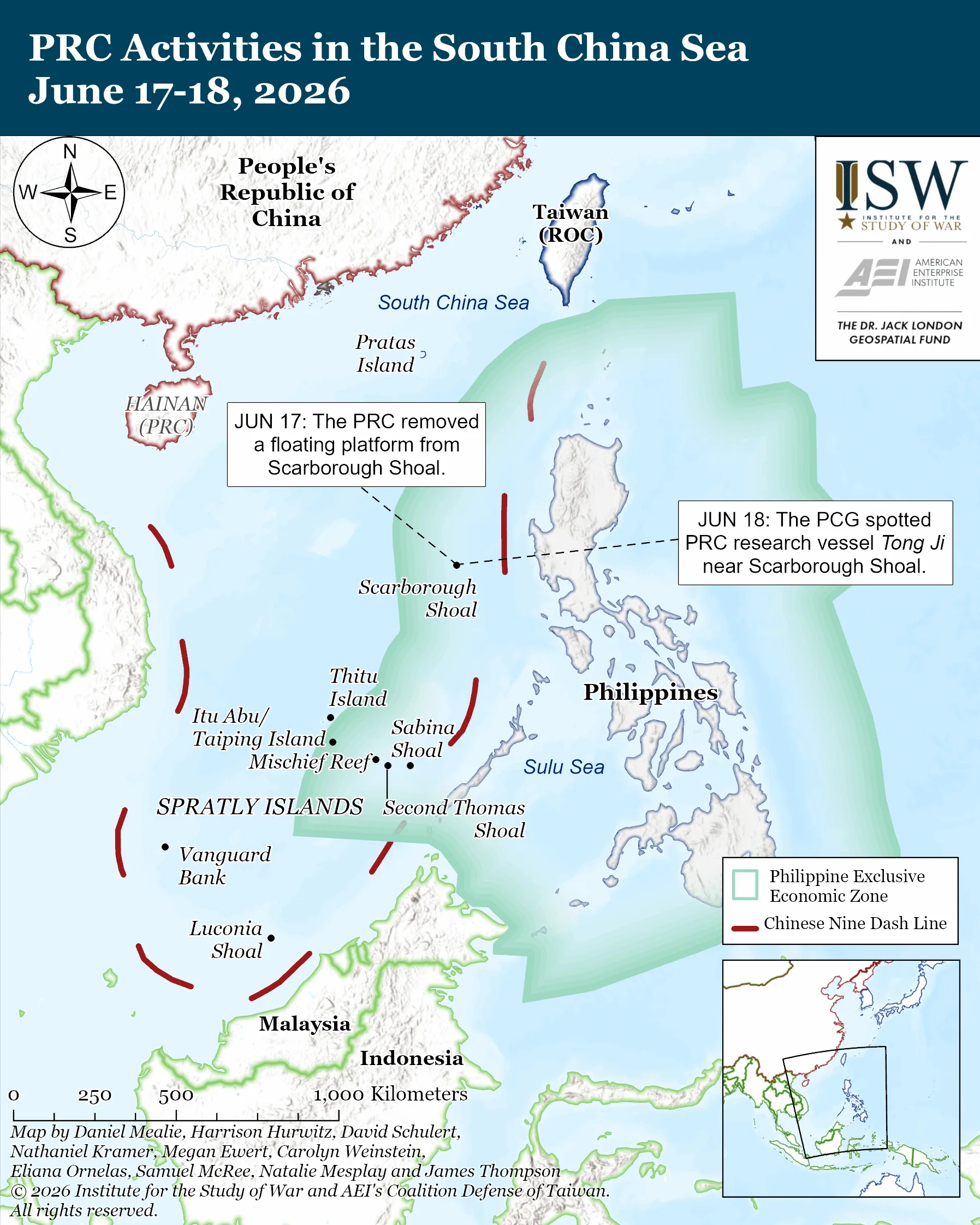
The PRC will likely continue its efforts to assert its territorial claims over Scarborough Shoal and increase its presence in the disputed waters under the guise of conservation and research efforts. The Philippine task force on the South China Sea reported on June 17 that the PRC removed a floating platform from the Scarborough Shoal.[71] Philippine officials first became aware of the structure in May and reported that the vessel was manned and included an antenna. The PRC state-controlled Chinese Academy of Sciences reported that the vessel was a temporary scientific research facility studying coral reefs.[72] The PRC frequently claims that its presence in the disputed shoal is for research and conservation purposes to provide a non-military justification for its operations. The PRC announced that it was establishing a nature reserve in Scarborough Shoal in September 2025, likely to enhance its territorial claims and justify its increased presence in the area.[73]
Philippine Coast Guard Spokesperson Jay Tarriela posted on X (formerly Twitter) on June 18 that PRC coastal research vessel Tong Ji sailed to Scarborough Shoal shortly after the platform was removed.[74] The PRC has maintained de facto control over Scarborough Shoal since 2012, but establishing a permanent or semi-permanent manned presence in the South China Sea could be a way for the PRC to enhance its territorial claims and lay the groundwork to seize permanent control of Scarborough Shoal. The PRC could then begin construction and militarization efforts of the shoal, posing a significant security concern for the Philippines and the United States.
Latin America
The PRC may be enhancing its signals intelligence (SIGINT) capabilities in Cuba. Washington, DC-based think tank CSIS on June 18 reported on modifications to a likely SIGINT site near Bejucal, Cuba.[75] These modifications may allow the PRC to capture signals intelligence from the United States. CSIS reported on four sites in Cuba that may support SIGINT in 2024, some of which had demonstrated links to the PRC. CSIS’s June 18 publication assessed that the site had “very likely” begun operation.[76] The report detailed modifications to an antenna field at the Bejucal site and showcased satellite imagery from May 2026 highlighting “completed” antenna rings.[77]
The PRC maintains strong bilateral ties with Cuba, but denied involvement with the SIGINT stations following CSIS’s 2024 report.[78] The PRC Embassy in Cuba similarly denied CSIS’s June 18 allegations. PRC state-affiliated tabloid Global Times amplified the PRC Embassy’s statement on June 24 and called the accusations “entirely unfounded, fabricated out of thin air, and completely baseless.”[79] US Representative Carlos Gimenez (R-FL) in 2025 called the SIGINT stations “one of the most brazen intelligence operations ever attempted near the American mainland” during a hearing.[80]

Endnotes:
[1] https://www.thepaper dot cn/newsDetail_forward_33420119
[2] https://understandingwar.org/research/china-taiwan/china-taiwan-update-june-18-2026/
[3] https://understandingwar.org/research/china-taiwan/china-taiwan-update-june-12-2026/
[4] https://amti.csis.org/maritime-claims-map/
[5] https://www.thepaper dot cn/newsDetail_forward_33420119
[6] https://www.iiss.org/online-analysis/online-analysis/2025/07/china-learns-from-the-kinmen-model-to-adapt-its-strategy-for-a-naval-campaign-against-taiwan/
[7] https://jamestown.org/strait-thunder-2025a-drill-implies-future-increase-in-pla-pressure-on-taiwan/; https://understandingwar.org/research/china-taiwan/china-taiwan-special-report-december-31-2025/
[8] http://eng.chinamil.com dot cn/2025xb/M_251449/V_251467/16468840.html
[9] http://globaltimes dot cn/page/202606/1364038.shtml
[10] https://www.airuniversity.af.edu/CASI/Display/Article/2334616/a-case-study-of-the-prcs-hypersonic-systems-development/; https://fas.org/publication/nuclear-weapons-at-chinas-2025-victory-day-parade/
[11] https://missilethreat.csis.org/missile/df-17/
[12] https://missilethreat.csis.org/missile/df-17/
[13] https://thediplomat.com/2016/04/china-tests-new-weapon-capable-of-breaching-u-s-missile-defense-systems/
[14] https://www.iiss.org/research-paper/2024/01/long-range-strike-capabilities-in-the–asia-pacific-implications-for-regional-stability/
[15] http://eng.chinamil.com dot cn/2025xb/M_251449/V_251467/16468840.html
[16] https://understandingwar.org/research/middle-east/iran-update-evening-special-report-march-11-2026/; https://www.csis.org/analysis/assessing-air-campaign-after-three-weeks-iran-war-numbers; https://americanisraelite.com/despite-cluster-challenge-israel-maintains-high-interception-rate-against-iranian-missiles/
[17] https://atlasinstitute.org/the-need-for-greater-civil-defense-in-the-indo-pacific/; https://www.twz.com/44142/sm-6-missiles-are-americas-only-defense-against-hypersonic-weapons-missile-defense-chief-says; https://nationalinterest.org/blog/reboot/yes-america-can-defend-itself-against-hypersonic-missiles-190201
[18] https://www.scmp.com/news/world/europe/article/3357208/eu-says-china-trained-russian-troops-bloc-weighs-tougher-stance-beijing
[19] https://www.mfa.gov dot cn/web/wjdt_674879/fyrbt_674889/202606/t20260616_11946785.shtml
[20] https://understandingwar.org/research/russia-ukraine/russian-offensive-campaign-assessment-may-19-2026/; https://understandingwar.org/research/china-taiwan/china-taiwan-update-may-29-2026/; https://meduza dot io/news/2026/05/19/reuters-okolo-200-rossiyskih-voennosluzhaschih-tayno-proshli-obuchenie-v-kitae-eto-pervyy-izvestnyy-sluchay-s-nachala-voyny; https://www.dw dot com/ru/cinovnik-es-kitaj-obucal-voennyh-rf-cast-popala-na-front/a-77528707; https://www.cna.com dot tw/news/aopl/202605190394.aspx
[21] https://www.reuters.com/business/aerospace-defense/russians-covertly-trained-by-china-return-fight-ukraine-sources-say-2026-05-19/; https://meduza dot io/news/2026/05/19/reuters-okolo-200-rossiyskih-voennosluzhaschih-tayno-proshli-obuchenie-v-kitae-eto-pervyy-izvestnyy-sluchay-s-nachala-voyny; https://www.dw dot com/ru/cinovnik-es-kitaj-obucal-voennyh-rf-cast-popala-na-front/a-77528707; https://www.cna.com dot tw/news/aopl/202605190394.aspx
[22] https://www.scmp dot com/news/world/europe/article/3357208/eu-says-china-trained-russian-troops-bloc-weighs-tougher-stance-beijing
[23] https://www.scmp.com/news/china/diplomacy/article/3316875/china-tells-eu-it-cannot-afford-russian-loss-ukraine-war-sources-say; https://www.reuters.com/world/chinese-nationals-fighting-russia-ukraine-are-mercenaries-us-officials-2025-04-11/; https://www.washingtonpost.com/world/2025/09/26/russia-china-weapons-sales-air-assault/; https://holod dot media/2025/04/12/kitajskie-oficzery-ukraine/; https://www.svoboda dot org/a/reuters-kitayskie-ofitsery-s-odobreniya-pekina-nahodilisj-v-rossiyskom-tylu/33383145.html
[24] https://www.scmp dot com/news/world/europe/article/3357208/eu-says-china-trained-russian-troops-bloc-weighs-tougher-stance-beijing; https://www.reuters.com/business/aerospace-defense/russians-covertly-trained-by-china-return-fight-ukraine-sources-say-2026-05-19/; https://www.cna.com dot tw/news/aopl/202605190394.aspx
[25] https://www.reuters.com/business/aerospace-defense/russians-covertly-trained-by-china-return-fight-ukraine-sources-say-2026-05-19/
[26] https://apnews.com/article/taiwan-hosts-military-drills-readiness-china-1e1228dcd54f8a2fdde9bf05beb8ce88
https://www.reuters.com/business/aerospace-defense/taiwan-stage-five-days-combat-readiness-drills-2026-06-21/
[27] https://www.reuters.com/business/aerospace-defense/taiwan-stage-five-days-combat-readiness-drills-2026-06-21/; https://www.scmp.com/news/china/military/article/3357942/amid-pla-pressure-taiwan-starts-drill-simulate-rapid-deployment-crisis?module=top_story&pgtype=section
[28] https://focustaiwan.tw/politics/202606220007
https://apnews.com/article/taiwan-hosts-military-drills-readiness-china-1e1228dcd54f8a2fdde9bf05beb8ce88
[29] https://www.cna.com.tw/news/aipl/202606220288.aspx
[30] https://www.reuters.com/business/aerospace-defense/taiwan-stage-five-days-combat-readiness-drills-2026-06-21/
[31] https://www.taipeitimes dot com/News/front/archives/2026/06/21/2003859460; https://www.cna.com dot tw/news/aipl/202606200060.aspx
[32] https://www.taipeitimes dot com/News/front/archives/2026/06/21/2003859460; https://www.cna.com dot tw/news/aipl/202606200060.aspx
[33] https://medium.com/doublethinklab/2022-taiwan-election-foreign-influence-observation-report-89951af668f1; https://www.reuters.com/world/china/china-turns-taiwans-own-voices-against-it-information-war-2026-04-17/
[34] https://www.taipeitimes dot com/News/front/archives/2026/06/21/2003859460; https://www.cna.com dot tw/news/aipl/202606200060.aspx
[35] https://www.nsb.gov dot tw/zh/assets/documents/%E6%96%B0%E8%81%9E%E7%A8%BF/023b202c-8bc9-4b19-a8eb-c0d0b5809f99.pdf; https://rsf dot org/en/how-chinese-marketing-network-quietly-injects-political-narratives-taiwanese-lifestyle-content
[36] https://rsf dot org/en/how-chinese-marketing-network-quietly-injects-political-narratives-taiwanese-lifestyle-content; https://medium.com/doublethinklab-tw/threads-%E4%B8%8A%E7%9A%84%E9%9A%B1%E5%BD%A2%E5%85%A7%E5%AE%B9%E8%BE%B2%E5%A0%B4-%E7%84%A1%E9%82%8A%E7%95%8C%E9%9B%86%E5%9C%98%E7%9A%84%E6%93%8D%E4%BD%9C%E6%8F%AD%E7%A7%98-e4c4ca8fcd87
[37] https://www.taipeitimes dot com/News/front/archives/2026/06/21/2003859460; https://www.cna.com dot tw/news/aipl/202606200060.aspx; https://medium.com/doublethinklab-tw/threads-%E4%B8%8A%E7%9A%84%E9%9A%B1%E5%BD%A2%E5%85%A7%E5%AE%B9%E8%BE%B2%E5%A0%B4-%E7%84%A1%E9%82%8A%E7%95%8C%E9%9B%86%E5%9C%98%E7%9A%84%E6%93%8D%E4%BD%9C%E6%8F%AD%E7%A7%98-e4c4ca8fcd87
[38] https://globaltaiwan.org/2022/09/past-patterns-and-present-provocations-chinas-electoral-interference-in-taiwans-local-elections/; https://medium.com/doublethinklab/2022-taiwan-election-foreign-influence-observation-report-89951af668f1
[39] https://rsf dot org/en/how-chinese-marketing-network-quietly-injects-political-narratives-taiwanese-lifestyle-content; https://medium.com/doublethinklab-tw/threads-%E4%B8%8A%E7%9A%84%E9%9A%B1%E5%BD%A2%E5%85%A7%E5%AE%B9%E8%BE%B2%E5%A0%B4-%E7%84%A1%E9%82%8A%E7%95%8C%E9%9B%86%E5%9C%98%E7%9A%84%E6%93%8D%E4%BD%9C%E6%8F%AD%E7%A7%98-e4c4ca8fcd87
[40] https://www.taipeitimes dot com/News/taiwan/archives/2026/02/25/2003852854; https://www.taipeitimes dot com/News/front/archives/2025/01/04/2003829623; https://www.nsb.gov dot tw/zh/assets/documents/%E6%96%B0%E8%81%9E%E7%A8%BF/023b202c-8bc9-4b19-a8eb-c0d0b5809f99.pdf; https://www.nsb.gov dot tw/en/assets/documents/%E6%96%B0%E8%81%9E%E7%A8%BF/1eeba30c-ebf8-459a-8fe3-ed2a54cb4ca0.pdf
[41] https://globaltaiwan.org/2026/02/enhancing-taiwans-information-resilience/; https://medium.com/@doublethinklab; https://iorg dot tw/_en
[42] https://indsr.org dot tw/focus?uid=11&typeid=38&pid=3177
[43] https://www.globaltimes dot cn/page/202606/1363785.shtml
[44] https://www.globaltimes dot cn/page/202606/1363785.shtml
[45] https://www.globaltimes dot cn/page/202606/1363785.shtml
[46] https://www.mfa.gov dot cn/web/wjdt_674879/fyrbt_674889/202606/t20260617_11947482.shtml; https://www.globaltimes dot cn/page/202606/1363783.shtml; https://www.scmp dot com/news/china/diplomacy/article/3357445/white-paper-making-chinas-case-new-rules-over-worlds-new-frontiers?module=top_story&pgtype=subsection; https://www.reuters.com/world/china/china-calls-more-global-south-voices-be-heard-united-nations-2026-06-17/
[47] https://www.globaltimes dot cn/page/202606/1363785.shtml
[48] https://www.globaltimes dot cn/page/202606/1363785.shtml
[49] https://www.mofcom.gov dot cn /zwgk/zcfb/art/2026/art_dfa9cc5c1e004d7fbb86f83d249e7986.html
[50] https://www.nytimes.com/2026/06/22/business/china-rare-earths.html
[51] https://www.reuters.com/world/china-hits-back-us-tariffs-with-rare-earth-export-controls-2025-04-04/
[52] https://en dot people.cn/n3/2026/0622/c90000-20469364.html
[53] https://news.cgtn dot com/news/2026-06-22/China-s-Liaoning-aircraft-carrier-formation-completes-far-sea-training-1ObLStQJAGc/p.html
[54] https://x.com/globaltimesnews/status/2069013023231180905?s=20; https://www.reuters.com/world/china/china-says-liaoning-aircraft-carrier-completes-over-40-days-drills-2026-06-22/; https://www.scmp dot com/news/china/military/article/3358058/what-chinas-aircraft-carrier-liaoning-testing-and-why-does-it-matter
[55] https://x.com/songs349/status/2069193533144338715; https://www.mod.go.jp/js/pdf/2025/p20250620_01.pdf
[56] https://www.defensepriorities.org/explainers/challenges-to-chinese-blue-water-operations/; https://news.usni.org/2021/01/22/chinese-navy-faces-overseas-basing-weakness-report-says; https://usawc-ssi-media.s3.us-east-1.amazonaws.com/pla-conf/PLAN_At_Sea_Logistics_Boggess_Dolney.pdf
[57] https://www.mod.go.jp/js/pdf/2026/p20260622_03.pdf
[58] https://www.scmp dot com/news/china/military/article/3358058/what-chinas-aircraft-carrier-liaoning-testing-and-why-does-it-matter
[59] https://x.com/MoNDefense/status/2068566747268219257?s=20; https://news.cgtn dot com/news/2026-06-22/China-s-Liaoning-aircraft-carrier-formation-completes-far-sea-training-1ObLStQJAGc/p.html; https://www.scmp dot com/news/china/military/article/3358058/what-chinas-aircraft-carrier-liaoning-testing-and-why-does-it-matter
[60] https://nationalinterest.org/blog/buzz/catobar-vs-stobar-which-aircraft-carrier-better-209219
[61] https://news.usni.org/2026/06/23/u-s-kicks-off-western-pacific-exercises-valiant-shield-resolute-dragon
[62] https://news.usni.org/2026/06/23/u-s-kicks-off-western-pacific-exercises-valiant-shield-resolute-dragon
[63] https://news.usni.org/2026/06/23/u-s-kicks-off-western-pacific-exercises-valiant-shield-resolute-dragon
[64] https://news.usni.org/2026/06/23/u-s-kicks-off-western-pacific-exercises-valiant-shield-resolute-dragon
[65] https://news.usni.org/2026/05/25/japan-announces-2-major-western-pacific-exercises-with-u-s
[66] https://asia.nikkei.com/politics/defense/japan-and-us-launch-island-defense-drills-in-kyushu-okinawa
[67] https://www.war.gov/NEWS/NEWS-STORIES/ARTICLE/ARTICLE/4522795/ALLIES-COME-TOGETHER-IN-THE-INDO-PACIFIC-FOR-EXERCISE-VALIANT-SHIELD-26/
[68] https://www.scmp dot com/news/china/military/article/3357913/japans-latest-live-fire-drill-about-offence-not-defence-pla-daily
[69] https://www.reuters.com/world/china/why-did-japan-pms-taiwan-remarks-cause-such-stir-2025-11-11/
[70] https://www.globaltimes dot cn/page/202605/1361663.shtml
[71] https://www.reuters.com/world/asia-pacific/philippines-says-floating-platform-removed-scarborough-shoal-2026-06-17/
[72] https://www.wsj.com/world/asia/chinas-latest-tool-to-control-a-disputed-atoll-a-strange-floating-platform-70c52e01?mod=asia_news_article_pos2
[73] https://paper.people.com dot cn/rmrb/pc/content/202509/11/content_30104414.html
[74] https://x.com/jaytaryela/status/2067509173735334018?s=20
[75] https://www.csis.org/analysis/new-activity-possible-chinese-intelligence-facilities-cuba
[76] https://www.csis.org/analysis/new-activity-possible-chinese-intelligence-facilities-cuba
[77] https://www.csis.org/analysis/new-activity-possible-chinese-intelligence-facilities-cuba
[78] https://understandingwar.org/research/china-taiwan/china-taiwan-weekly-update-december-20-2024/
[79] https://www.globaltimes dot cn/page/202606/1364305.shtml
[80] https://homeland.house.gov/2025/05/08/icymi-homeland-republicans-examine-new-evidence-of-potential-ccp-surveillance-infrastructure-in-cuba/