
The queue said it all. Gates at Crystal Palace Bowl weren’t until 4pm, yet by midday a line was already snaking through the South London greenery, red suits and aloha shirts glinting between the trees. Four months after Masayoshi Takanaka sold out two nights at Brixton Academy in a matter of minutes, the city pop revival had graduated from a theatre to open parkland, and around 15,000 people turned up to make the point.
City Pop Waves, the UK’s first large-scale outdoor festival dedicated to Japanese music, arrived as part of the inaugural Palace Bowl Presents series, sharing a summer bill with Grace Jones, Tom Jones, and Lenny Kravitz. The Bowl itself carries more history than its modest pond-side amphitheatre lets on. Bob Marley played his final London show on this ground in 1980, an event now commemorated with a blue plaque in the park, and in the Garden Party era a decade before it, Pink Floyd and Elton John headlined to crowds who famously waded into the lake for a better view of the stage. Now, overdue by around four decades, Japanese jazz fusion and city pop join that lineage.
As with all of Takanaka’s international performances this last year, the crowd were as much of the show as the artists on stage. Takanaka cosplayers in the full red suit and black bow tie drifted towards each other across the field like long-lost relatives, posing for photos with strangers who needed no introduction beyond the outfit. Papaya hair clips and papaya shirts dotted the bowl, worn by fans in their twenties and thirties who had no business knowing a note of music recorded twenty years before they were born, yet here they were in their masses, ready to sing every viral chorus and slick guitar riff right back at the stage at the top of their lungs.
Ginger Root opened proceedings with a vinyl DJ set that doubled as a syllabus on the need-to-knows. The Californian, whose own records helped funnel a generation towards this sound (and whose designs featured across Takanaka’s world tour merchandise), held each sleeve up to the crowd as he spun EPO, Minako Yoshida, Taeko Onuki, and Makoto Matsushita, drawing cheers with each one.

Himiko Kikuchi struck up ‘Ducky Ducky’ from behind the Hammond, six horns adding a wallop the studio version doesn’t prepare you for and turning the grounds into a big-band jazz club. The set pulled from her 1987 fusion album ‘Flying Beagle’, which, as is the theme of the event, was rediscovered online by listeners half her age in recent years, its beagle artwork worn proudly across the matching t-shirts of everyone on stage. ‘Baby Talk’ bounced with the high spirits of bubble-era Japan, while the flugelhorn line of ‘A Seagull & Clouds’ transported Crystal Palace somewhere closer to the California coast than SE19. She saved the album’s opening track for last, Rhodes piano and brass driving ‘Look Your Back!’ across the finish line.

Junko Yagami emerged in a glittering blue dress under a kimono-style silk coat, colour-matched to the evening sky behind the stage, and greeted the field with a beaming “Hello! London!”. Her half hour ran to just four songs, but few singers alive could have made them count for more. ‘Imagination’ gave way to ‘Tasogare no Bay City’, the latter coming back at her in Japanese from pockets of fans who had travelled from across the globe for the privilege.
For the centrepiece, Yagami put aside city pop’s rose-tinted escapism for 2021’s ‘TERRA ~here we will stay’, an 11-minute, multi-part epic on humanity’s place on an increasingly fragile planet. As English translations rolled over images of the Earth behind her, her commanding voice hushed the field, switching from near-spoken recitation to full-bodied cries of “TERRA”, while guitarist Nozomi Furukawa became her duet partner, the pair trading the spotlight as his spine-tingling lead lines cut through the arrangement. Onstage, she made the song’s wider human stakes explicit, telling the crowd “We say ‘NO’ to war” and, having become a grandmother just a week earlier, dedicating it to her grandchild’s future.
After staring down the fate of the planet came the samba-charged ‘Mizuiro no Ame’. Its opening notes brought an immediate roar from the field, and any question of whether the 1978 original’s stratospheric high notes would survive the years was answered.
By the time the “TA-KA-NA-KA” chants started rolling around the bowl, the sun was dipping and the anticipation was at its peak. The man himself strode out grinning in the red suit, hoisted two cut-outs of half a papaya aloft, and dropped into ‘Brasilian Skies’ as the entire field sang the riff back at him.


What followed was a two-hour, 20-song set, with several tracks receiving their first documented performances outside Japan, among them ‘Seven Goblins’ and ‘Plumed Bird’ from 1981 concept album ‘The Rainbow Goblins’. The former has become a social media favourite, and when Takanaka shouted “Goblin!”, the whole bowl roared in response. The world tour regulars slotted straight back into their roles, Nobu Saito seasoning the set from behind his congas and hand percussion, while Kaoru Inoue’s keytar charge during ‘Ready to Fly’ repeated his Brixton trick to an even bigger pop.
The oddities, as ever, were half the fun. During ‘Izu Amanatsu Nattou Uri’ Takanaka played with a wind chime hanging from a tuning peg, every movement setting off a small ring as a field of phone lights slowly swayed. The customary mid-set breather made its return too, Takanaka waving from his seat while the band made light work of a song without him. Before introducing Nobu, Takanaka seemingly blanked on his name, excusing himself with “my brain is too old” as the field answered with a thunderous “NOOO!”.

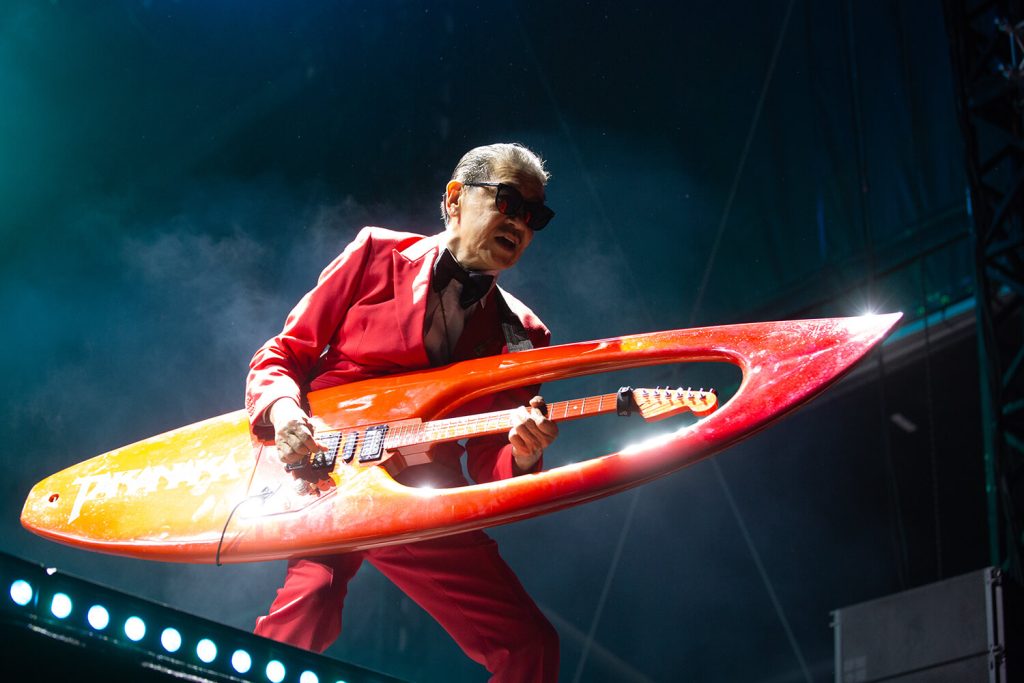
Cries of “Surfboard!” rose over three-beat claps until Takanaka re-emerged for ‘Jumping Take Off’ with the famous red surfboard guitar around his neck, all six kilograms of it paraded across the full width of the stage like a lap of honour. Then the night’s biggest surprise: “See you next year at Wembley!”. Takanaka last played Wembley across two nights in October 1975, supporting Roxy Music with Sadistic Mika Band at the old Empire Pool, and a 2027 return would put his own name above the door.


‘You Can Never Come to This Place’ closed the night, Takanaka calling out “Arigatou!!” before the full band bowed deeply together to sustained cheers. Two hours in, the grin still hadn’t left his face. Watching Takanaka, you start to believe playing guitar is the most fun a person can have.
RELATED: Takanaka teases Wembley show for 2027 as sold-out City Pop Waves draws around 15,000 fans
For a measure of how strange this new chapter is, rewind to SURF & BREEZE at MUSIC AWARDS JAPAN WEEK in June, where we caught Takanaka in front of his home crowd in Tokyo. Fully seated, polite applause between songs, barely a soul leaving their chair beyond a handful boogieing in the aisles and a few internationals in aloha prints who had breached containment. No knock intended, different strokes for different crowds, but watching the same man soundtrack two entirely different worlds inside a few months makes the case for his second life better than any streaming statistic. And we’ll admit it: roaring guitar lines back at the stage in typical British concert fashion is far more fun.
There’s a lazy accusation that this is all a passing algorithm fad, and sure, parts of it rhyme with the Pitbull bald-cap phenomenon, and no doubt a few came for a cheeky Reel and an “I was there” selfie in a Shein Hawaiian shirt. But listen to the natter on the grass; strangers sparring over deep-cut knowledge, trading appreciation for artists once written off as another generation’s property, and coming together in their droves to create one of the happiest festival atmospheres you’ll find anywhere, for a line-up old enough to be most of the crowd’s grandparents. A crowd this young, this international, and this fluent in the catalogue doesn’t behave like a trend on its way out.
Takanaka’s SUPER TAKANAKA LIVE 2026-2027 tour of Japan begins on September 18th, while his sold-out Brixton debut is out now on Blu-ray as ‘Super Takanaka World Live 2026’.


Masayoshi Takanaka
RAINBOW GOBLINS STORY Live at Budokan 1981
Release Date: 30/09/2026
Label: Universal Music
Pre-order: 2CD | Limited edition 3LP vinyl
About Masayoshi Takanaka
Masayoshi Takanaka is a Japanese guitarist, composer, and producer who became one of the central figures of Japan’s rock and jazz-fusion scene. Born in Tokyo in 1953, he began his professional career in 1971 as a bassist with progressive rock band Flied Egg before joining Sadistic Mika Band as guitarist the following year. After continuing with Sadistics, he launched his solo career in 1976 with ‘SEYCHELLES’, beginning a prolific run of instrumental records that established his melodic, instantly recognisable guitar sound. Albums including ‘TAKANAKA’, ‘AN INSATIABLE HIGH’, ‘BRASILIAN SKIES’, ‘JOLLY JIVE’, and the 1981 concept album ‘THE RAINBOW GOBLINS’ moved freely between jazz fusion, rock, funk, samba, bossa nova, and other Latin influences, producing enduring tracks such as ‘Ready to Fly’ and ‘Blue Lagoon’. Across his career, Takanaka has also worked with musicians including Lee Ritenour, Carlos Santana, Narada Michael Walden, and Sheila E., before establishing his own Lagoon Records label in 2000. Decades after his commercial peak in Japan, Takanaka found an entirely new international audience through streaming, YouTube, and the wider rediscovery of Japanese city pop and fusion. By 2026, around 90% of his streams were coming from outside Japan, largely from younger listeners. That resurgence carried him onto the SUPER TAKANAKA WORLD LIVE tour, selling out venues across the UK, US, Australia, and New Zealand before a headline appearance at London’s City Pop Waves. His colourful live persona, tropical imagery, and unmistakable surfboard guitar have become part of the appeal for a generation discovering music recorded decades before they were born.