
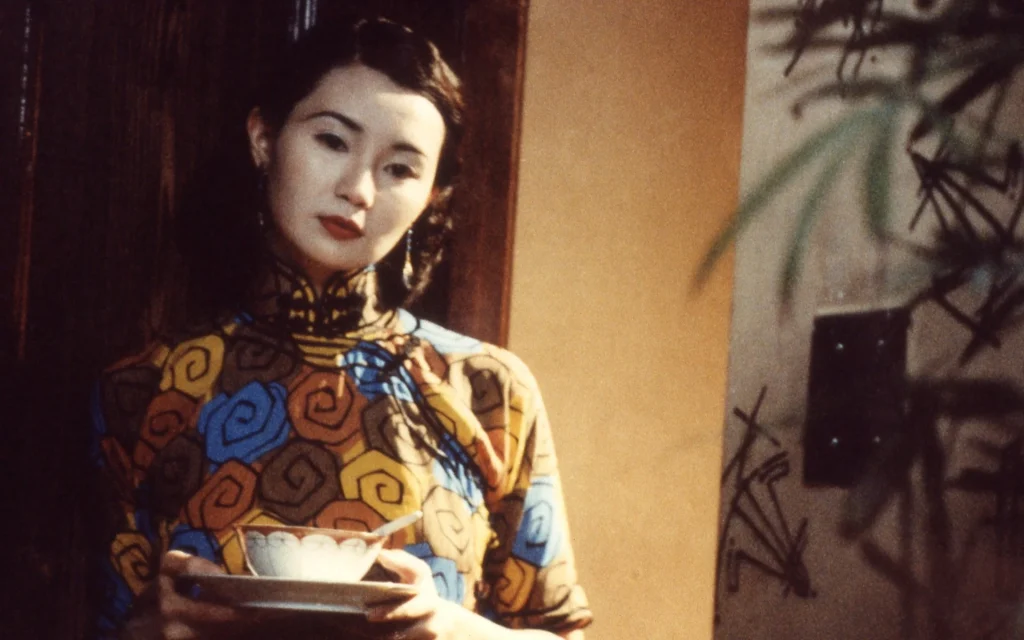
I’ll be honest, I did not find this an easy watch. I’m very much a dilettante when it comes to Chinese cinema of any origin, perhaps even more so with the cinema of Hong Kong specifically. This did not feel like an easy entry point for someone not well familiar already with Chinese film history or style, and so I feel that I should mention that I am perhaps not the most qualified party to offer an in-depth review of this film. However, as critics we review films from various cultures all the time, both those we are well-read in and those we are not, and so I also believe that my viewpoint has validity, especially for those like myself who may be interested in the film without much of a Hong Kong film background. Along those lines, though, one of the interesting aspects of the film for me was the fact that all of Ruan’s films were silent, even though her final film was released in 1935, well after the birth of talkies; it seems that the Chinese industry adopted the technology later, though the characters do mention the American industry’s talkies and Ruan repeatedly sings Marlene Dietrich’s iconic “Falling in Love Again” from The Blue Angel (dir. Josef von Sternberg, 1930), one of Germany’s first sound films. I guess I had just never thought about the possibility that audiences in other countries were watching international sound films years before their own industries were producing them.
The film employs metafictional aspects, cutting between the main dramatized narrative, scenes of the film’s cast and crew discussing Ruan, interviews with Ruan’s biographers and surviving contemporaries, and clips from Ruan’s films (other than those that are lost, which is unfortunately most of them). Cheung’s acting is beautifully subtle and intricate, the cinematography is gorgeous, and the production and costume design conveys an earlier era of film elegantly. I just found the whole thing overall a bit long and boring, though quite frankly I think that says more about me than it does about the film. I’ve never been the biggest Tarkovsky fan, for example, so if exquisitely-crafted slow-moving cinema is your jam, you’re likely to have a better time than I did. The storyline of a tragic actress at the birth of cinema and the interview sections call to mind Millennium Actress (dir. Satoshi Kon, 2001), though stylistically the films are pretty different, and not just because one is animated.