
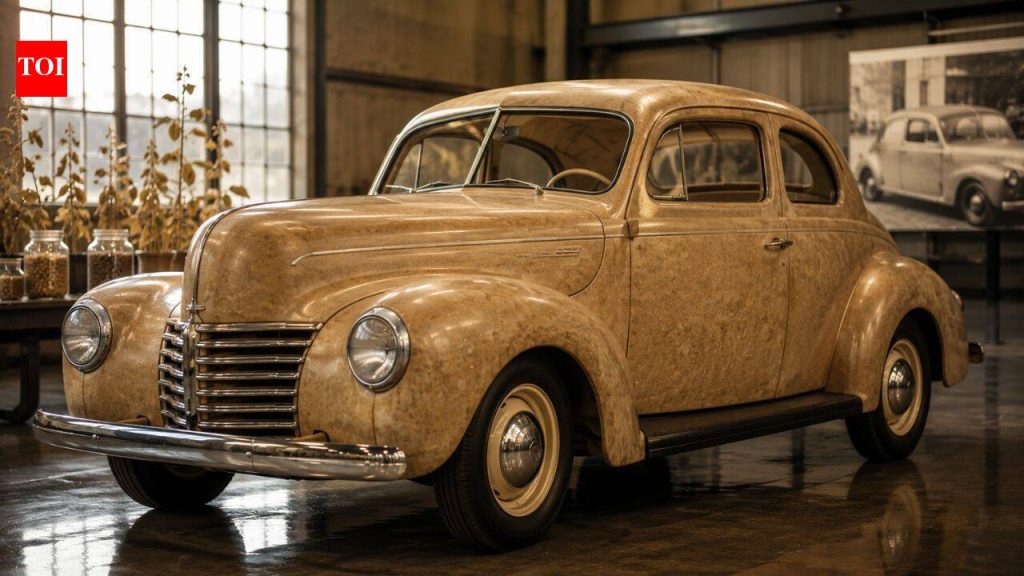
Long before “bio-based materials” entered the lexicon of the car industry, Henry Ford was trying to answer a different question. Could farms supply more than food? Could fields also provide the raw materials for manufacturing? That idea reached its most unusual expression in the summer of 1941, when Ford unveiled an experimental vehicle with a lightweight plastic body derived partly from crops. It arrived at a time when American industry was searching for alternatives to steel, while Ford himself was investing heavily in research that linked farming with manufacturing. The project never became a production car and was soon overtaken by World War II. Even so, it remains one of the earliest attempts to rethink what an automobile could be made from, decades before plant-based composites became part of mainstream engineering. Although the prototype never entered mass production, its vision anticipated many modern sustainability efforts, demonstrating that renewable agricultural materials could play a meaningful role in manufacturing and inspiring later innovations in lightweight, eco-friendly automotive design. Nearly a century later, as automakers race to reduce their reliance on petroleum-based plastics, Ford’s forgotten experiment reads less like a historical curiosity and more like an early blueprint for the sustainable materials shaping today’s automotive innovation.
What was Henry Ford’s 1941 soybean car made of, and how did its plant-based plastic body reduce weight
When the prototype appeared at Dearborn Days in Michigan on 13 August 1941, it looked like an ordinary passenger car. Underneath, however, it represented a very different approach.According to The Henry Ford Museum, the vehicle used a tubular steel frame covered by fourteen moulded plastic body panels rather than an all-steel body. Those panels made the car significantly lighter, reducing its weight to around 2,000 pounds, roughly half a ton less than many comparable steel-bodied vehicles of the period.The precise composition of the plastic has never been fully established because no complete manufacturing formula survives. The Henry Ford notes that contemporary accounts and later recollections differ, although both point towards agricultural materials playing a central role. One description suggested a mixture including soybeans, wheat, hemp, flax, and ramie, while Lowell E. Overly, who led the project’s engineering work, later described it as soybean fibre combined with a phenolic resin, with formaldehyde used during processing.As Oregon State University’s historical overview describes, the body was made from plant fibres such as straw and flax, held together with soybean meal and resins, and notes that Ford experimented with tyres made from goldenrod latex and fuel derived from vegetable oil. Although different accounts describe the recipe in different ways, they all point in the same direction: Ford was attempting to replace a substantial amount of conventional industrial material with products grown on farms.
Why Henry Ford built the 1941 soybean car and how it connected agriculture with automobile manufacturing
The project reflected Henry Ford’s long-standing interest in connecting agriculture with manufacturing rather than relying solely on traditional industrial supply chains. Ford was initially dissatisfied with the styling work and moved responsibility for the project to the Soybean Laboratory in Greenfield Village. Lowell E. Overly, whose background was in tool and die design, became responsible for developing the experimental vehicle, while chemist Robert A. Boyer provided scientific support throughout the programme.Ford’s reasons extended beyond experimentation for its own sake. The museum explains that he hoped to combine agriculture and industry in practical manufacturing, while also exploring whether plastic body panels could improve passenger safety by resisting damage differently from steel. Material shortages were another consideration, as metals were becoming increasingly valuable in the years leading into wartime production.The prototype also became a public demonstration. It was first displayed during the Dearborn Days festival before being transported to the Michigan State Fairgrounds, where visitors could see Ford’s latest agricultural experiment up close. One of the most enduring images associated with the project shows Henry Ford striking a plastic panel with an axe. According to The Henry Ford, however, that famous photograph does not depict the soybean car itself. Instead, Ford was testing a plastic rear deck lid fitted to one of his personal vehicles to demonstrate the material’s strength.
Why Henry Ford’s 1941 soybean car never entered production and what happened to the original prototype
The soybean car never had the opportunity to move beyond the prototype stage. A second experimental vehicle was already under construction when the United States entered World War II. Civilian automobile production was suspended as manufacturers shifted towards military equipment, bringing work on the plastic-bodied car to an abrupt halt. Once the war ended, the industrial landscape had changed. Petrochemicals had become deeply embedded in manufacturing, offering inexpensive and readily available plastics produced from fossil fuels rather than crops.Ford’s original ambition, to create products from renewable plant materials, was largely eclipsed as petrochemical industries expanded rapidly after the war. Yet the publication argues that many of those ideas resurfaced decades later as researchers revisited plant-derived materials for plastics, rubber and industrial manufacturing.The original prototype also disappeared. Lowell Overly later stated that designer E.T. Gregorie destroyed the vehicle, leaving photographs and written records as the main evidence of one of Ford’s most unusual engineering projects.
How Henry Ford’s soybean car inspired today’s use of plant-based materials in the automotive industry
Modern vehicles routinely use natural-fibre composites made from flax, hemp and other plant materials inside door panels, dashboards and interior trim. Those technologies differ greatly from Ford’s experimental plastics, but they reflect a similar effort to reduce dependence on heavier or less sustainable materials.Flax, one of the crops associated with Ford’s experiment, has continued to attract attention because it combines high strength with low weight. The university also highlights research into alternative plant sources for plastics, rubber and other industrial products, suggesting that Ford’s work anticipated questions researchers are still exploring many decades later.The 1941 soybean car was never intended to define the future of the automobile industry on its own. It was an experiment built around the belief that farms could contribute directly to manufacturing as well as food production.That experiment was interrupted before it could be properly tested in the marketplace. Even so, it remains an early example of engineers looking beyond conventional materials and asking whether the next generation of vehicles might begin, not in a steel mill, but in a field.