
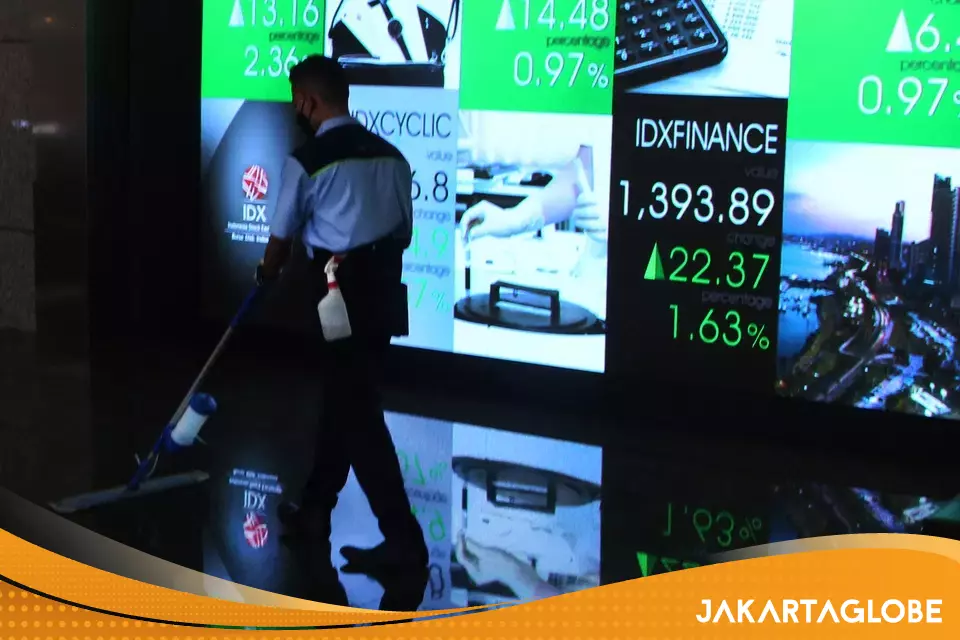
Jakarta. Indonesia’s benchmark stock index rose 2.78% in the week through Aug. 7, extending gains as investors weighed solid domestic economic growth and ample foreign-exchange reserves against renewed geopolitical and inflation risks.
The Jakarta Composite Index (JCI) ended Friday at 6,409.654, up from 6,236.126 a week earlier, according to data from the Indonesia Stock Exchange (IDX).
The exchange’s total market capitalization climbed 2.64% to Rp 11,212 trillion ($629.85 billion) from Rp 10,923 trillion in the previous week.
Trading activity also increased, with average daily transaction frequency jumping 27.62% to 2.32 million transactions from 1.82 million. Average daily trading value, however, edged down 0.38% to Rp 15.38 trillion.
ADVERTISEMENT
Foreign investors posted net purchases of Rp 1.24 trillion on Friday. They remain net sellers for the year, with cumulative outflows reaching Rp 71.29 trillion through Aug. 7.
Pilarmas Investindo Sekuritas said Indonesian equities were supported by solid economic fundamentals despite growing global uncertainty.
One source of confidence was Bank Indonesia’s foreign-exchange reserves, which stood at $145.3 billion at the end of July, little changed from $145.6 billion a month earlier. The reserves were equivalent to 5.5 months of imports, or 5.3 months of imports and government external-debt repayments, well above the international adequacy benchmark of about three months.
Indonesia’s economy expanded 5.29% in the second quarter from a year earlier, accelerating from the same period last year as household consumption and investment remained the main engines of growth, the Central Statistics Agency, or BPS, reported Wednesday.
Household consumption contributed 2.67 percentage points to overall growth, while investment added 2.06 percentage points and government consumption contributed 1.07 percentage points. Net exports detracted 0.78 percentage point as imports grew faster than exports.
Still, global risks remain in focus. Investors are monitoring developments in the Middle East after reports of restrictions on US and Israeli vessels transiting the Strait of Hormuz sent oil prices higher and revived concerns about inflation.
Pilarmas also said markets were watching signals from the US Federal Reserve, with Chairman Kevin Warsh indicating that policymakers could raise interest rates in September if inflation pressures persist in the coming weeks.
Domestically, investors are also awaiting the government’s announcement of a permanent governor for Bank Indonesia, adding another potential catalyst for the rupiah and local financial markets.
Tags:
Keywords:

