
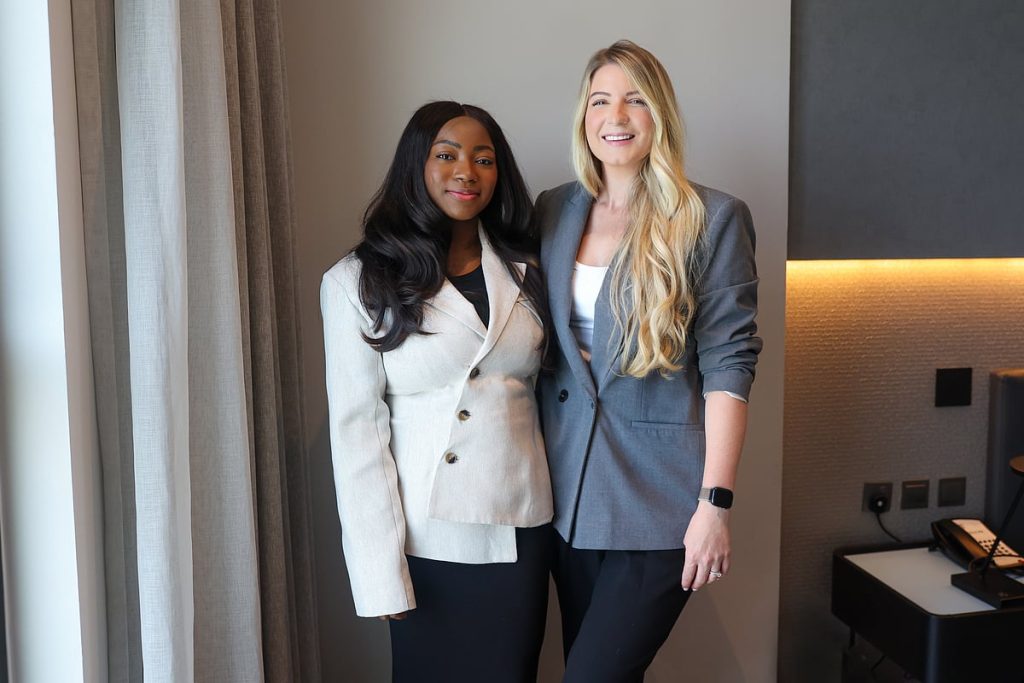
He had not. The messages were just playful, but the question stayed with them.
Within 24 hours, the two Dubai-based entrepreneurs had built the first version of Good Husband, a self-funded communication tool designed to help men find the right words during difficult conversations with their partners.
“People are already using AI every day to help them write messages, emails and difficult responses,” Alhassan said. “Since communication is what Sarah and I have spent our careers doing, we thought, who better to build something that helps people find the right words?”
From private joke to business idea
Alhassan and Curtis have spent years working in communications, first through their careers in public relations and later through POP Communications, the agency they founded and grew together.
Good Husband emerged from the same skill they had used throughout their professional lives, understanding how language can change the way a message is received.
The platform offers private coaching and personalised reply suggestions for men who care about their relationships but may struggle to express themselves clearly during sensitive moments.
The idea, according to the founders, was never about replacing genuine communication, but about helping users say what they already meant more thoughtfully.
Built by two best friends
Alhassan, a 34-year-old Nigerian entrepreneur, moved to Dubai in 2013. Curtis, a 36-year-old British entrepreneur, arrived a year earlier.
Their friendship developed alongside their careers, eventually leading them to build several businesses together.
“Sarah and I are best friends. We do almost everything together and spend most of our time in each other’s company,” Alhassan said.
That closeness also played a big role in the way Good Husband was created. There was no lengthy development cycle or outside funding round. The founders tested the idea and built the first version themselves.
The company remains completely self-funded.
A decade of lessons behind a new venture
Good Husband is new, but the founders are drawing on almost ten years of experience running POP Communications, which has worked with more than 200 clients across the region.
Their businesses have operated through economic uncertainty, the Covid pandemic and periods of regional instability.
“The biggest lesson has been that resilience matters more than almost anything else,” Curtis said. “There will always be difficult periods. The businesses that last are usually the ones that keep showing up and adapting.”
Both founders admit that entrepreneurship has repeatedly made them question whether returning to a conventional job would be easier.
“Every entrepreneur has moments when they question what they’re doing,” they said. “Building a business can be incredibly rewarding, but it can also be stressful, unpredictable and exhausting.”
Those moments, however, have never lasted long enough to change their direction.
Freedom remains their biggest success
Neither founder describes revenue, awards or expansion as their biggest achievement.
“We both get to build businesses we care about while still being present for our families,” Curtis said. “We don’t take that for granted. The ability to do meaningful work and still have time for the people we love is probably the achievement we’re most proud of.”
Their families had professional and entrepreneurial backgrounds, but Alhassan and Curtis still had to develop their own approach to business.
The ventures they created were different from those built by their parents, leaving much of their learning to experience, experimentation and trial and error.
Curtis has one piece of advice for anyone considering a similar move.
“Just start,” she said. “You can read all the books, listen to all the podcasts and take all the advice in the world, but nothing teaches you how business works quite like actually building one.”
Dubai shaped their journey
Both women began their careers in the UAE and built the professional relationships that later supported their businesses.
“The UAE is where we built our professional networks, developed our expertise and created the relationships that helped shape our entrepreneurial journey,” Curtis said.
The founders also credit the wider business and media community with helping their work reach new audiences.
“We’ve been incredibly fortunate to build a strong network of people who support us, champion our work and recommend us in rooms we never imagined we’d be part of,” Alhassan said.
Their ambition is now to take Good Husband beyond Dubai and reach men across the world.
“I hope that five years from now, Good Husband has helped millions of men around the world become more thoughtful and effective communicators,” Alhassan said.
The long-term goal is an integration with WhatsApp, but the business began with something far smaller: one wife showing her best friend a text from her husband and asking why he suddenly sounded so different.
Nivetha Dayanand is Assistant Business Editor at Gulf News, where she spends her days unpacking money, markets, aviation, and the big shifts shaping life in the Gulf. Before returning to Gulf News, she launched Finance Middle East, complete with a podcast and video series.
Her reporting has taken her from breaking spot news to long-form features and high-profile interviews. Nivetha has interviewed Prince Khaled bin Alwaleed Al Saud, Indian ministers Hardeep Singh Puri and N. Chandrababu Naidu, IMF’s Jihad Azour, and a long list of CEOs, regulators, and founders who are reshaping the region’s economy.
An Erasmus Mundus journalism alum, Nivetha has shared classrooms and newsrooms with journalists from more than 40 countries, which probably explains her weakness for data, context, and a good follow-up question.
When she is away from her keyboard (AFK), you are most likely to find her at the gym with an Eminem playlist, bingeing One Piece, or exploring games on her PS5.