
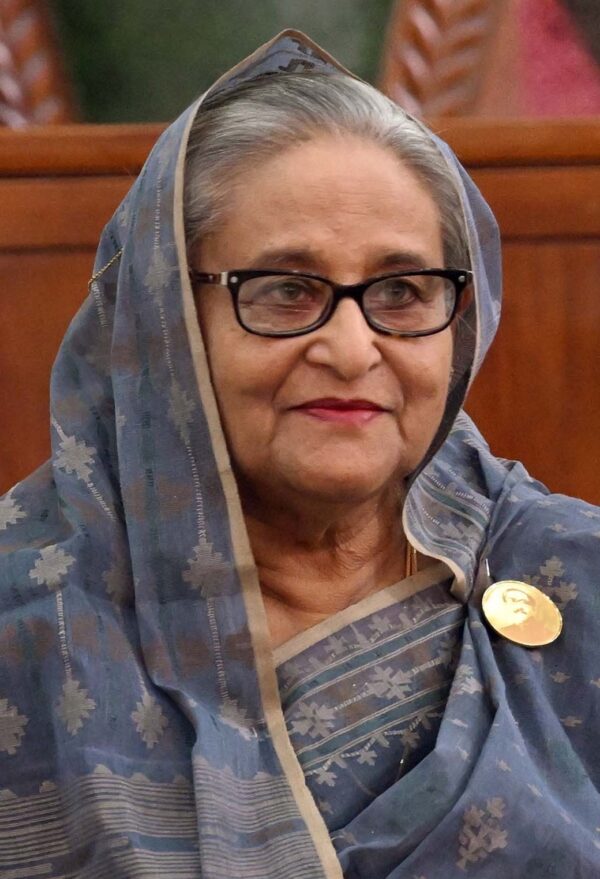
Bangladesh’s former Prime Minister Sheikh Hasina has said she will return to her country in December this year, almost two and a half years after fleeing to India following violent student protests that culminated in the ouster of her government.
In a message delivered online to Indian and foreign journalists in New Delhi on August 5, Hasina said her decision to return home was based on her desire to serve her country and its people. Acknowledging the possibility of imprisonment or even execution if she returned to Bangladesh, Hasina said that such apprehensions would not deter her.
“My return, and the return of the Awami League to the democratic process, is not about power. It is about putting Bangladesh back on the right track,” Hasina said. She also defended her government’s action against protesters who she said had destroyed public infrastructure and vandalized monuments associated with Sheikh Mujibur Rehman, who led Bangladesh’s liberation war in 1971 and became independent Bangladesh’s first president.
Hasina’s media interaction drew an angry response from the Bangladesh Nationalist Party government, which expressed “outrage” over India allowing the press conference to be organized in Delhi. “Dhaka deeply regrets that in spite of concerns conveyed a priori to the Government of India about the likely ramifications of this event on the reset of our bilateral relations, this public event was permitted to be held,” it said. That it took place on the very day that Bangladesh was observing the second anniversary of Hasina’s ouster was “an affront to the sovereignty of Bangladesh and a grievous insult to the martyrs of the July Revolution,” it added.
On the eve of Hasina’s online interaction with the media, India distanced itself from the Hasina event, saying it had no role in it nor had it endorsed it. The Awami League presser was hosted by the Foreign Correspondents Club of South Asia in New Delhi.
But that did not convince Bangladesh.
Hasina had deployed extreme force to quell the protests of summer 2024, which led to over a thousand people getting killed in the crackdown. She was forced to step down on August 5, 2024.
She fled to India after the fall of her government. India’s sheltering of Hasina since then has irked Bangladeshis immensely, especially after November 2025, when a special Bangladeshi tribunal convicted and sentenced Hasina and her Home Minister Asaduzzaman Khan Kamal to death for crimes against humanity. Besides, Hasina had issued statements and given media interviews while in India, prompting Dhaka to repeatedly ask India to curb her political activities on Indian soil. Dhaka has also sought her extradition to face justice in Bangladesh. However, India has ignored Dhaka’s requests.
Forcing Hasina back to Bangladesh is not an option for India. Her return of her own volition may help ease the current tensions in Bangladesh-India ties.
There is some speculation that India has been working behind the scenes with some European countries to ensure Hasina’s safety when she returns home. That is something the Indian External Affairs Ministry has not commented on.
When Hasina was in power, the Bangladesh-India relationship was warm. That changed with her ouster, especially when the interim government under Mohammed Yunus leaned toward China and seemed insensitive to Indian concerns.
Although previous BNP regimes were perceived in Delhi as anti-India, this time around, when the BNP took office in February, it raised hopes for a reset in ties. Foreign Minister Khalilur Rehman’s visit to New Delhi in April was seen as a confidence-rebuilding exercise. Yet India remains wary, largely because of the BNP government’s growing closeness to Pakistan, China, and Turkiye.
For India, stable ties with Bangladesh are a priority given that the two share a 4,100-km-long border. India looks for support from Dhaka not only for greater connectivity with its landlocked Northeast but also to deal with insurgencies in this restive region.
Given these imperatives, India has made several overtures to Dhaka in recent months. It sent Foreign Secretary Vikram Misri and Speaker of the Parliament Om Birla to Prime Minister Tarique Rahman’s inauguration in February, sent over 45,000 tons of diesel in April 2026 amid fuel shortages, and appointed a new envoy in Dhaka to aid in the recalibration of bilateral ties. The envoy, Dinesh Trivedi, was also elevated to cabinet minister status to ease his access to the Bangladeshi prime minister.
India has also invited Rahman to the BRICS summit in Delhi in September, although the Bangladeshi prime minister is yet to accept the invite.
An important issue that could shape bilateral relations decisively is the Ganga Water Sharing Accord. Signed in 1996 when Hasina first became prime minister, the treaty is valid for 30 years. It is up for renewal this December. Factors like the volume of water flowing in the river currently and the impact of climate change on both countries will have to be factored in while renewing the treaty. A quick renewal could help place New Delhi’s ties with Dhaka on a firmer footing.
With the Bharatiya Janata Party now in power both at the center and in West Bengal, India and Bangladesh are better positioned to conclude an agreement on the sharing of the waters of the Teesta River – a long-standing demand of Dhaka. Previously, Mamata Banerjee, chief minister of West Bengal, had opposed a pact.
The Narendra Modi government would do well to also follow up on recommendations made by the Parliament Committee on External Affairs. In comments made public in July, the panel had urged the government to leverage its comparative advantage in development cooperation to strengthen trust and reinforce its position as “Bangladesh’s most reliable partner,” noting with concern “the increasing Chinese footprint in Bangladesh, particularly in infrastructure development, port expansion, and defense cooperation.”
A reset in relations is imperative. But first, New Delhi will have to limit the damage done by Hasina’s online engagement with the media.