
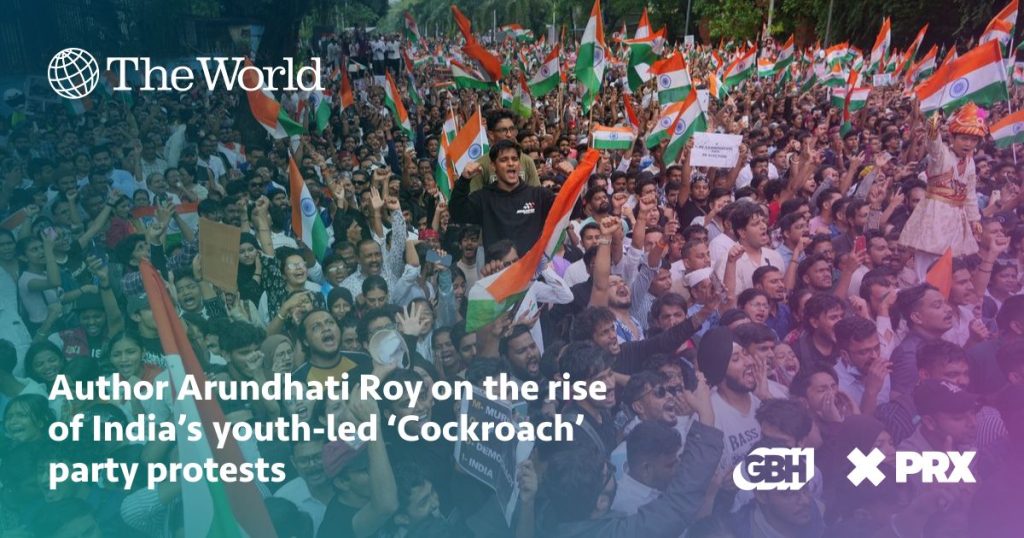
India is seeing a new wave of anti-government protests inspired by the satirical Cockroach Janta Party. While a leading figure of the movement, activist Sonam Wangchuk, has ended his hunger strike, young people are pushing for more change.
On Monday, the student-led movement celebrated a win after the government agreed to at least some demands, including the resignation of the country’s education minister.

Protesters celebrate after Education Minister Dharmendra Pradhan resigned following nationwide protests as part of the Cockroach Janta Party’s protest movement in Mumbai, India, July 26, 2026.Rafiq Maqbool/AP
Award-winning Indian author and activist Arundhati Roy joined The World’s Host Marco Werman to discuss what the movement reveals about the country’s political moment and whether India’s growing protests have staying power.
Marco Werman: Describe the atmosphere in New Delhi right now.
Arundhati Roy: The atmosphere is simultaneously hilarious and a little full of apprehension because we’ve never seen this particular sort of section of society — young middle class Hindu, for the most part, students, but also every other kind — you know, Muslims and Buddhists and Christians — but altogether, really the Hindu majority whose parents’ generation really voted for [Prime Minister Narendra] Modi and the [Bharatiya Janata Party] BJP, now just up in arms, well unarmed, but armed with the wildest humor you can possibly imagine, despite massive violence on the part of the police. So, now I don’t know what’s going to happen next. You know, the air is very tense. And the jokes are very sharp.
Hilarity and apprehension, that’s a great way of summing it up, and not surprising because the Cockroach Party began as satire but has become a real political force. What do you think this movement captures about India today that conventional opposition politics has failed to do?
Well, I think people actually missed the fact that this younger generation does not subscribe to the same politics as its parents, and there’s been such a fear and a pall of silence that hung around, so it was hard to know what people were thinking. I mean, just 10 days ago, a mildly off-color joke about Modi could get your social media shut down. If you’re a Muslim, it could get you put in jail. And suddenly there’s an outpouring of fury and hilarity.

Saurav Das, chief spokesperson of the Cockroach Janta Party, center, looks on as fellow spokesperson Ashutosh Ranka, right, shakes hands with India’s Health Minister J.P. Nadda during a joint press conference in New Delhi, India, July 25, 2026, following the resignation of India’s education minister.AP
How else has satire come up in these protests?
It’s hard for me to convey it because most of it is in Hindi. Most of it is just a kind of collection of expletives, and it’s like as though the quiet part is being said out loud. Everyone is saying what we thought but could not say, but they’re saying it in such numbers that nobody can do anything about it. And this is the internet generation, so they’re like little fish swimming around. They tried to jam the internet; it didn’t work. Social media is just like, all of us just spend our whole nights awake laughing at it.
I mean, there have been so many reasons to rise up over the years. Why do you think this is happening now?
But the point is that even after you get an education, there are no jobs. Everything has been privatized. Everything is put into the hands of these two industrialist friends of Modi’s. Obviously, for the upper ranges, AI is taking over. You have a situation of a country of 1.5 billion people that has been brought to its knees, the middle class and the poor alike. So, that’s what you’re seeing in these protests. Everybody’s out there.

People shout slogans during a citizen protest march in support of the Cockroach Janta Party’s protest movement in Dharamshala, India, July 26, 2026.Ashwini Bhatia/AP
If we just look at this education scandal, Prime Minister Modi has promised to punish government officials involved in it. What is your reaction to that?
My reaction is to burst out laughing because this is the fourth time he said the same thing, and there has never ever been a conviction, ever. And in fact, yesterday the kingpin of the previous scandal was given what they call a clean chit and released. So, this is just standard bulls — from our politicians.
The fact that Prime Minister Modi is responding in this way, what does that tell you about his sense of vulnerability right now?
It tells me that he has no idea what he’s up against.
Sonam Wangchuk has ended his 26-day fast, but the protests continue. The demands have broadened beyond one individual. What are the current demands?
The current demands of the students are very simple: The resignation of the education minister, compensation for all the young people who died by suicide, an apology from the prime minister, and action against the police who’ve beaten up kids very badly. But if you go to the protest and you follow it, what has been said is way beyond that. Now, the target is singularly Modi himself. And Sonam Wangchuk, of course, he galvanized the whole thing with his fast, but he has been previously allied with the BJP. So, he broke his fast in the presence of BJP ministers, and I don’t think that’s gone down very well. And I don’t think this movement actually has any specific leaders.
I mean, vocal opposition to Modi has carried dangers in the past.
Yes.
What’s your sense of the risk to protesters today and dissenters like yourself?
And I’m just wondering, I mean, if they were Muslims or Sikhs or Christians or tribespeople or Kashmiris, the army would have been out and would have killed quite a few by now. Now, this, as I keep saying, this is their major constituency. So, what’s going to happen? Is he going to try and get the army out, or is he going to defuse it? Already the television channels are saying, “Oh, it’s a foreign plot, they are Pakistani,” and so on.

In this file photo, Booker Prize-winning novelist and activist Arundhati Roy, center, participates in a gathering for Kashmiris to observe Eid al-Adha away from their homes in New Delhi, India, Aug. 12, 2019.Manish Swarup/AP/File photo
Well, you do know what it means for Modi to control the media and freedom of expression. How has he managed to control the narrative up to this point?
Well, you see, the point is that the media, for example, is owned by big corporations, many of whom are very close allies of Modi, and in return for their favors, they get ports and coal mines, and everything is privatized, and even that privatization is centralized. Some of them own up to 27 news channels. There’s a conflict of interest in the ownership itself.
Arundhati Roy, you’ve spent years warning about democratic backsliding, centralization of power, the narrowing of dissent. Does this feel like an inflection point or simply another chapter in a much longer story you’ve been telling?
It’s hard to say, but as I said, I have never seen this individual, Mr. Modi, being so mocked and jeered at before. So, that does feel like an inflection point, but I really can’t say how it’s going to pan out because this regime is capable of unbelievable brutality.
You’ve been imprisoned for your own activism, although briefly, and have more recently faced prosecution over remarks you made years ago about the Indian territory of Kashmir, which was considered provocative. Has living under the threat of legal punishment changed the way you think about speaking out on issues in India?
Yes and no, in the sense [that] it has sharpened me, it has made me cautious, it has made me think carefully about what I say and how I say it, but it hasn’t stopped me from saying what I want to say.

Protesters participate in a demonstration demanding educational reforms during the Cockroach Janta Party’s ongoing protest movement in New Delhi, India, July 25, 2026.Vipin/AP
If the Cockroach Movement has exposed a generation’s frustration with corruption, unemployment and accountability, what do you think comes next?
Honestly, right now, these young people, very, very young people, their first outing into the political arena, and it’s been amazing. But now it’s time for the opposition and for adults to come in, because as I said in the piece I recently wrote, the reason the government feels it does not need to listen to anything and anyone is [that] it has captured the election machinery. It’s reconstituted the Election Commission. It has fiddled with the voting machines. It has voter lists now where there are millions of phantom names and millions of real people deleted from it, trying to realign the constituencies and how they are mapped in its favor. The courts look away. The bureaucracy and the police are completely complicit. So, it doesn’t feel that it can really lose an election, and therefore it doesn’t need to listen to people. But this is a huge country, and we have a history of fighting for things. And for a while, that was snuffed out, but I feel that it’s coming back.
I wanted to get your thoughts on this before we let you go. It’s intriguing that the name for the Cockroach Party came from an Indian student living in Boston, who posted on Instagram, “What if all cockroaches came together?” after India’s chief justice labeled unemployed young people “cockroaches.” What do you make of this global boomerang effect? What does that tell you about what’s happening right now?
It just tells me that there’s a new thing in the air, a new way of doing politics. And sometimes, people don’t understand it. Sometimes it can go badly wrong, like you have student uprisings and you had the Arab Springs, and then it goes back to something even more frightening, and worse, because there’s a clampdown. So, the opposition has to somehow come together and be responsible, the political opposition parties. Otherwise, things are going to get very, very bad because, you know, the vigilante Hindu right-wing is very violent. So, these kids, as I said, they’re beautiful and they’re funny, but when things start to go south, what’s going to happen? I don’t know.
This interview has been lightly edited and condensed for clarity.