
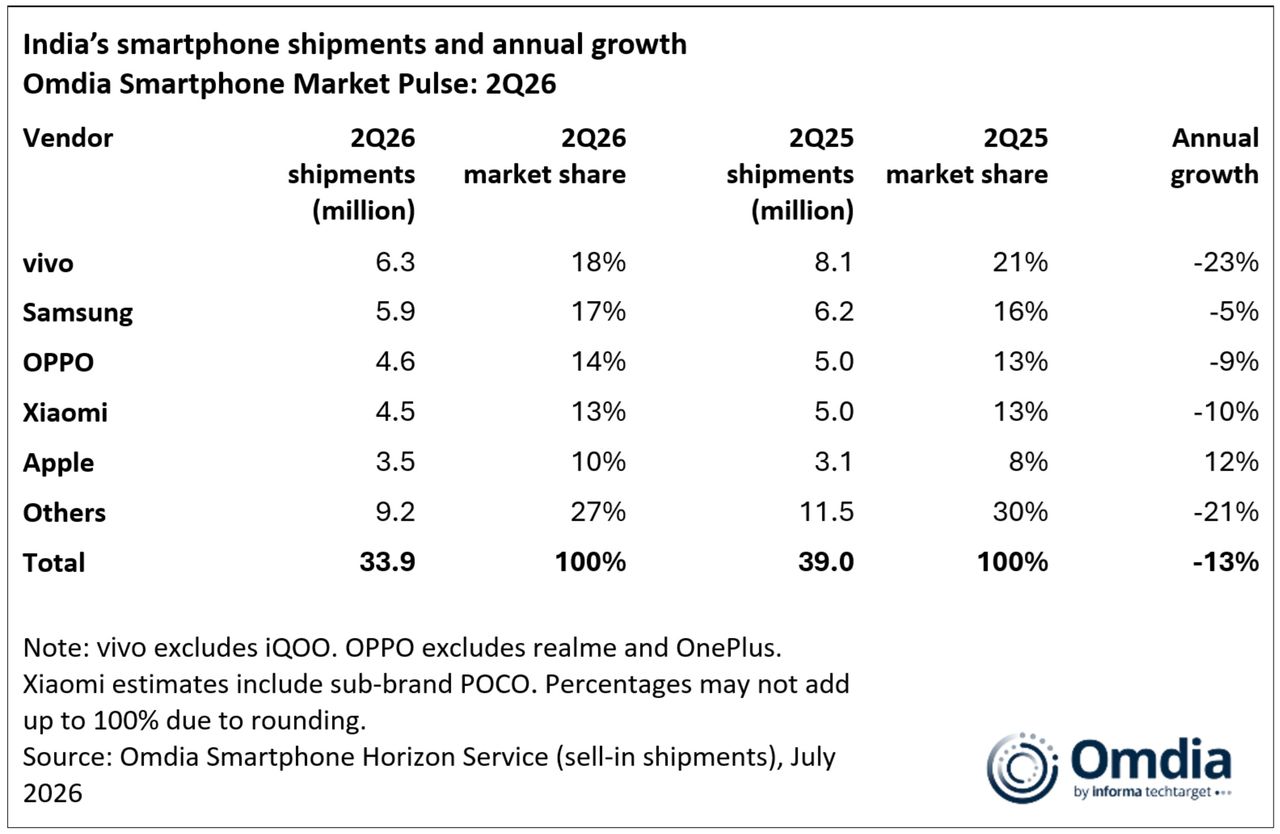
New stats from Omdia put shipments at 33.9 million units, down 13% on last year – the sharpest decline since the pandemic.
With memory makers focused on quenching the AI industry’s well-documented thirst for DRAM, there is a shortage of RAM for smartphones, and prices have gone through the roof. The effects are felt particularly keenly in the entry-level and mid-range categories, which are the mainstay of India’s smartphone market.
Other factors that Omdia said contributed to the dismal performance are delayed upgrades ahead of festive-season offers; rupee depreciation; inflation; and weak summer retail footfall.
As a result, the 13% decline in India in Q2 is steeper compared to the global market which, according to stats from Counterpoint Research, tumbled by 11%.
Faced with these challenges, vendors in India “increasingly simplified and repositioned their portfolios in 2Q26 to improve profitability, sharpen product differentiation and enhance channel efficiency,” said Sanyam Chaurasia, principal analyst at Omdia.
“Brands became more selective at the entry level – prioritising hero models, extending product lifecycles and staggering launches to better align inventory with sell-out – while redesigning premium portfolios around clearer upgrade paths,” he added.
Vivo maintained its position as the number one OEM, but only just, as shipments plunged 23% year-on-year to 6.3 million units. Second-placed Samsung shipped 5.9 million, representing a comparatively modest decline of 5%. Had it been able to achieve flat shipments, it would be more or less neck and neck with Vivo.
Vivo’s performance was heavily impacted by price hikes, said Omdia, but it defended its position by streamlining its entry-level portfolio and introducing the V70 FE, a more affordable version of its mid-range V-series handsets.
Samsung was propped up by the enduring popularity of the A07 and Galaxy A17, Omdia said, while various financing, exchange, and buyback programmes helped shift its more expensive Galaxy S26 line-up.
Fifth-placed Apple was the only major vendor to see shipments head in the right direction. According to Omdia, it benefited from inventory build-up for the iPhone 17 ahead of anticipated price increases and the possibility that the iPhone 18 might not launch this year.
Oppo and Xiaomi maintained their respective third and fourth places, but both had a rocky ride in Q2. The former shipped 4.6 million devices, down 9% YoY; the latter 4.5 million, down 10%.
“As higher device prices increased inventory values, retailers increasingly concentrated their investment on brands offering stronger sell-out visibility and financing support. Samsung and Apple were better positioned to capture a larger share of channel inventory as retailers prioritised brands with lower inventory risk and stronger premium demand,” said Chaurasia.
This is the third consecutive quarter of declining volumes in India, and Omdia is yet to see a glimmer of hope on the horizon.
“Omdia continues to expect a double-digit decline in India’s smartphone market in 2026, with consumer demand remaining constrained by macroeconomic pressures and elevated device prices,” said Chaurasia.
“Persistent inflation, rupee depreciation and higher living costs are expected to weigh on discretionary spending, while below-normal rainfall could further soften rural incomes and festive season demand. At the same time, elevated memory costs are likely to keep smartphone prices high through the remainder of 2026, with broader smartphone price normalisation unlikely before the first half of 2027.”
He urged OEMs to align prices with rising component costs but mitigate the impact with promotional initiatives, such as financing, cashback offers, exchange programmes and value-added service bundles, rather than mere discounts.
It’s an uphill struggle in India at the moment, and Omdia’s stats and predictions suggest that it is getting steeper.