

Image Source: Getty Images
Myanmar President U Min Aung Hlaing’s visit to India at the end of May and the beginning of June sought to reinvigorate bilateral ties, with both countries committing to strengthening connectivity, expanding economic cooperation, and enhancing efforts to combat transnational crime.
During a press conference following the visit, Indian Foreign Secretary Vikram Misri confirmed that Prime Minister Narendra Modi and Min Aung Hlaing had also discussed cooperation in the critical minerals and rare earths sector, alongside trade, connectivity, and border management. Modi himself underscored India’s interest in partnering with Myanmar on critical minerals. While Myanmar’s rare earth reserves undoubtedly hold strategic significance, its ability to emerge as a reliable supplier of India’s growing critical minerals warrants careful assessment.
Why Myanmar Matters
Myanmar now ranks as the world’s third-largest rare earth producer, with 2024 output put at roughly 31,000 tonnes. The country is especially rich in dysprosium and terbium — the heavy rare earths used in high-performance magnets for EV motors, wind turbines, and precision defence equipment — rather than the lighter rare earths that dominate most other deposits worldwide.
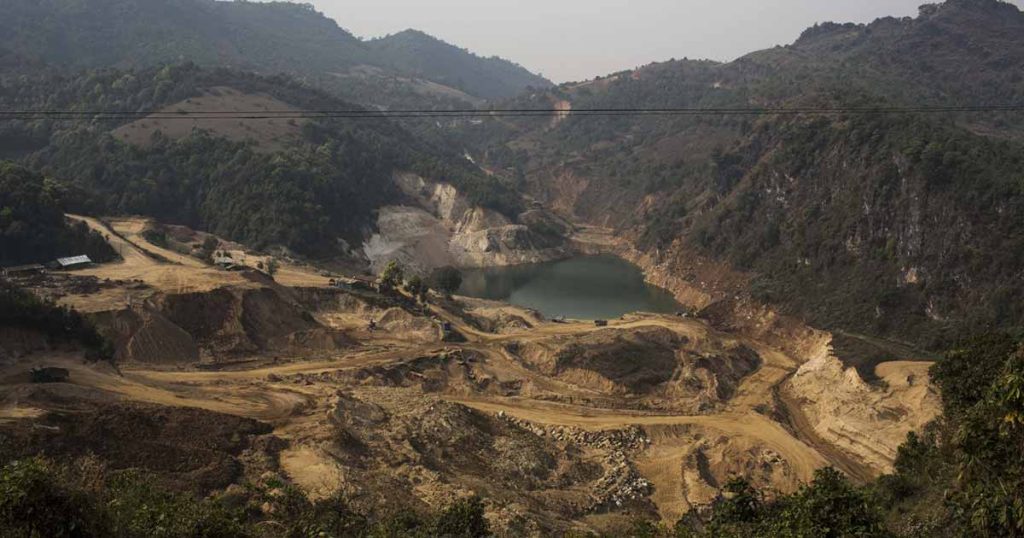
The bulk of this production is concentrated in Kachin State, particularly in areas around Chipwi and Momauk, where mining has expanded rapidly over the past decade with minimal regulatory oversight due to the collapse of civil administration following the 2021 coup and the area’s fragmented territorial control. Beyond rare earths, the country also holds substantial reserves of tin, tungsten, and jade, making it a broader repository of strategic minerals relevant to electronics, alloys, and defence manufacturing.
China holds roughly 60 percent of the world’s rare earth deposits, and it processes close to 90 percent of the world’s supply — a concentration that has become a source of geopolitical leverage, most visibly through Beijing’s export restrictions on rare earth materials and processing technology. It is against this backdrop of concentrated supply and processing power that Myanmar’s heavy-rare-earth deposits acquire enormous weight.
India accounts for less than 1 percent of global rare earth mining output — a gap that widens further downstream, given its negligible processing and refining capacity — which is precisely why the heavy-rare-earth-rich deposits of Kachin State matter so much for India’s critical mineral security.
For India, this endowment sits at a moment of acute urgency. India holds one of the largest rare earth resource bases in the world, with roughly 6.9 million tonnes of rare earth oxides. However, these are concentrated in light rare earths. India accounts for less than 1 percent of global rare earth mining output — a gap that widens further downstream, given its negligible processing and refining capacity — which is precisely why the heavy-rare-earth-rich deposits of Kachin State matter so much for India’s critical mineral security.
India’s National Critical Mineral Mission, launched in 2025, and its amendments to the Mines and Minerals (Development and Regulation) Act, 1957, in 2023 and 2025, are steps toward expanding exploration activities. The accompanying institutional architecture — the Geological Survey of India (GSI), Indian Rare Earths Limited (IREL), and Khanij Bidesh India Limited (KABIL) — reflects a recognition that domestic exploration alone cannot meet the scale of demand generated by India’s electric vehicle, renewable energy, electronics, and defence manufacturing ambitions.
The Structural Reality Behind the Rhetoric
Myanmar, sharing a 1,643 km border, offers a geographically proximate and diplomatically familiar alternative to distant and more competitive markets such as Australia or Argentina, where KABIL has already secured exploration agreements.
The difficulty is that Myanmar’s rare earth wealth is not directly accessible to New Delhi. The most commercially significant deposits in Kachin State lie substantially outside the control of Myanmar’s military government and instead fall under the administration of the Kachin Independence Army (KIA), which has expanded its territorial control since the 2021 coup, particularly post Operation 1027.
This means that any Indian engagement with Myanmar’s critical minerals sector cannot rely solely on a government-to-government framework. It necessarily raises questions about dealing, directly or indirectly, with a non-state armed actor — one that Naypyidaw does not recognise as a legitimate counterpart, and with which India has no prior history or established mechanism for engagement. Reports have suggested that India has been quietly exploring rare earth supply arrangements with armed groups in the region following Chinese export curbs. Still, such claims have been denied by both the KIA and Indian authorities in the media.
Any Indian engagement with Myanmar’s critical minerals sector cannot rely solely on a government-to-government framework. It necessarily raises questions about dealing, directly or indirectly, with a non-state armed actor — one that Naypyidaw does not recognise as a legitimate counterpart, and with which India has no prior history or established mechanism for engagement.
Compounding this is China’s deeply entrenched position within both the country and the network. Decades of infrastructure investment, established buyer-intermediary networks, and geographic proximity mean that the existing flow of rare earth ore runs from Kachin State into Yunnan province, where Chinese processing facilities absorb the material.
Chinese firms have kept their grip on this trade less through formal contracts than through working arrangements with whichever militia or armed group controls a given mining enclave. This model has proven durable enough to survive Myanmar’s 2018 export ban, the 2021 coup, and repeated border closures since — including a partial trade restriction that Beijing itself imposed in late 2024 to pressure the KIA during ceasefire talks that ultimately failed.
India recognises this fact. This caution was visible even in the language New Delhi used during the visit, where Foreign Secretary Vikram Misri described the critical minerals discussion only as a subject under ‘bilateral consideration,’ with both sides committing to ‘stay in touch.’ No Memorandum of Understanding (MoU), offtake agreement, or joint venture structure emerged from the visit.
Furthermore, for India to redirect any meaningful share of this trade southward would require not merely a bilateral political understanding, but a competing offer of infrastructure, financing, and logistics that does not currently exist at the necessary scale. The stalled Kaladan Multi-Modal Transit Transport Project and the India-Myanmar-Thailand Trilateral Highway — both central to providing India’s northeast with viable access to the Bay of Bengal and Southeast Asia — demonstrate how connectivity gaps compound the mineral access problem.
For India to redirect any meaningful share of this trade southward would require not merely a bilateral political understanding, but a competing offer of infrastructure, financing, and logistics that does not currently exist at the necessary scale.
Both projects have been delayed for years by the security situation in Rakhine and Chin States, especially since the 2021 coup. During a coordination meeting on 9 July, the military regime committed to completing both projects within its current term in office. Even so, the routes themselves remain far from secure for vehicles or personnel to traverse. India and Myanmar will still need to rebuild large stretches and construct entirely new sections — work that requires time and a war-free environment that neither side can realistically expect in the near future.
Way Ahead
None of these constraints diminishes the strategic rationale behind India’s engagement with Myanmar. On the contrary, they reinforce the need for a long-term approach that balances diplomatic engagement with practical measures to improve access to critical minerals.
The Quad Critical Minerals Initiative Framework, formalised in May 2026 among India, Australia, Japan, and the United States, offers a potential multilateral scaffolding through which India could pursue Myanmar-linked supply chains with partners who bring complementary capital, technology, and diplomatic cover.
Japan illustrates this potential well, given its established role in mineral processing and infrastructure financing. Yet even this framework has, to date, produced no formalised engagement specific to Myanmar — reflecting the broader caution that all external actors, not India alone, have exercised toward a resource base entangled in an active civil conflict. Realising this potential, however, will require several concrete steps.
First, India must keep cooperating with the Naypyidaw administration while increasing commercial and technical collaboration through organisations like GSI, KABIL, and IREL. This will make it possible to continue discussions on geological mapping, exploration, and potential future investments even if large-scale extraction is still not feasible in the near future.
Working through frameworks such as the Quad Critical Minerals Initiative with partners like Japan and Australia can provide access to financing, processing technology, and supply-chain expertise that India currently lacks and may find difficult to mobilise in Myanmar’s complex operating environment.
Second, India needs to leverage minilateral partnerships to reduce both commercial and political risks. Working through frameworks such as the Quad Critical Minerals Initiative with partners like Japan and Australia can provide access to financing, processing technology, and supply-chain expertise that India currently lacks and may find difficult to mobilise in Myanmar’s complex operating environment.
Third, India’s strategy must remain flexible enough to respond to changing political realities within Myanmar. As the conflict remains far from resolved, the distribution of territorial control is likely to evolve, making it unwise to anchor policy exclusively to either the military government or the resistance. Instead, India’s policies need to be shaped to engage with whichever authorities exercise effective control over strategically important regions, while remaining consistent with its broader foreign policy objectives.
Ultimately, Myanmar should be viewed as a long-term strategic opportunity. Realising that opportunity will require sustained engagement between relevant central and state-level agencies in both nations, the completion and security of connectivity routes, processing capacity, and a policy that is sufficiently adaptable to Myanmar’s evolving political landscape. Until then, Myanmar’s rare earth wealth will remain, for India, a strategic aspiration rather than an operational asset.
Sreeparna Banerjee is an Associate Fellow with the Strategic Studies Programme at the Observer Research Foundation.
The views expressed above belong to the author(s). ORF research and analyses now available on Telegram! Click here to access our curated content — blogs, longforms and interviews.