

Japan’s governing political party is preparing changes to shareholder proposal rules that could drastically reduce the number of investors able to file resolutions, marking one of the most significant constraints on shareholder rights in years.
The proposals would make it materially harder for domestic and foreign investors to submit resolutions or requisition meetings, highlighting a broader shift in Japanese policymaking away from shareholder empowerment and favouring the interests of corporate entities.
Significant shift for shareholder proposals
Japan’s Liberal Democratic Party (LDP), which has governed since 2012, is reportedly expected to consolidate recommendations from a taskforce examining changes to shareholder proposal rules. The resulting draft proposals could materially alter investors’ ability to submit resolutions.
According to reports, the taskforce will recommend raising the threshold for shareholder resolutions. Investors currently qualify by holding either 1% of voting rights or 300 voting units. The proposal would remove the 300 voting unit provision, substantially reducing the number of shareholders able to lodge resolutions. It has been suggested that minority shareholder proposals could fall by as much as 80%.
For example, for a company with a market capitalisation of ¥1 trillion (U$6.2 billion) or more, shareholders would need to hold more than ¥10 billion in shares, creating a significant hurdle even for established institutional investors. As foreign investors rarely hold more than 1% of voting rights in Japanese companies, removing the 300 voting unit threshold would affect both domestic and international investors.
The reports followed a consultation carried out by Japan’s Ministry of Justice, which ran from March to May this year. The consultation set out two core options of either abolishing the 300 voting units rule or raising it to a higher number. It appears that policymakers are set to opt for the former option, despite some shareholders speaking out against the change. The consultation also contained potential rules regarding virtual-only AGMs, a topic that has divided opinion among market participants, particularly given concerns from some investors about the effect on shareholder rights and meeting accessibility.
ClientEarth criticised the proposals earlier this year, arguing they would impose disproportionate restrictions relative to their stated objectives of reducing burdens on companies and improving meeting efficiency. The organisation said the changes could significantly limit the exercise of shareholder rights by institutional investors, NGOs and individuals, while further hollowing out shareholder meetings.
Potential implementation timeline
The government could introduce legislation as early as January 2027 when the next ordinary Diet session begins. Depending on timing, the changes could affect the 2027 proxy season, although implementation by the 2028 season appears highly likely. With the LDP controlling 316 of 465 seats in the House of Representatives, passage would be expected.
The proposals build on discussions that have been underway for some time. In April, reports indicated that influential LDP lawmakers were considering higher shareholder proposal thresholds, driven by concerns that current rules encourage companies to focus on short-term investor demands rather than long-term growth.
The debate also reflects comments from Prime Minister Sanae Takaichi, who criticised companies last year for focusing too heavily on shareholders instead of raising wages. The direction of travel suggests policymakers are placing greater emphasis on corporate priorities than shareholder influence.
The likely changes to shareholder proposal thresholds seem to go against the general direction of Japan’s corporate governance reforms over the last decade which has encouraged greater shareholder engagement, enhanced board accountability, stronger minority shareholder protections and increased focus on long-term corporate value creation – making it harder for investors to hold boards accountable.
This week, Japan’s revised Corporate Governance Code has come into effect, the first update since 2021, which has made major reduction in the number of principles it contains as regulators seek to promote more substantive implementation.
Question marks over the catalyst
While the US has previously cited rising shareholder proposal volumes as justification for tightening filing rules, though resolution numbers dipped in 2026 following widescale changes from the SEC, the same argument appears less convincing in Japan. According to Minerva Analytics data, shareholder proposals peaked at 271 in 2023 before falling back to 161 in 2024, rising to 209 in 2025 and standing at 163 year-to-date in 2026.
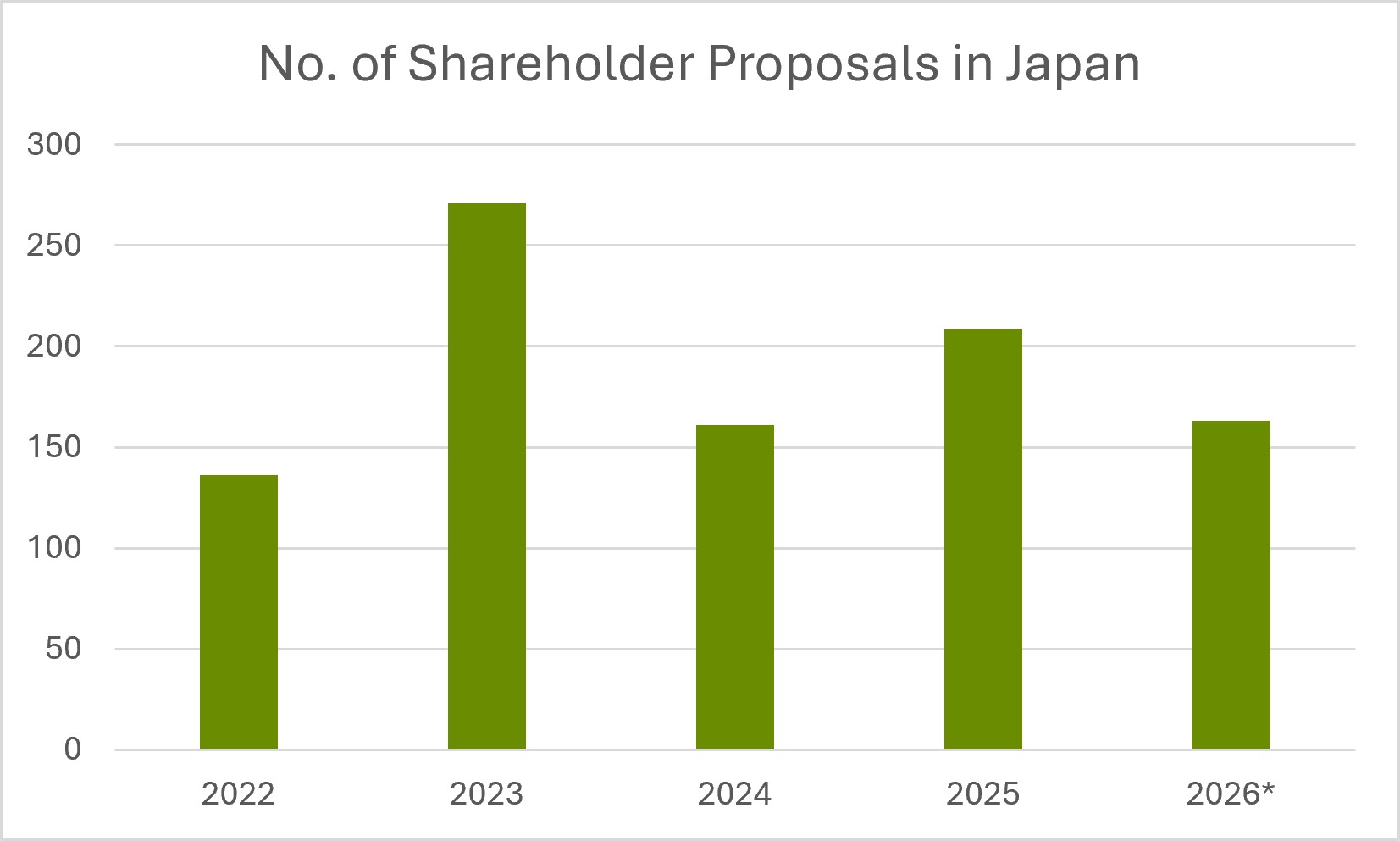
*The number of shareholder proposals for 2026 are YTD
The 2026 figure is below last year’s level, and with Japan’s peak proxy season having already passed, further increases are likely to be limited. The data suggests the proposed reforms are not primarily a response to an increase in shareholder proposal activity. Rather, policymakers appear to be more focused on concerns around meeting administration, the burden on companies and the substance of shareholder proposals.
The changes would also follow a broader trend of measures that could weaken shareholder influence. The number of Japanese companies adopting articles permitting virtual-only AGMs almost tripled between 2023 and 2025.
Extraordinary general meeting alterations
The package is also expected to tighten requirements for calling extraordinary general meetings. The current threshold of 3% of voting rights would rise to 5%, bringing Japan into line with markets such as the UK and much of Europe. However, the increase would reduce investors’ ability to convene meetings when governance concerns arise.
Other reported measures include stronger monitoring and enforcement mechanisms, alongside restrictions on shareholder proposals relating to specific business decisions such as fundraising, organisational structures and personnel matters. The LDP has also highlighted concerns about alleged coordination between activist investors and private equity firms amid rising take-private activity.
Key investor takeaways
If adopted, the reforms would represent a significant recalibration of Japanese corporate governance. Supporters argue the changes could reduce burdens on companies, but investors are likely to see them as narrowing one of the few formal mechanisms available to challenge boards and raise governance concerns through the AGM process.
For investors, the key question is whether this marks a temporary response to activism concerns or a more lasting retreat from the shareholder-centred reforms of the past decade.