
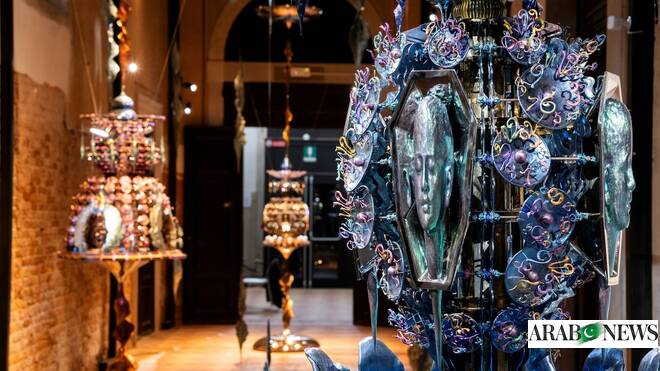
VENICE: Renowned Hong Kong artist Wallace Chan turned 70 this year. With his long salt-and-pepper beard and mischievous eyes he is still as experimental and as disciplined as ever.
“Every day is my birthday,” he told Arab News with a smile. “Every minute is my birthday, but not every second, not so fast. Not so fast. Not so fast.”

Chan has long pioneered the use of titanium, twisting it into poetic and ethereal art, transforming it from a medium most known as an industrial material.
His first dual-site exhibition, “Vessels of Other Worlds,” is now on in Shanghai and Venice.
“The dialogue between Venice and Shanghai allows these works to exist within different cultural and architectural contexts, extending their presence across space and time,” he said.

Curated by James Putnam, the exhibition introduces a striking new series, expanding both the spatial and conceptual dimensions of Chan’s practice.
In Venice the exhibition is housed within the Pieta Chapel until Oct. 18, while his work at the Long Museum in Shanghai’s West Bund arts and cultural area will be on show until Oct. 25.
The exhibition in Italy is intrinsically tied to Venice, as the three featured sculptures are inspired by the three sacred oils used in the Catholic Church for blessing rituals, known as the Olea Sancta.

A thick door drowns out the sound of splashing water and pedestrians walking outside. Within the threshold, Chan has transformed a sliver of space into a place of wandering wonder, coinciding with the 61st International Art Exhibition of La Biennale di Venezia.
The space is deeply connected sonically because of proximity to Antonio Vivaldi’s church, the Italian composer who crafted whimsical classical masterpieces during the Baroque period.
Being next door to where Vivaldi composed “The Four Seasons” in the early part of the 18th century provides a subtle soundtrack for Chan’s work.
“During our installation and also during the exhibition period the orchestra rehearsed next door starting from the afternoon. Then they have concerts at night. It always gives me goosebumps because sound is an important element in the work,” he said.

Around the three central works is a collection of suspended titanium sculptures that allude to liquid oil droplets in motion.
These fantastical forms symbolize birth, growth and rebirth and also draw inspiration from “The Garden of Earthly Delights,” the vibrant triptych oil painting created by the Northern Renaissance master Hieronymus Bosch between 1503-15.
Chan’s structure unfolds further within the Pieta Chapel, where three video screens on the altar serve as a portal to the works’ monumental counterparts on show in Shanghai.
“Water is like a moving mirror and so we always see our own reflection on the water, but it’s always twisted and that’s why we twist the faces. This is also my ideal face of the universe,” Chan said.
“To me the ideal face is that face. And it’s more or less the same face I use for every sculpture because this is not female or male. It’s not old, it’s not too young.”
The central sculpture features a physical and spiritual doorway, inviting audiences to step inside and experience its kaleidoscopic interior with separate mirrored apertures referencing Chan’s celebrated carving technique, the Wallace Cut.
His work has long been defined by a playful and proactive pursuit of passionate innovation.
The parallel exhibition opened in Shanghai on Saturday. Visitors can see the same three vessels on a dramatically larger scale, standing at seven, eight, and 10 meters high.
Reflecting on his life and work, Chan said he appreciated his mistakes.
“Every failure, every attempt, every trial in the past went into creating these new works to life,” he said.
When asked which parts of his work represented failure, he said: “All of it. All of it.”
“It is a result of countless times of failures. If there were no failures, it means I am just copying or repeating the past.”
Chan said that he constantly took inspiration from the great Italian sculptor and painter Michelangelo.
“To look at Michelangelo’s works again, I came to realize that Michelangelo found the light,” he said.
“When light traveled on the surface, he captured that. So Michelangelo saw things in relation to light and shadows. I am even more inspired by him now than when I came across his work the first time.
“The creative process is about constantly training oneself, one’s mind, one’s heart. And to the extent that the material becomes me and I become the material. It’s all one again,” he said.
“It is also my philosophy that no matter how you are found or how the world might try to change or pressure you, you must try to be grounded and find calmness inside.
“I am also calm outside. Figuring out how to get yourself to that sort of calmness and stillness is huge power.”