
On an unseasonably hot day in September 2004 I travelled sixty-five kilometres northeast from Delhi to Meerut, a city in western Uttar Pradesh. Weaving between bullock carts and rickshaws, the bus took me on two-hour journey past sugarcane processing factories and English-medium private schools. I was returning to Meerut College, an affiliate of Chaudhry Charan Singh University — with its quarter of a million students — where I had spent many months in 1996 researching education and social change.
Arriving eight years after my first trip, I was a little nervous about having to build relationships with a new set of students. But my fears quickly dropped away: many of the students I’d met in 1996 were still there, living in the same hostel rooms.
In the intervening years I had married, got a job and bought a house. Meanwhile, several students told me, their lives had effectively stood still. Unable to find secure employment, they had simply remained in university, collected degrees and applied in vain for government jobs.
Their experience reflected the changing makeup of the Indian economy. Technology companies were hiring, but their growth was not translating into jobs more widely. The public sector needed to pick up the slack, but pitifully few government jobs were available. Often, many thousands of young people applied for a single position. The young men — for they were mainly men — had limited sense of the structural nature of their disadvantage. They felt the failure personally, which helped explain the lack of social mobilisation.
But lively cultures of unemployment existed at an everyday level. Young men described themselves as “waiting,” or “just doing timepass.” “Timepass” was the term they used to evoke their boredom, detachment from the world, and sense of being left behind. They spent long periods literally “passing time” at tea stalls, hostels, and street corners around the city.
But they also used the term humorously. “What are you doing?,” I’d ask. “Nothing,” came the reply. “Really, nothing?” “Timepass” was the answer, at which point they would break into laughter.
The idea of being engaged in “timepass” — of waiting, seemingly endlessly, for work — served as a type of “intimate culture,” in the anthropologist Michal Herzfeld’s terms. It gave a set of insiders a sense of identity, often founded on humour, that would be embarrassing if exposed to outsiders.
As my fieldwork continued, I learnt that timepass was not simply “nothing.” While doing timepass, young men hung out with people who didn’t share their caste or religion. I often saw Hindus with their arms draped around the shoulders of Muslim friends, or high castes fraternising with low castes in ways that were not common in their rural homes. Timepass provided the space for a distinctive masculine subculture that broke down some social boundaries.
When my book on the topic, Timepass: Youth, Class and the Politics of Waiting, was published in 2010, I hoped I had accurately captured the stories of young people at that point in time. But I imagined the book would slowly fade into irrelevance as times changed. After all, India seemed to be moving fast — as does the traffic from Delhi to Meerut, a journey that now takes about fifty minutes in the SUVs and other recent-model cars that stream along a new six-lane highway.
But Timepass has become more relevant in the 2010s and 2020s. The Indian economy’s strength, as measured by GDP growth since the mid-2000s, has failed to translate into graduate-level jobs. More than 350 million of the country’s people are aged between fifteen and twenty-nine, and the rapid growth of education and the accelerating entry of women into the labour force is dramatically increasing jobseeker numbers. One recent study estimated that four in every ten young graduates across India are unemployed.
As one of my PhD researchers, Avishek Jha, has recently written — drawing on new research in Meerut — a mass industry of coaching institutes and commercial workspaces called “libraries” has emerged. “Timepass” is no longer the common term, but many young people still see themselves as people “in wait”: in a state of constant “preparation” (taiyaari) for government jobs.
The Indian government’s encouragement for young people to create their own jobs has paid some dividends, producing some vibrant start-up cultures, especially in the south of the country, and a substantial domestic market for innovation. But a gap remains between images of India’s progress and Gen Z’s reality, especially in the north.
Despite decades of ground-level frustration among young people, widely based political movements have been rare. The youth- and student-led Naxalbari mobilisation of the 1960s was confined to West Bengal, and the Jayaprakash (“JP”) Narayan movement of 1974–79 — with large numbers of students and unemployed young people protesting and striking over joblessness, inflation and the perceived breakdown of effective governance — focused on the state of Bihar.
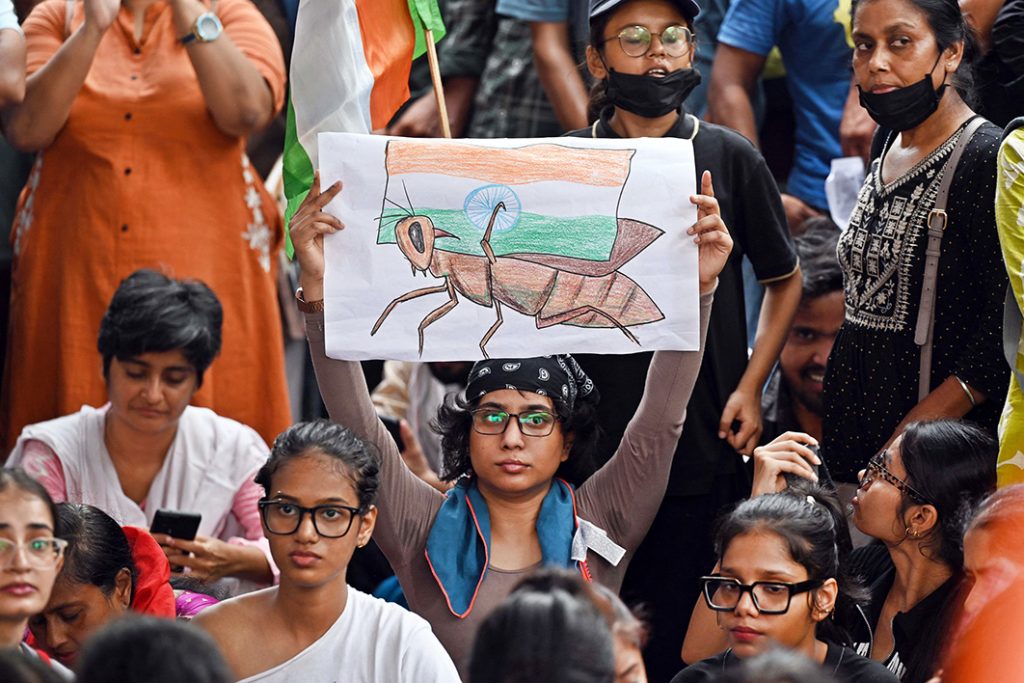
Only in May this year did the beginnings of a national movement finally emerge, with the formation of a movement focused on unemployment and government malpractice. Its eye-catching name, the Cockroach Janata Party, or CJP, was a satirical reference to chief justice Surya Kant’s labelling of unemployed young people as cockroaches. Although Kant clarified that his comment was aimed only at young people with fake degrees, Gen Z picked up the term and ran with it.
Like the participants in the JP Movement in Bihar, members of this new movement are motivated by their opposition to a system that holds out a tantalising measure of hope (a government job) but leaves most people frustrated. Unemployed young people in such situations are like the figures in cartoons who run over a cliff edge and remain hanging in free air until the moment they look down. As the French sociologist Pierre Bourdieu put it, their hopes continue upward, carried by their own inertia.
By highlighting feelings of stigma, frustration and even shame, common in my discussions with unemployed young men, the chief justice’s reference to cockroaches played a key part in spurring young people to action.
Tellingly, one of the immediate causes of the CJP’s formation was the revelation in May that government medical examination papers had been leaked. It’s hard to imagine an incident more aggravating for many young Indian people: the top educational and government exam system is already stacked against young people who expend vast amounts of money and time in the glass bead game of getting a job. The leak added insult to injury.
The CJP has gained more than twenty-two million Instagram followers and has held small-scale demonstrations in India’s metropolitan areas and a few smaller cities. While it is largely an urban phenomenon, it has made inroads into rural areas via social media. And it seems to be gathering steam: the CJP is planning a march to the Indian parliament next week, bringing together students, their parents, and various political leaders and activists, to demand reforms to India’s education system.
The party is unlikely to make rapid inroads in formal politics, at least in the short term. Its main significance is to bring to national and international attention the youth subcultures — now extending to young women — that I studied in the mid-2000s and have since been boosted by social media. The CJP and related mobilisations provide a language for young people to share their sense of disappointment and create connections across lines of social difference, just as the notion of timepass did twenty years earlier. Also like timepass, the cockroach movement contains the in-jokes and elements of self-parody that Herzfeld associates with intimate cultures, and these now circulate widely on social media.
Whether the CJP and the broader associated movement will catalyse medium-term change is a moot point. It is possible to imagine three scenarios. In the first, the CJP grows in popularity and encourages broader mobilisation, perhaps leading to the emergence of a charismatic leader who becomes a political force. India may then take its place among countries including Nepal, Bangladesh and Sri Lanka where Gen Z protests have led to major change.
In a second scenario, the CJP fades from view — having temporarily shone a light on youth unemployment and cultures of exam preparation — and timepass continues to operate largely under the radar.
There is also a third possibility, wherein the dent to the ruling regime is real but no well-organised opposition emerges to galvanise disgruntled young people.
One thing is for certain, unemployment is not a problem that will go away in the late 2020s. “Cockroach young people,” like their real insect equivalents, will remain as a defining feature of modern India. •