
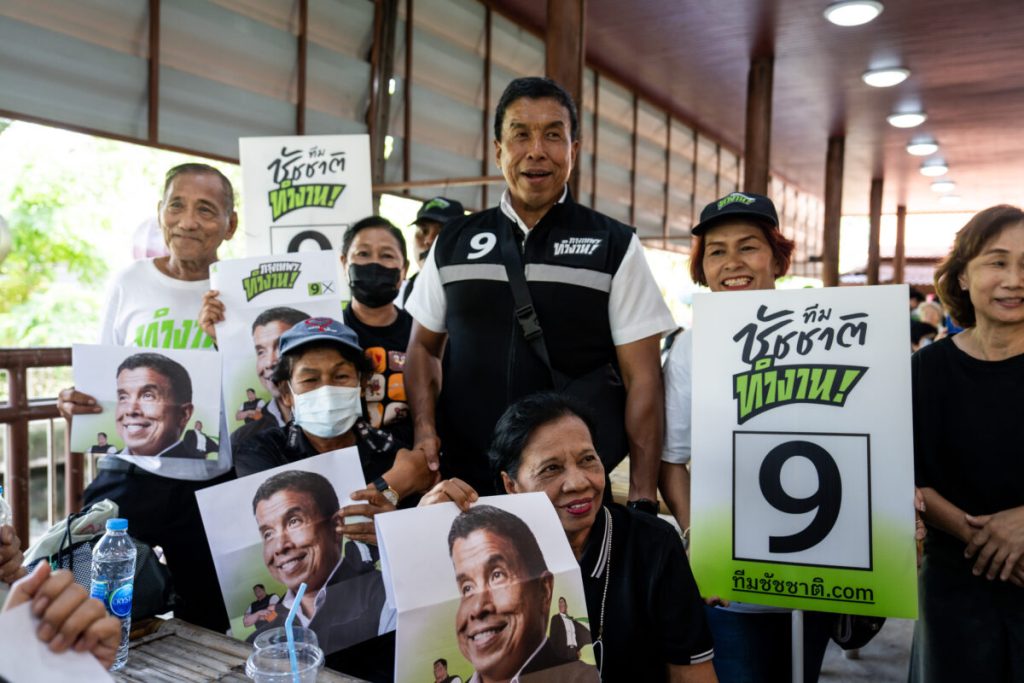
Four months after Thai Prime Minister Anutin Charnvirakul rode a nationalistic wave to a resounding general election victory, the 28 June 2026 Bangkok gubernatorial election saw independent incumbent candidate Chadchart Sittipunt win a second term. Chadchart’s victory was sweeping, with 67.9 per cent of the vote — the highest vote share recorded by any Bangkok governor. Bangkok’s mayoral contest has long run on a logic of its own and this year was no different.
Bhumjaithai — Anutin’s conservative party that now leads the national government — did not field a candidate in the gubernatorial election nor did it hold a single seat among Bangkok’s 33 parliamentary constituencies in the February 2026 national election. And the progressive People’s Party, which swept all 33 of those constituencies, did not fare any better.
This raises doubts about whether Thai Prime Minister Anutin Charnvirakul’s government has built the groundwork for a sustainable conservative coalition, or whether it remains a mere patchwork held together by nationalist opportunism and pre-election bargaining.
Anutin became Prime Minister in September 2025 not through an election but through a deal with the progressive People’s Party, in exchange for a promise to dissolve parliament and pursue constitutional reform. These reforms were voted down by his own members of parliament, yet Anutin dissolved parliament regardless in December 2025 following border clashes with Cambodia. This conflict handed him a different script — Anutin portrayed himself as a firm defender of Thai sovereignty and upon this nationalist ground, Bhumjaithai took 191 seats in the 8 February 2026 snap election.
While Anutin’s prime ministerial victory relied on party machinery and ideology, Chadchart’s gubernatorial win rested on delivery. His first term focused on improving municipal services like drainage, footpaths and rubbish collection, alleviating daily frictions felt by Bangkok’s residents. His campaign was built upon this track record, which remained firm despite the ‘Agong regime’ accusation which dominated local coverage and claimed that a shadow network within Chadchart’s first term extracted payments totalling four million baht (US$120,000) for district director appointments.
This pattern of Bangkok voters grading candidates by what they have done, not what they say, also explains the People’s Party’s defeat. Its candidate Chaiwat Sathawornwichit carried Bangkok’s largest party bloc into the race, yet that brand was no substitute for Chadchart’s governing record. Chaiwat finished a distant third with about 8 per cent of the vote.
Yet Chaiwat’s defeat does not necessarily indicate that reformist support for the People’s Party has waned in the months since the February national election. The second-place hawkish independent candidate Mallika Boonmeetrakool Mahasuk captured only around 13 per cent of the vote, which was too modest to signal a consolidated conservative bloc. The results instead point to the importance of Chadchart’s personal draw, which will say little about national conservative or reformist alignments unless he enters national politics.
Mallika’s votes most likely came from former conservative Palang Pracharath and Democrat Party supporters, not new converts. But these votes do not necessarily translate into support for Anutin’s conservative coalition, especially since Anucha Burapachaisri — Anutin’s childhood classmate who had run on Bhumjaithai’s party list in February before switching to the Democrats for the gubernatorial race — finished fourth with under five per cent.
If proximity to Anutin explained conservative performance in Bangkok, Anucha — not Mallika — should have fared better. Mallika’s result speaks more to the durability of an existing Democrat-aligned bloc than to the reach of Anutin’s mandate.
Chadchart’s victory looks less like an ideological swing against reform and more like split-ticket voting, with Bangkok residents backing the People’s Party’s brand while rewarding individual records in races that hinge on a single name. The People’s Party won all 33 of Bangkok’s parliamentary constituencies in the February 2026 national election but only 22 of the 50 Bangkok Metropolitan Council seats in June. The rest went mostly to incumbents and local independents, including the Democrat Party with eight seats and candidates aligned with Khon Tum Ngarm (‘Working People’), a group that campaigned on Chadchart’s branding.
On the national level, Anutin’s agenda is already being hemmed in by the bargains that built his coalition, with a charter referendum promised to the People’s Party moving slowly and any reforms touching the monarchy or the military kept off the table. His platform of subsidies, capped bills and small business support, paired with Pheu Thai’s entry into government, looks more like provincial patronage management than the enactment of a conservative doctrine. Yet patronage is not necessarily a liability, as deeply rooted local networks were precisely what carried many winning Bangkok metropolitan councillors to victory, regardless of party.
While Anutin’s nationalist mandate delivered a sweeping victory for Bhumjaithai in the February 2026 general election and the People’s Party’s reformist mandate swept every constituency in Bangkok, neither translated into success in the capital’s gubernatorial contest. The winners and losers of Bangkok’s gubernatorial race were determined more by whether candidates possessed a personal record that voters could see — a bar that even the People’s Party’s national brand could not clear.
If Bangkok’s voters keep favouring demonstrated performance over rhetoric, both conservative and reformist camps may come to realise that political agendas alone are insufficient guarantors of success in the capital’s gubernatorial elections.
Ladawan Khaikham is Assistant Professor of Political Science and Public Administration at Kasetsart University, Bangkok.