
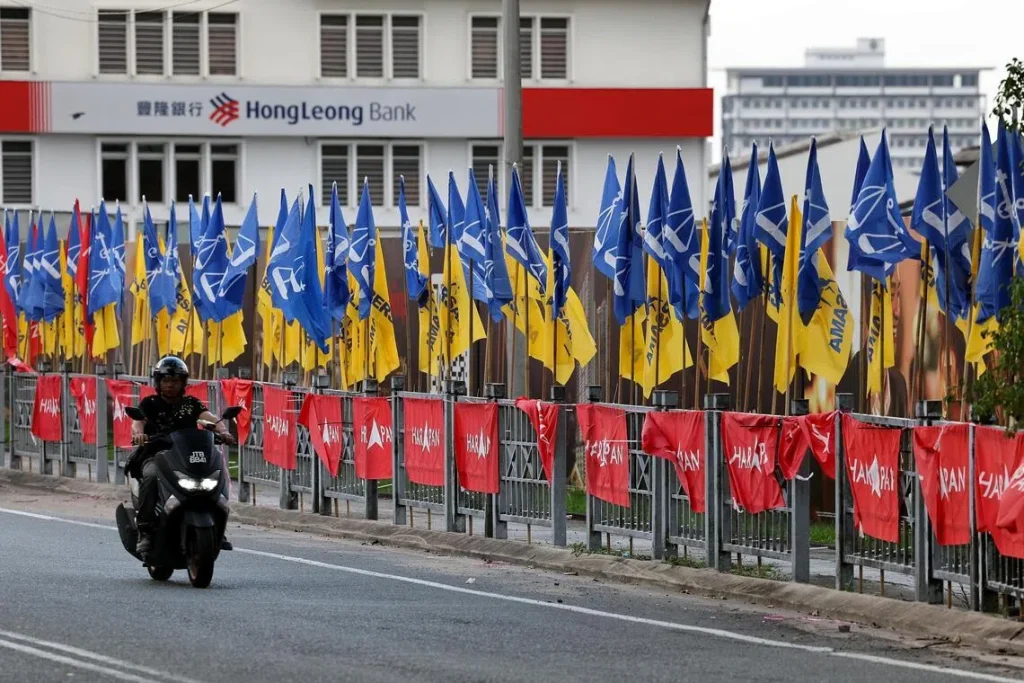
If the lead-up to the July 11 Johor polls lacks the pulsating mood of recent Malaysian elections, it might be because the script feels largely pre-written.
A late surprise is always possible, of course. For now, though, there is little reason to doubt the pundits’ view that, most likely, the status quo will hold.
That means the Barisan Nasional (BN) alliance, with its linchpin Umno, will remain the southern state’s dominant force, leaving Prime Minister Anwar Ibrahim’s Pakatan Harapan (PH) to play second fiddle at the state level.
Most of the campaign themes, too, seem familiar from previous polls. There are, for instance, questions about the Johor royalty’s influence in politics, about BN’s continued lobbying for its jailed former leader Najib Razak to be pardoned, and about the sentiment of Chinese voters.
But look beyond this familiar chatter and there is a compelling, if little discussed, trend worth scrutinising: the fraying partnership between some of Malaysia’s 13 states and the federal government, and whether the country’s splintered politics can sustain a fiscal model in which Putrajaya holds most of the purse strings.
To be clear, this has been building since the 2018 polls, which exposed the fragmentation of Malaysian politics in a big way. In the aftermath of that vote, state and federal polls have often been decoupled, with different coalitions leading at the two levels and making their own calls on when to seek a fresh mandate. This Johor vote, which will be held well ahead of the state assembly’s expiry in April 2027, is a case in point.
The result is that state leaders have more room, and more incentive, to campaign against Putrajaya.
Johor’s grievance
The friction between Putrajaya and the states comes down largely to how national revenue is carved up, or fiscal federalism.
Johor’s grievance is the loudest, if only because it has been aired relentlessly throughout the ongoing election campaign. In short, the state’s case is that it deserves more. Its economic clout is growing, it is contributing ever more to the national kitty, and this momentum will only intensify as the Johor-Singapore Special Economic Zone moves fully into gear.
There is acknowledgement that wealth redistribution is par for the course, a necessary means of promoting balanced national development.
But Johor’s point, to borrow the framing of its Regent, Tunku Ismail Sultan Ibrahim, on a June 21 podcast, is that the current formula is far too skewed against it.
BN politicians, including caretaker Menteri Besar Onn Hafiz Ghazi, have echoed this view, pointing out that poorer states which contribute less to the national coffers get more back from the centre on a per capita basis.
Johor is by no means alone. Penang, another of the country’s economic powerhouses, has also complained of being “shortchanged” and called for an urgent review of revenue-sharing.
That this issue is rearing its head so sharply ought to worry Malaysians. Federalism has been the glue holding this country together since independence. Without a more balanced revenue settlement, the compact risks turning increasingly rancorous, stoking a politics of envy in which each state asks why it should get less, pay more or wait longer than the next.
Liew Chin Tong, the deputy finance minister and an Anwar ally, noted in a July 6 commentary that an “adversarial federalism” was taking root in the country.
Heart of the dispute
At the heart of the dispute in Malaysia is how its fiscal federalism works. It is the centre that holds almost all the revenue-raising power. The states’ most substantial source of independent income is land-related, leaving them heavily reliant on transfers from the federal government.
A report by the Institute for Democracy and Economic Affairs (IDEAS), released in June 2026, notes that states receive funding across 15 types of transfers, along with special grants for some. It is the size and fairness of these transfers that are now in contention.
In Johor’s case, it is not so clear-cut that the state’s grievance is simply political haymaking ahead of the polls, as some say, or that Anwar’s defensive volleys on behalf of the federal government can settle the matter. Both positions mask the fullness of the problem.
Johor has asked that 25 per cent of the annual tax revenue collected in the state – which it estimates at between RM20 billion (S$6.3 billion) and RM30 billion – be returned, so that it can independently fund projects it considers important. That would be a leap from the roughly RM2.6 billion it says it now receives.
Chief among these projects is an elevated autonomous rapid transit (E-ART) system, seen as an urgent necessity to move the expected surge of commuters in Johor Bahru once the Rapid Transit System Link to Singapore opens.
The federal government, through Anwar, has countered that Johor contributed an average of RM14 billion annually to federal coffers between 2023 and 2025, and received RM16 billion in return through various projects, operating allocations and programmes. He said earlier that every state received higher allocations under his administration, despite differences in tax contributions.
The discrepancy in figures notwithstanding, the argument really ought to return to first principles.
At its most basic level, Johor’s public demand for a steep increase in federal transfers, in one fell swoop and for itself only, goes too far. The state already receives one of the largest allocations in absolute terms, and to press for more in this manner threatens to upend a fiscal model that has, despite its flaws, sustained the federation thus far. Once one state cuts its own deal, every other will want the same.
Even if this is political rhetoric by BN against PH – nominal governing partners at the federal level, though the signs of fraying suggest that arrangement may not hold for long – turning fiscal transfers into a campaign cudgel is unwise. The problem, in other words, is not the principle of what Johor has asked for, but its maximalism and the manner of asking.
Two-way street
That said, one has to acknowledge that Johor’s underlying demand for more resources to do more for its people is, on the face of it, sound. It does need the means to deliver.
As is the case in many federations, it is state and local authorities that are most intimately involved in delivering, financing and administering daily government services. It is they who bear the brunt of public frustration when access or quality falls short for want of resources.
Johor’s case is that its needs on this front are outgrowing its means: Data such as those by the IDEAS think-tank shows that for all that it contributes to national coffers, the state sits only around mid-table when federal transfers are measured on a per capita basis.
On the part of the federal government, whoever is in charge, an ideal approach would leave not even a shred of suspicion that it is squeezing the states simply because it can.
The Democratic Action Party (DAP), which controls the state legislature in Penang and is part of PH, knows this well: Penang’s current assertiveness arguably stems from the years before 2018, when the state had to endure federal foot-dragging over a metro link it wanted built because the BN government of then Prime Minister Najib was simply unwilling to play ball.
Johor’s current exasperation with Anwar’s PH government over its own public transport needs understandably carries echoes of this. Onn Hafiz said in June that while the E-ART proposal had been tabled to the Cabinet in 2024, no physical works had yet begun. The federal government, for its part, has said funds have been allocated.
The point, then, is that this tension over revenue-sharing is not a one-sided problem. A pushy state can be the culprit, but the federal government can be just as culpable when federalism turns adversarial.
Weakened centre
In his commentary, Liew, a senior DAP figure, suggested a new mode of thinking, in which the states and the federal administration adopt a principle of shared resources with shared responsibilities. This, he argued, could chart the course for a more constructive federalism discourse in the country.
He cited, for example, the Anwar government’s efforts since coming to power in 2022 to further devolve certain functions to Sabah and Sarawak, in keeping with the Malaysia Agreement 1963, or MA63, the founding pact under which the two Borneo states and the Peninsular Malaysia states formed the current federation.
That is perhaps a sanguine view, even an overly generous one. In the case of the two Borneo states, further devolution has to be seen as the exception rather than the rule: Their parliamentary seats matter to whoever governs in Putrajaya, giving them leverage other states can rarely match. The concessions, in that sense, may owe as much to political necessity as to fidelity to MA63.
Herein lies a catch-22. To smooth relations and chart what Liew calls a “new deal” that would appease restive states, the centre needs to be strong. But the centre is weak precisely because of the political fragmentation that has emboldened the states in the first place.
The same problem dogs the alternatives. For example, beyond redrawing the current transfer formula, which Penang and Johor have asked for, the federal government could devolve further revenue-raising powers to the states or grow the national revenue base itself, say, by reinstating the goods and services tax. Both demand political capital that is in short supply.
The bottom line is that a federal government commanding enough clout to reset the fiscal bargain on its own terms is hard to foresee any time soon.
In that milieu, the next best bet for keeping the federation from fraying is restraint on both sides. That means the states pressing their claims at the negotiating table rather than on the campaign trail, and Putrajaya treating even opposition-led states as partners to be dealt with fairly, not supplicants to be kept waiting.
Fiscal federalism was always going to be renegotiated as Malaysia’s politics fragmented. Whether it is renegotiated as a shared endeavour or fought over as spoils will decide if the glue holds.