
On June 17, U.S. President Donald Trump and Iran’s President Masoud Pezeshkian signed an interim deal to end the war, reopening the Strait of Hormuz and lifting the oil sanctions that had crippled Iran’s economy. As the Iran war moves into the final stages of negotiation, the episode has surfaced the strategic calculations of every actor drawn into it. Those calculations carry consequences well beyond the Middle East, reshaping diplomatic relationships and the terms on which governments choose to align.
For China, its Middle East strategy has now narrowed to keeping the Gulf states, and above all Saudi Arabia and the UAE, from drawing closer to Washington.
Beijing had already started reordering its priorities well before the war. In April 2025, leadership recast China’s diplomatic hierarchy at the Central Conference on Work Related to Neighboring Countries, the first gathering of its kind in 12 years. Notably, the conference moved China’s own neighborhood to the foremost place in its external strategy – by implication, placing the Middle East below it.
Now the Iran-U.S. war is forcing China to define what it wants from a part of the world that no longer sits near the top of its agenda.
The war has redrawn the Middle East’s alignment, drawing some states closer to the United States and pushing others further away. Israel sits unambiguously within the U.S. camp.
Iran, obviously, is further estranged from Washington, with little prospect of repair. Tehran and the United States will almost certainly remain at odds for the foreseeable future. For Beijing, this means that even if China commits nothing further to Tehran it can count on Iranian dependence. Tehran simply has no other potential partners of comparable weight to turn.
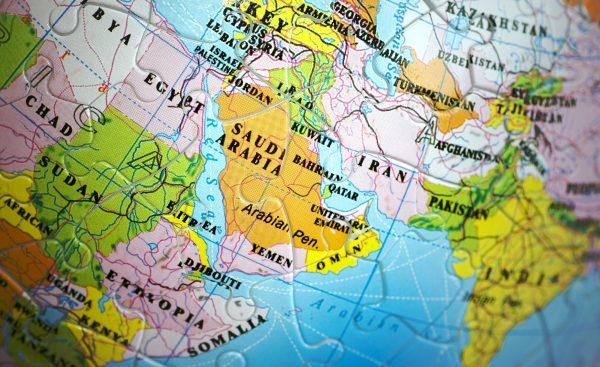
What remains unsettled is the Gulf, the set of swing states on which China’s regional position now rests. Beijing’s task in the Middle East now is to prevent the Gulf monarchies from leaning to the U.S. side, a concern that centers on the region’s two heavyweights, Saudi Arabia and the UAE.
China backs Iran in concrete ways, purchasing the overwhelming majority of Iranian oil exports and abstaining from condemning Iranian attacks on Gulf states over the course of the fighting. This year’s conflict, however, marked the outer limit of what Beijing is willing to do for Tehran. With noninterference in the affairs of other states being a stated principle of Chinese foreign policy, direct military support, or any Chinese military presence on Iranian soil, would cross thresholds Beijing has shown no intention of approaching. Iran, as noted above, has little choice but to accept that limit. China’s relationship with Iran is therefore durable and inexpensive to sustain, and it requires little further investment from Beijing.
From China’s point of view, the danger is that both Gulf heavyweights end where Israel now sits, fully inside the American system, leaving Beijing with commercial ties but little diplomatic influence. But China’s ability to prevent such an outcome will be limited by the resources it is prepared to commit.
Beijing has long sorted the world into tiers that rank its diplomatic priorities, treating relations among the major powers as the decisive arena, the neighboring and periphery countries as the priority, the developing world as the foundation, and multilateral institutions as the stage on which influence is performed.
The April 2025 Central Conference moved China’s immediate neighborhood to the top of that order, displacing major power diplomacy, and Xi Jinping described the periphery as the foremost consideration in managing China’s overall diplomatic situation. The official message indicates that China’s neighborhood now stands above every other theater, and it will absorb the bulk of Beijing’s diplomatic attention and resources.
The Middle East, by contrast, falls within the third priority category. The region is valuable to China as a source of energy and a market for its goods, but it is not an arena where Beijing intends to spend the same amount of political and military capital it is concentrating closer to home. That ordering draws the lines to China’s Gulf strategy.
Beijing is neither willing nor able to match the security guarantees the United States extends to its partners in the region, and it has no intention of trying. Its aim in the Gulf is correspondingly modest: to hold its position at low cost and to keep the major Arab states from sliding fully into the U.S. camp, where the option of working with China would disappear.
Of the two Gulf heavyweights, the UAE has moved furthest away from China – and toward the United States. Over the course of the war, it watched U.S.-supplied systems intercept hundreds of ballistic missiles and thousands of drones aimed at its territory. The lesson Abu Dhabi drew is that only Washington can guarantee its defense. Anwar Gargash, diplomatic adviser to the UAE president, put it plainly in April, calling the United States the country’s “main security partner” and pledging to “double down” on the relationship.
Saudi Arabia presents the more open case for China. In March 2023, Beijing brokered the restoration of diplomatic relations between Saudi Arabia and Iran, establishing itself as the only external power able to hold open lines to both governments at once. China supported the diplomacy that produced the June settlement, with Iran’s foreign minister openly acknowledging Beijing for its active role in reaching the Iran-U.S. agreement. China’s capacity to shape Iranian conduct rests on economic dependence rather than force, an advantage Washington cannot match.
Saudi Arabia has kept itself at relative distance from both powers. It has never sought a permanent U.S. base on its territory, nor a formal defense treaty with Washington, and it has preserved greater structural distance from the U.S. security architecture than either the UAE or Bahrain. It was the first Gulf state to acquire Chinese ballistic missiles, and it remains one of only two, with Qatar, to have done so. Saudi Arabia has since conducted joint exercises with the People’s Liberation Army Navy, and it has stayed outside Pax Silica, the U.S.-led silicon supply chain initiative, and the Stargate AI buildout. That distance is the space within which Beijing is able to operate.
Abu Dhabi, on the other hand, took the other road by aligning closely with the U.S. security and AI infrastructure. The UAE has signed on to both Pax Silica and the Stargate Project. When U.S. officials made clear that G42’s Chinese partnerships were incompatible with continued access to American chips, the AI champion stripped out Huawei hardware in exchange for U.S. investment and Nvidia processors. The UAE’s alignment with the U.S. on both defense and AI constrains what it can build with China, and that pro-U.S. tilt has only hardened since the Iran war.
Since the Iran war, China’s plans to engage the region have stalled. The second China-Arab States Summit, originally scheduled for mid-June in Beijing, was postponed indefinitely amid the regional instability, and the parallel China-GCC summit has slipped with it. The platforms on which Beijing intended to consolidate its position have fallen away as a byproduct of the war. With the region’s alignments in flux, China only has a narrow window to read what Riyadh and Abu Dhabi want before their choices set.
It is apparent that the postwar Middle East sees Iran bound to China and Israel aligned squarely with Washington. Beijing’s task at hand is to keep the space for cooperation with the Gulf from closing, and to keep Riyadh and Abu Dhabi from settling onto the U.S. side before the question is decided for good.
Beijing is not trying to win the Gulf states so much as to prevent them from passing a point of no return, where the major Arab states have moved entirely into the U.S. camp and diplomatic cooperation with China is severely constrained With its attention and resources fixed on its own neighborhood, China is not prepared to afford anything more ambitious.