
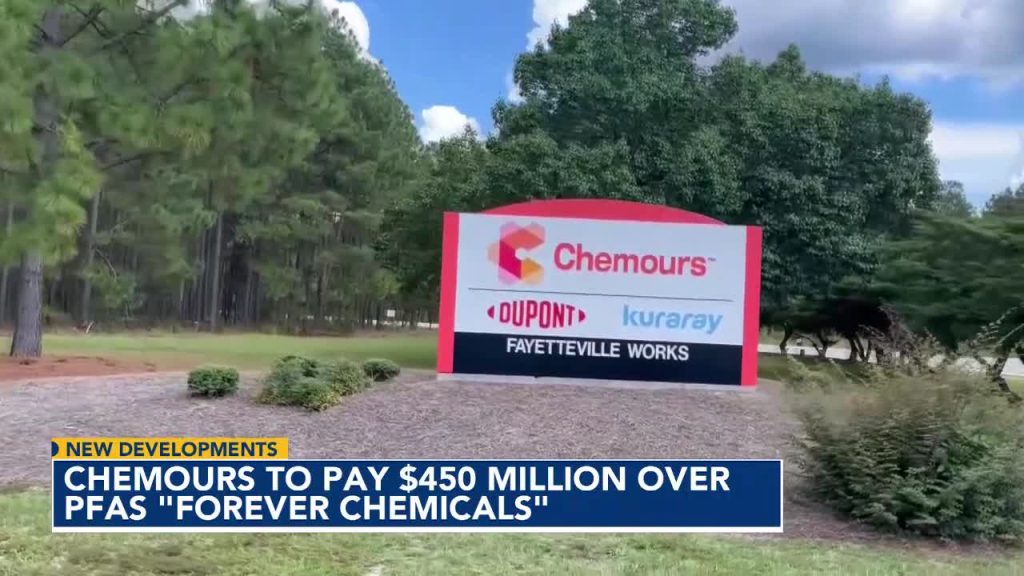
WASHINGTON (AP) — The Trump administration on Wednesday reached a multi-state settlement with chemical giant Chemours Co. over years-long, illegal discharges of synthetic “forever chemicals” used to make products resistant to water, grease and stains. The settlement is the first by the federal government to resolve enforcement claims against a manufacturer of harmful chemicals known as PFAS.
For North Carolina, where Chemours’ Fayetteville Works facility became the center of the state’s GenX contamination crisis, the announcement immediately drew criticism from state leaders and environmental groups who questioned whether the agreement creates meaningful new protections for communities along the Cape Fear River.
Under the agreement, filed in federal court in West Virginia, Chemours will pay a civil penalty of $22.5 million for alleged violations and spend $90 million over 15 years to mitigate PFAS discharges in three states: West Virginia, North Carolina and New Jersey.
Chemours, a spin-off of chemical maker DuPont, also agreed to install PFAS pollution controls for and surface water discharges and air emissions at a West Virginia facility at an estimated cost of $60 million, supply clean drinking water to communities near its West Virginia and New Jersey sites at an estimated cost of $280 million; and implement controls to reduce releases of PFAS and other toxic chemicals from its facility in North Carolina, based on a pending independent assessment.
Combined, the penalties and relief programs are estimated to cost at least $450 million, the Justice Department said.
The settlement allows Chemours to continue manufacturing PFAS for commercial and military applications while preventing future contamination and protecting communities from existing pollution, said Adam Gustafson, principal deputy assistant Attorney General for the Environment and Natural Resources Division.
Justice Department says settlement protects public health
“The Trump administration recognizes the important role of Chemours for it commercial and military obligations,” Gustafson said in an interview. “The settlement protects public health while preserving that important balance.”
The settlement against a major PFAS manufacturer “delivers on the Trump administration’s promise to make polluters pay and stop PFAS contamination at the source,” said Jeffrey Hall, assistant EPA administrator for enforcement and compliance assurance.
The agreement will greatly reduce PFAS contamination of water, land and air and even begin to mitigate past harm, Hall said. “This settlement brings Chemours into compliance with the law and holds it fully accountable,” he said.
In a statement Wednesday, Chemours said it has already begun planning and implementing operational improvements at its facilities and will take steps to mitigate future emissions and enhance existing programs.
“This settlement provides Chemours with greater clarity on future compliance requirements and actions to support long-term responsible manufacturing,” spokeswoman Jess Loizeaux said.
In response to questions from WRAL, Chemours said EPA considered operational improvements already implemented at Fayetteville Works over the past decade when negotiating the agreement.
The company said the North Carolina facility will hire an EPA-approved third-party auditor to review certain manufacturing processes and determine whether additional controls are needed to further reduce emissions. Chemours said it would then submit a response plan to EPA for approval.
Chemours also said Fayetteville Works will be required to capture 99.5% of GenX emissions, including HFPO-DA byproduct emissions, and said prior investments in emissions control technologies position the site to meet that requirement.
The settlement comes as the Trump administration is expected to propose softening Biden-era limits on “forever chemicals” in drinking water, while delaying but keeping tough standards for two common types of the substance.
Chemours did not directly answer WRAL’s questions about whether the agreement creates any new drinking water protections for North Carolina communities, how much new spending would occur in North Carolina, or what obligations are new compared with existing requirements.
The proposal will start the formal process of rolling back parts of the first-ever limits on PFAS in drinking water finalized during former President Joe Biden’s administration. Officials at the time found they increased the risk of cardiovascular disease, certain cancers and babies being born with low birth weight.
The agency is committed to addressing Per- and Polyfluoroalkyl substances (PFAS) in drinking water while following the law and ensuring that regulatory compliance is achievable for drinking water systems, EPA Administrator Lee Zeldin said.
Chemours discharged PFAS into rivers in three states
The settlement determined that facilities Chemours operates in the three states have discharged PFAS into the Ohio River, Cape Fear River and Delaware River, respectively, in violation of permits required by the Clean Water Act and state laws. Chemours also violated legal requirements under the federal Toxic Substances Control Act at all three facilities.
As a result of the alleged violations, people living near the facilities were exposed to illegal PFAS, officials said. PFAS are widely used and found around the world, with scientific studies showing that exposure to some PFAS in the environment may be linked to harmful health effects in humans and animals.
The violations continued for over a decade, the Justice Department said. The facilities were previously owned for many decades by DuPont. The settlement announced Wednesday does not resolve DuPont’s liability for past PFAS violations, officials said.
A federal judge last year ordered Chemours to stop discharging unlawful levels of cancer-causing chemicals into the Ohio River from the company’s Washington Works plant in West Virginia. The pollutants endanger the environment, aquatic life and human health, U.S. District Judge Joseph Goodwin wrote in the August 2025 order.
The West Virginia Rivers Coalition had asked Goodwin to require the company to immediately comply with its permit limits after violating them for more than five years.
DuPont, Chemours and another company, Corteva, agreed to pay New Jersey up to $2 billion last year to settle environmental claims stemming from PFAS. The federal settlement does not affect the state case.
North Carolina AG blasts settlement
North Carolina Attorney General Jeff Jackson called the settlement “an insult to the people of eastern North Carolina.”
His state is “ground zero for GenX contamination, but this deal does practically nothing to clean up our water,” said Jackson, a Democrat. GenX is a trade name for a synthetic chemical developed as an alternative to PFAS but which has raised significant health and environmental concerns in its own right.
In an interview with WRAL, Jackson said North Carolina plans to continue pursuing its own case against Chemours focused on groundwater contamination and said the federal settlement does not resolve the state’s claims.
“The EPA may have given up on holding people accountable for groundwater contamination, but as attorney general, I have not,” Jackson told WRAL. “We have our own case and we’re going to continue to press that case.”
Jackson also criticized the settlement’s value to North Carolina.
“The headline number here from the EPA is La La Land,” Jackson told WRAL. “It has no connection whatsoever to North Carolina and what we actually stand to receive as a result of this deal is either nothing or practically nothing.”
Gov. Josh Stein also denounced the agreement and said North Carolina is not guaranteed meaningful cleanup or drinking water relief under the proposed terms. Stein’s office said state officials were not consulted during negotiations.
“Chemours made this mess, and Chemours should clean it up,” Jackson said in a statement.
The federal consent decree calls for 14 specific treatment systems to reduce PFAS in wastewater, stormwater and groundwater from the West Virginia plant. Chemours will test drinking water near the West Virginia and New Jersey sites and provide treated or alternative clean water.
Environmental groups also questioned whether the settlement would result in meaningful changes for North Carolina.
Jean Zhuang, senior attorney at the Southern Environmental Law Center, told WRAL the agreement appears unlikely to create additional concrete protections for communities in the Cape Fear region.
“Not much in this agreement appears to change conditions for North Carolina communities,” Zhuang said. “The requirements look relatively easy for Chemours to meet in North Carolina, and compliance is likely to be a cakewalk.”
North Carolina already has a separate 2019 consent order with Chemours requiring reductions in PFAS emissions, filtration and replacement drinking water in some cases, reductions in contamination reaching the Cape Fear River and broader contamination controls at Fayetteville Works. State regulators continue enforcing that agreement.