
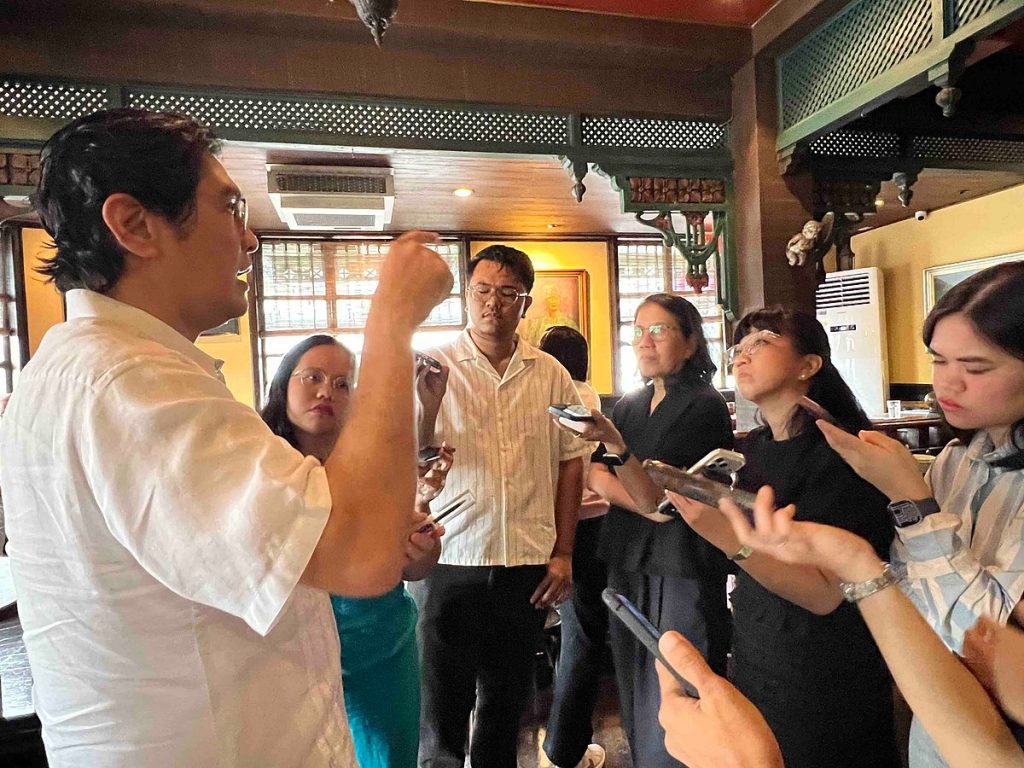
“I don’t know why they (DTI) have not yet implemented it. As to whether it will be mandatory, the DTI is yet to decide,” AISC President Ronald Magsajo, who also chairs the South East Asia Iron and Steel Institute (SEAISI), said during a media briefing in Manila on Wednesday.
Magsajo said the DTI has the authority to expedite implementation through a memorandum circular, particularly when public safety is at stake.
His call comes in the wake of the magnitude 7.8 earthquake that struck General Santos City and Sarangani on 8 June, killing more than 60 people and injuring over 100 others.
The standards in question refer to Philippine National Standard (PNS) 49:2026, which was approved in May. Developed by the Bureau of Philippine Standards’ Technical Committee 11, the updated standard aligns local rebar specifications with the National Structural Code of the Philippines and international seismic design requirements.
According to Magsajo, the revised standard eliminates low-yield, non-seismic grades of reinforcing bars that are unsuitable for use in earthquake-prone areas.
He cited data from the Philippine Institute of Volcanology and Seismology (PHIVOLCS), which estimates that about 13 percent of Metro Manila’s residential and commercial buildings could collapse in the event of the so-called “Big One.”
Induction furnace concerns
Magsajo also renewed calls to prohibit the use of induction furnace (IF) technology in producing construction-grade steel.
China banned IF-produced construction steel in 2017 due to product quality and environmental concerns, resulting in the shutdown of an estimated 120 million to 150 million metric tons of steelmaking capacity. Much of the decommissioned equipment was later exported to other countries, including members of ASEAN.
An induction furnace is an electrically powered furnace that melts metal through electromagnetic induction and joule heating.
The AISC first warned ASEAN governments in 2018 about the risks posed by the migration of obsolete IF equipment into the region. It repeated the appeal in 2021, but Magsajo said governments largely failed to act.
“Last year, in the aftermath of the earthquake that struck Myanmar and Thailand, which brought down a government building under construction, and a subsequent quake in Johor, Malaysia, a region not prone to earthquakes, the AISC formed a task force to examine the safety of steel used in the region,” Magsajo said.
The task force concluded that the absence of primary refining in IF operations prevents the effective removal of impurities from recycled steel scrap, resulting in reinforcing bars that may not be suitable for critical structural applications.
China, Indonesia, Thailand, Singapore and Malaysia have already banned the use of IF technology for producing construction-grade steel.
In the Philippines, local ordinances banning IF operations were passed in San Simon, Pampanga, and Sta. Maria, Bulacan, but Magsajo said these measures have yet to be fully enforced.
“The new standard aligns with our National Structural Code and specifies that only seismic-grade rebars are to be manufactured and sold in the country. This higher grade is unattainable using IF,” he said.
“Unfortunately, the updated standard has yet to be mandated, nor is there any indication of a target date for implementation,” he added.
Magsajo estimated that around 30 firms nationwide continue to operate induction furnace facilities. — Raffy Ayeng