
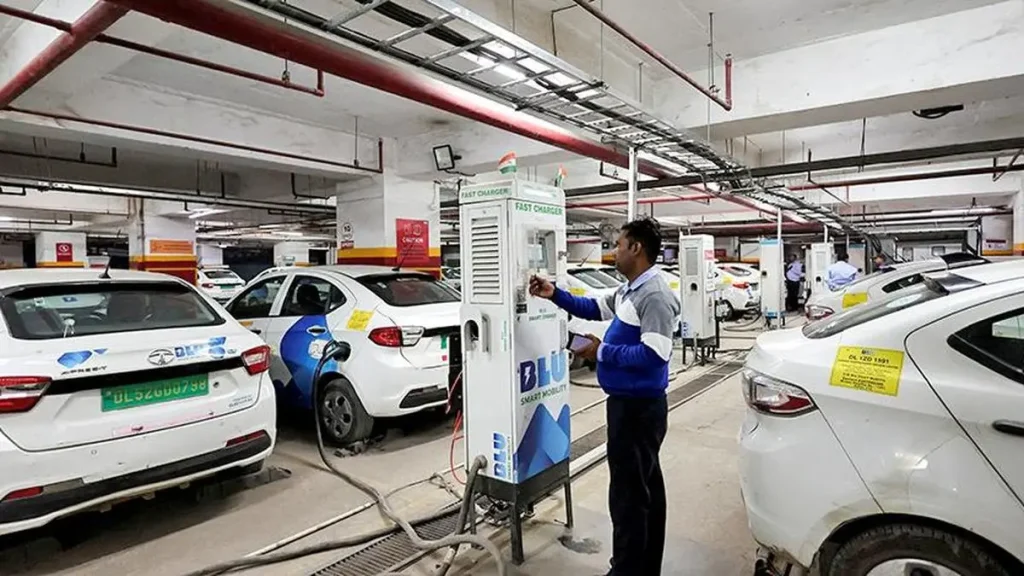

Delhi currently has over 10,000 charging points, and EV charging load has surged nearly nine times, from 24 MW in 2018-19 to over 227 MW today
| Photo Credit:
ANUSHREE FADNAVIS
The Delhi Government recently released its Draft Delhi Electric Vehicle (EV) Policy 2026. This draft comes on the back of the Delhi EV Policy 2020, which has been extended since August 2023, when it expired. The current draft is the third version of the policy since 2025, the earlier two versions did not reach the public domain. At first blush, the draft presents an ambitious statement of intent, by proposing aggressive phase-out mandates to ban new internal combustion engine (ICE) two-wheelers from April 2028, mandating only electric three-wheeler registrations from January 2027, and electrifying government fleets entirely. To nudge individual owners towards EV transition, the policy proposes a cascading set of purchase incentives for two-wheelers, three-wheelers and goods vehicles, alongside scrappage bonuses that extend to private car buyers as well. This intent is backed by a budgetary outlay of nearly ₹3,954 crore.
Behind the headline mandate lies a challenge that the policy largely sidesteps. Delhi does not yet have the infrastructure to charge the vehicles it is asking its residents to buy. Delhi currently has over 10,000 charging points, and EV charging load has surged nearly nine times, from 24 MW in 2018-19 to over 227 MW today. Some projections suggest that if Delhi were to convert its entire vehicle fleet to EVs, the city’s annual incremental electricity demand would approach 26,000-28,000 GWh. This will effectively amount to adding another Delhi to the grid in terms of electricity consumption. Modelling estimates suggest that on peak demand days, even under optimistic managed-charging scenarios, this transition would add between 1,500 and 5,000 MW of additional demand on a grid whose all-time peak has been 8,656 MW. Managing this surge in demand will need infrastructure augmentation.
Nodal agency
In this context, the designation of Delhi Transco Ltd (DTL) as the nodal agency for planning and coordinating public EV charging and battery swapping infrastructure is perhaps the right move. It is beyond doubt that the current transmission and distribution infrastructure design cannot absorb the load that simultaneous charging of EVs will put on the system. To make EV transition a reality, thousands of transformers will need to be upgraded or replaced, new feeder lines will have to be set up, and existing lines will have to be reinforced. Whether that can be realistically achieved in the four-year window of this policy cycle remains anybody’s guess. If it must be done, the policy is silent on how it proposes to achieve that, whether in terms of planning or funding.
A fair few interventions will be required at the policy level to achieve this. EV charging will have to be managed in a way that the charging load remains staggered through the day and does not disproportionately add to the peak demand. This will have to be done through dynamic time-of-use electricity pricing that incentivises charging during off-peak hours.
There is also the question of land, perhaps the most underestimated constraint in Delhi’s EV infrastructure story. Public charging stations need physical space, and in one of the most densely built cities in the world, space does not come easily. To begin with, the draft policy does direct urban local bodies and other land-owning agencies to periodically identify suitable land parcels for deployment of public EV charging and battery swapping infrastructure. However, allocation of public space comes with its own challenges, of encroachment, building bye-laws, and constraints of local political economy. On top of that there is the issue of pricing. If public auction of land becomes the default mode, the public will pay the price through high charging fee. The exercise must be truly done in a public-private partnership mode, where the land is either made available at nominal cost or the civic agencies are paid through revenue share rather than upfront payment.
Building bye-laws too will have to catch up. A significant share of Delhi’s future EV charging will happen not at public stations but at homes, housing societies, and commercial premises. The bye-laws will have to mandate EV-ready electrical infrastructure not only in new construction, but also in the retrofitting of existing buildings. Commercial buildings, malls, multiplexes, and office complexes will also have to be brought under a similar mandatory EV-ready parking norm. For existing buildings, a simplified procedure for obtaining separate EV metered connections may have to be introduced through the two discoms.
For the policy to be effective, it needs to address the structural challenges in the power sector and urban infrastructure. Purchase incentives, registration bans, and scrappage bonuses, are the sweeteners, but the real nourishment will come when grid is ready, land is available where it is needed, and buildings are wired for the future. Until these foundations are in place, the policy mandate will only remain aspirational.
Tripathi is the Managing Partner of Sarthak Advocates and Solicitors, and Senger is a Counsel at same firm
Published on June 24, 2026