
Development has become the defining language of our age. We celebrate it in kilometers of highways completed, bridges inaugurated, tunnels excavated and projects delivered ahead of schedule. Progress is increasingly measured through numbers: more extraction, more construction, more growth.
Yet beneath this arithmetic of advancement lies a question that modern societies are often reluctant to confront: how much is enough?
This is not a philosophical diversion from the business of development. It is a practical question, perhaps one of the most important of our time. Civilizations rarely decline because they lack ambition or technical capability. More often, they encounter difficulty when ambition outpaces restraint, when the capacity to transform landscapes exceeds the willingness to recognize their limits. The challenge before us is not whether to develop, but how to do so without undermining the very systems upon which development depends.
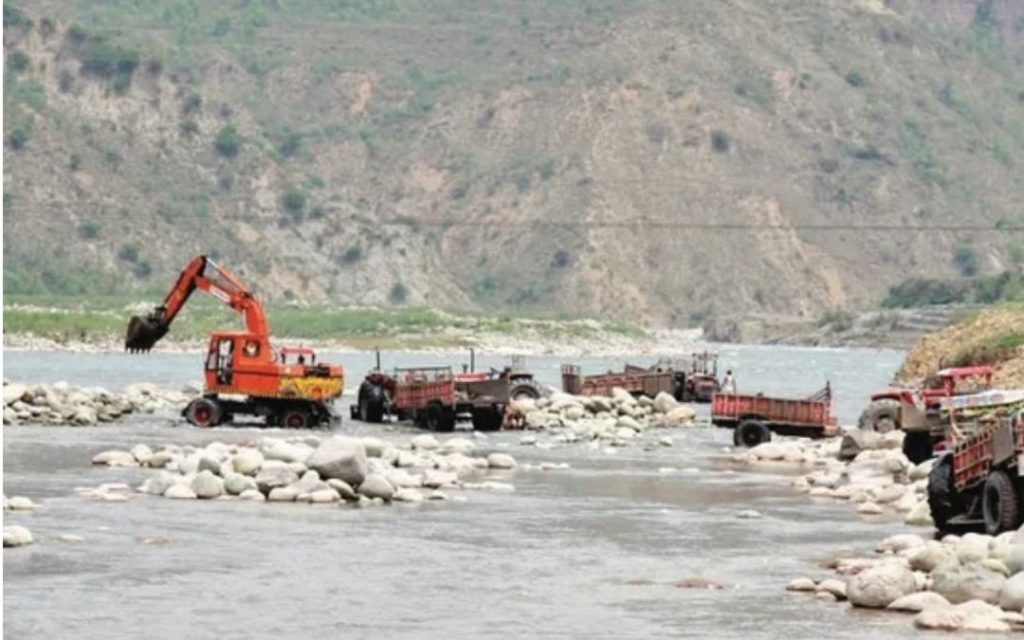
The debate surrounding riverbed mining offers a revealing illustration. Whenever concerns are raised about the scale of extraction from rivers, an immediate objection follows. If not riverbed material, then what? Roads must be built, bridges must stand, homes must rise and economies must continue to grow. These concerns are legitimate. No serious argument against indiscriminate extraction is an argument against development itself.
What deserves closer examination is the assumption that natural systems exist primarily as repositories of material, available for withdrawal whenever demand requires. The more fundamental question is not where construction aggregates will come from, but how nature creates, moves and replenishes them, and what happens when human intervention begins to exceed the capacity of those systems to recover.
To understand this, one must look beyond individual projects and consider the Earth as an interconnected whole. Mountains are often viewed as huge masses of stone that are only there to be excavated and transformed into various forms of infrastructure. Geologically, however, mountains are not inert stockpiles of material. They are structural elements of the planet, maintained through a delicate balance of forces operating over immense timescales.
Their elevation is sustained because they possess deep geological roots. These roots exist as part of a process known as isostatic equilibrium, whereby the Earth’s crust effectively floats upon a softer mantle beneath it. This balance is not theoretical; it is one of the foundational principles of modern geophysics.
When large quantities of material are removed from mountain systems without sufficient regard for geological constraints, the consequences are rarely confined to the extraction site. Slopes become less stable. Drainage patterns shift. Landslides become more frequent. Rivers receive increased sediment loads. Such outcomes are often described as isolated environmental problems, when in reality they represent the Earth’s response to disturbance.
At the same time, it is important to recognize that erosion itself is not abnormal. Mountains are shaped by erosion, and paradoxically, they continue to rise because they erode. As material is removed from the surface, the crust becomes lighter and gradually uplifts to restore equilibrium. This continuous interaction between uplift and erosion has sculpted mountain landscapes for millions of years.
The material carried away by this process does not vanish. It enters another cycle. What we call sediment is simply mountain mass in motion.
Modern discussions often treat sediment as waste or surplus. Nature does not.
Transported through streams and rivers, deposited across floodplains and eventually carried towards deltas and coastlines, sediment performs functions that are indispensable to the health of river systems. It stabilizes channels, supports riverbanks, replenishes agricultural soils and helps maintain the dynamic balance that allows rivers to function.
A useful analogy may be found in the human body. Blood must circulate continuously to sustain life, but both deficiency and excess can create serious problems. Sediment behaves in a similar manner. Its movement is not incidental to river health; it is fundamental to it.
Like the water cycle, the sediment cycle operates through a continuous sequence of uplift, erosion, transport and deposition. The difference lies only in timescale. Water moves through landscapes over days, months and seasons. Sediment moves over decades, centuries and sometimes longer.
Yet its slower pace does not diminish its importance.
This distinction becomes critical when riverbeds are mined beyond their natural rate of replenishment. In such circumstances, extraction is no longer the removal of excess material. It becomes an interruption of an active geological process.
The consequences often emerge gradually. River channels deepen. Groundwater levels decline. Bridge foundations become vulnerable. Riverbanks erode. Flood behavior changes in ways that are difficult to predict and even more difficult to reverse. What appears efficient in the present can quietly create instability that only becomes visible years later.
None of this implies that development should cease or that human intervention in natural systems can be avoided. Every society modifies its environment. Every road, tunnel, dam and settlement leaves an imprint upon the landscape. The relevant question is not whether disturbance should occur, but how much disturbance a system can absorb before its behavior fundamentally changes.
This is where the distinction between quarrying and riverbed mining becomes important.
Neither is free of environmental cost. Yet they are not equivalent forms of intervention. A quarry generally affects a defined and finite area. Its impacts can be assessed, monitored and, at least partially, mitigated through regulation and rehabilitation. A river, by contrast, is a living system in motion. Disturbances introduced at one location can propagate downstream, affecting ecosystems, infrastructure and communities far removed from the point of extraction.
The alternative to excessive riverbed mining is therefore not the search for a single substitute material. It is the adoption of a more disciplined approach to resource use: reducing unnecessary demand through better design, extending the lifespan of infrastructure, reusing excavated material from construction projects, expanding the use of manufactured aggregates where feasible and permitting quarrying only within scientifically established limits.
Such measures do not impede development. They strengthen it.
Development operates according to the same principle.
The difficulty, however, lies in society’s relationship with the idea of limits. Limits are often perceived as obstacles to progress when, in reality, they are frequently what make progress possible. We accept speed limits because unrestricted speed increases the risk of catastrophe. Medicines save lives only when administered within prescribed dosages. A person at risk of diabetes does not avoid sugar because sweetness is harmful, but because excess is.
The notion of “enough” should not be mistaken for stagnation. It is simply an acknowledgement that every system possesses thresholds beyond which stability begins to erode. The Earth is finite.
This is neither an ideological statement nor an environmental slogan. It is a physical fact.
When natural systems are repeatedly pushed beyond their capacity to recover, they do not return unchanged. Rivers alter their course. Slopes become unstable. Productive land is gradually lost. The planet endures, but the conditions upon which human prosperity depends become increasingly
fragile.
There is a growing tendency to assume that technology can repair whatever damage follows from excessive intervention. Such confidence mistakes technical capability for ecological immunity. Engineering remains one of humanity’s greatest achievements, but engineering without humility risks becoming calculation without foresight.
The defining achievement of this century may not be the tallest structure, the longest tunnel or the fastest highway. It may be our ability to align development with the processes that sustain the
landscapes on which development depends.
The debate over riverbed mining is therefore not a debate about stopping growth. It is a debate about recognizing boundaries.
The question, “How much is enough?” is not intended to obstruct progress. It is intended to preserve it.
For development that ignores limits does not secure the future. It mortgages it. And unlike financial debt, ecological debt cannot be restructured, refinanced or written off. It is ultimately paid by the generations that inherit the consequences.
Er. Mohiuddin Akhoon is an M. Tech (Geotechnical Engineering), IIT Delhi and Chief Engineer (Rtd.). Currently he is Sr. Consulting Geotechnical Engineer and RSE with Saptagon Asia Pvt Ltd.