
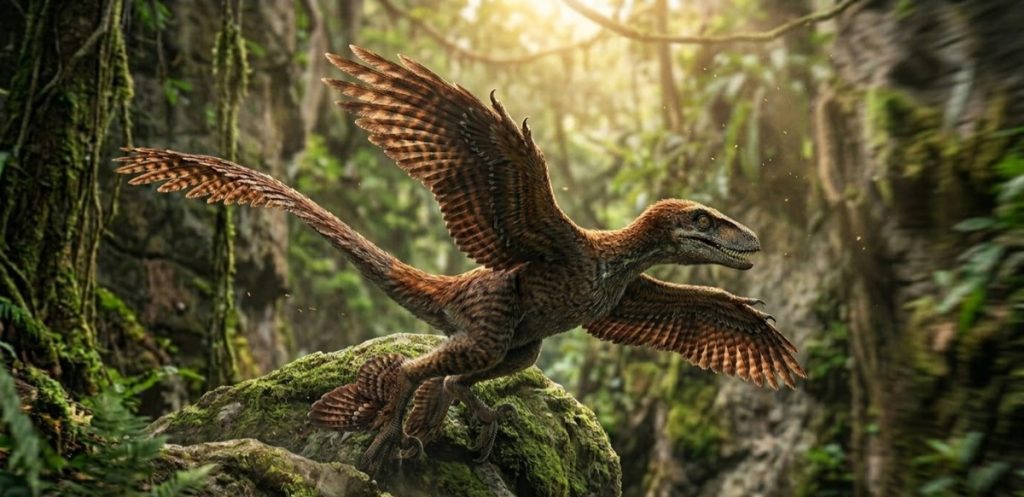
The exceptionally well-preserved fossil, unearthed in Liaoning Province in north-east China, retains clear imprints of extensive plumage surrounding its skeleton.
The recent study in Vertebrata PalAsiatica reveals that this dinosaur is the only known pennaraptoran – a group closely related to modern birds – to have developed both large foot feathers and notably long, fan-shaped tail feathers simultaneously. Its tail had about 16 feathers, resembling a peacock’s plumage.
The research team has classified the new species as a dromaeosaurid theropod dinosaur, indicating it is closely related to Velociraptor and Microraptor.
Scientists observed that this unique morphological combination – large forelimb wing feathers paired with well-developed foot and tail feathers – has not been seen in any other known dinosaur. This rare characteristic serves as a vital “golden key” to unlock the mystery of the evolution of dinosaur flight and to uncover the origins of modern birds.
Team leader Xu Xing, an academician of the Chinese Academy of Sciences, officially named the species Changzhousaurus sinensis. The name honours Changzhou, a city in Jiangsu Province in eastern China, for its enduring efforts to integrate dinosaur science popularisation with cultural tourism.
Previously, Qazinform News Agency reported that scientists in Thailand had identified a new species of giant dinosaur that lived around 120 million years ago, marking a major breakthrough in Southeast Asian palaeontology.