
On June 12, Indian External Affairs Minister S. Jaishankar phoned U.S. Secretary of State Marco Rubio to register a “strong protest” about the killing of three Indian seafarers by U.S. strikes in the Gulf of Oman on June 9. The sailors were aboard the Palau-flagged tanker Settebello, which the United States said “violated the ongoing blockade” on Iranian-linked shipping.
With the United States and Iran signing a peace deal this week, it seems likely that the diplomatic fractures between Washington and New Delhi will outlast the Iran war.
Rubio’s public response to Jaishankar was remarkably unyielding. Asserting that U.S. forces “will continue to take all necessary measures to enforce maritime security and counter hostile threats in the region,” Rubio offered neither apology nor regret for the deaths. He made no commitment to adjust the rules of engagement and didn’t provide assurance to India, a strategic partner of the United States, that such an incident wouldn’t be repeated in the future.
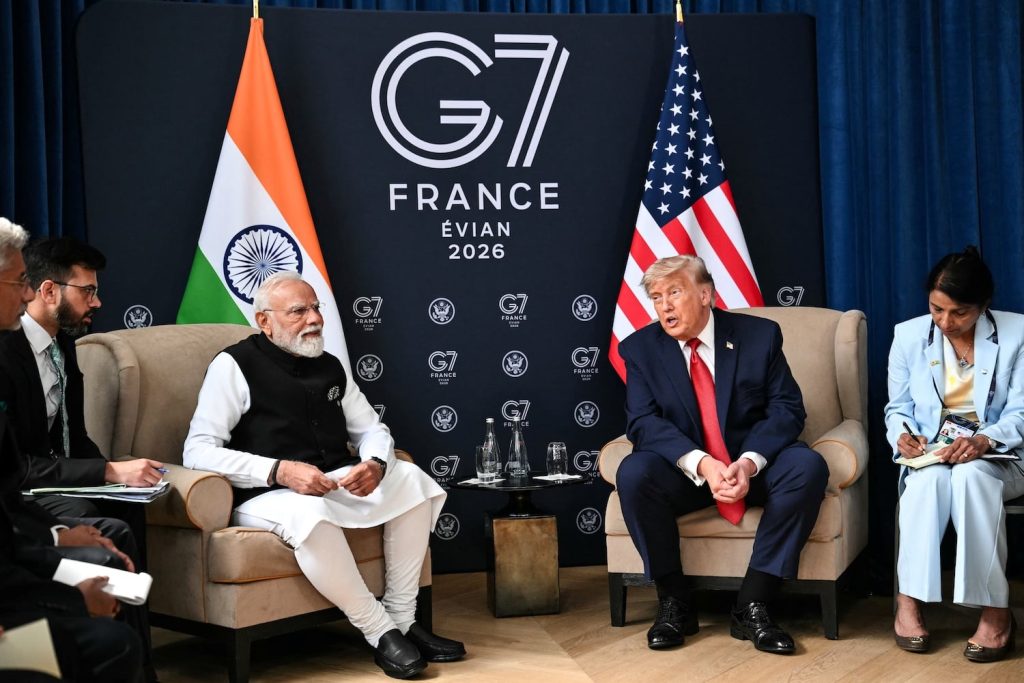
The diplomatic friction came as Indian Prime Minister Narendra Modi publicly thanked U.S. President Donald Trump for offering Modi congratulations about becoming India’s longest-serving premier—and as the two sides finalized preparations for a bilateral meeting between the leaders on the sidelines of the G-7 summit in France this week.
When asked about the deaths of the Indian sailors after the two leaders met on Wednesday, Trump replied, “We love all of those people.” He praised Modi but made no substantive announcements on bilateral ties and sidestepped a question about the Quadrilateral Security Dialogue, or the Quad.
Such dissonance seems to define India-U.S. affairs today. Beneath the pretenses of a rock-solid partnership, the strategic trust between New Delhi and Washington has suffered a rupture. Rubio’s trip to India in May showed that while Washington projects nonchalance, New Delhi is navigating an environment where it sees its strategic autonomy as constrained by its most important Western partner.
Two primary factors underscore the deterioration in these ties since the Iran war began, which won’t be undone when the war ends. The first is the destabilizing economic crisis that the conflict unleashed within India. The second is the political cost that Modi now faces after staking his reputation on partnership with the Trump administration.
There is an incompatibility in the two countries’ strategic goals that may persist after Trump’s second term.
In India, the economic consequences of the Iran war have been immediate and structural. The country imports nearly 89 percent of its domestic oil consumption, making it uniquely vulnerable to disruptions to global supplies. When crude oil prices spiked, it fueled high domestic inflation and undermined the purchasing power of the Indian public. The disruptions to the Strait of Hormuz also left India with an acute deficit in imported fertilizers and cooking gas.
This energy and supply shock was compounded by a decline in remittances from Indian expats working in the Middle East, where instability has also disrupted local economies. As these inflows diminished, India’s export sectors faced contraction due to rising insurance premiums for maritime freight and disrupted supply chains. Two years ago, Indian officials boasted of the country soon becoming the world’s third-largest economy; now, it has fallen to sixth place.
The crisis made the Indian rupee the worst-performing currency in Asia, triggering substantial capital flight. Foreign investors have withdrawn record volumes of capital from Indian equities and debt markets, seeking safer assets in places such as Taiwan and South Korea. This economic downturn comes alongside an expanding fiscal deficit, constraining the government’s ability to engage in public capital expenditure or provide relief to the affected sectors.
The economic architecture that India hoped would project its national power has instead become highly vulnerable to shocks generated by the Trump administration’s unilateral decision-making.
The war in Iran has also created political liabilities for Modi, whose authority rests on showing India’s strength. The strikes that killed the Indian sailors brought the human cost of the conflict directly to the public. This latest loss of life was preceded by an incident where the United States torpedoed an Iranian vessel off the Indian coast—directly challenging the idea that India functions as a net security provider in the Indian Ocean region.
India’s failure to protect its citizens or secure its immediate maritime area exposed a gap between its strategic rhetoric and its capabilities. This has led to a visible domestic setback for Modi, who has built his brand on the assertion that India is a rising global power.
Another aspect of the crisis, of course, is the shifting balance of power in South Asia. For nearly a decade, Modi has pursued a policy of diplomatic isolation of Pakistan, characterizing the country as a state sponsor of terrorism and an insignificant regional player. But the Trump administration has validated Pakistan by utilizing its channels to negotiate with Iran, rendering it indispensable to the U.S. exit strategy.
Islamabad served as a critical, discreet backchannel for U.S. proposals when direct talks were politically untenable. And on June 14, Pakistani Prime Minister Shehbaz Sharif was the first to announce the preliminary peace deal. For India, this represents a significant reversal in the region, as its primary adversary has successfully converted a U.S. military operation into an opportunity for a diplomatic turnaround.
To understand how New Delhi is approaching this transformed relationship with Washington, one must look closely at Rubio’s recent visit to India. The trip highlighted the growing disconnect between optics projected by both sides and the substance of their engagement. India treated Rubio’s visit as an effort to stabilize ties after deep strain, while the United States dismissed any notion that such restoration was needed.
During his public appearances in India, Rubio insisted that bilateral relations remained stable, rather than acknowledging the visible fractures caused by recent U.S. policy. He offered Modi an invitation to visit the White House. Indian officials, meanwhile, responded with a form of defensive diplomacy that signaled some dissatisfaction without provoking a diplomatic breach.
Indian readouts conspicuously ignored Rubio’s public invitation to Modi. When Rubio announced an ambitious target requiring India to purchase $500 billion worth of U.S. goods in the next five years, New Delhi maintained a calculated silence. (If implemented, this massive purchasing mandate would convert India’s historical trade surplus with the United States into a structural trade deficit.)
The substantive outcomes of Rubio’s visit were limited; it yielded only one formal agreement concerning critical minerals cooperation that replicated existing frameworks under the Indo-Pacific Quad, as well as Washington’s “Pax Silica” initiative. The glue of the Indo-Pacific has come unstuck because the strategic logic that underpinned the partnership has eroded. This shift means that the region is no longer governed by a unified strategic framework but by disconnected national interests.
Trump’s approach to the Quad has increasingly pivoted away from a grand vision of an alliance directed at China to a more transactional model. The grouping hosted a foreign ministers’ meeting during Rubio’s trip, doing away with a leaders’ summit. In another sign of the declining importance of the Indo-Pacific, on June 16, the U.S. Defense Department reverted to the name “Pacific Command” for its combatant command in the region, which had previously been called the Indo-Pacific Command.
Still, the bureaucratic and military momentum between the United States and India is too massive to completely stall, anchored by the Initiative on Critical and Emerging Technology (iCET) and deep defense cooperation. They conduct joint military exercises, work on initiatives such as the Indo-Pacific Maritime Surveillance Collaboration, and share information on the maritime domain awareness in the Indian Ocean region. India also remains a buyer of U.S. defense platforms.
But if the trust gap remains, then these areas will likely be constrained. The iCET and defense industrial cooperation will move at a slower pace, limited by U.S. export restrictions and technology transfer barriers. The Trump administration will prioritize domestic industries and impose stricter conditions on technology sharing, and India will need to diversify suppliers or develop indigenous capabilities.
The U.S. shift toward protectionism and India’s heightened vulnerability have already forced India to make adjustments in its foreign policy, most notably toward China.
New Delhi has begun offering significant concessions to Beijing, altering its previous stance of firm confrontation. The Modi government has instructed domestic filmmakers to stop producing films related to the deadly Galwan Valley clash in 2020, during which 20 Indian soldiers were killed, for example. The outgoing Indian chief of defense staff recently granted Beijing a pass for providing real-time operational support to Pakistan during its military clash with India last year.
These actions can be viewed as temporary measures intended to seek an immediate thaw with China, but they are establishing a new normal in bilateral ties. This alignment may become institutionalized enough that a future U.S. administration might find it difficult to reengage with India as a viable strategic counterweight to China.
The United States was once India’s most trusted strategic partner, but that trust has eroded—even if Washington pretends otherwise. India’s leadership hopes to keep the relationship functional and escape Trump’s second term with minimal damage, but this assumes a stability that does not exist in international relations today. A more realistic strategy would set explicit limits on cooperation until the United States restores true reciprocity and respects India’s core interests.
What if the current disruption is not an aberration linked to a single presidency, but rather a permanent structural shift in U.S. behavior, driven by domestic political constraints?
In the long term, Indian policymakers must recognize that the material conditions underlying the partnership with the United States have fundamentally changed. Polite diplomatic signaling and the quiet management of domestic media cannot mask the fact that the illusion of an unshakable partnership has left India in a more exposed position in a volatile international system.
Ultimately, India’s resilience will depend not on waiting out a single U.S. presidency, but on building its domestic strength and diversifying its options in a fracturing world.