
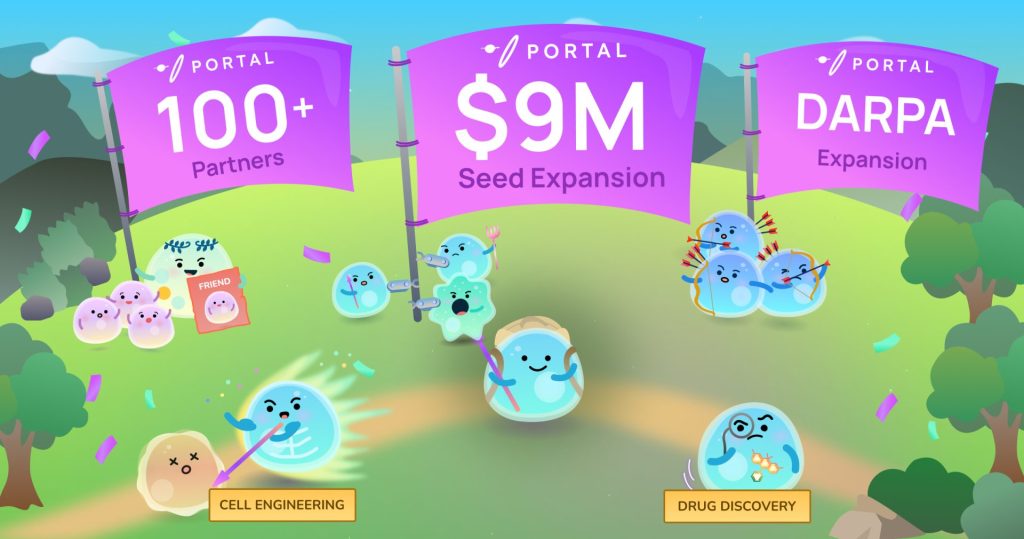

Portal Biotechnologies has closed an oversubscribed $9 million financing round led by NFX, as the cell engineering company expands commercial adoption of its platform across pharmaceutical companies, research institutions and cell therapy developers.
The round included participation from existing investors IA Ventures, Pear VC, Undeterred Ventures, IKJ Capital and TechU Ventures. The funding will support the continued commercialization of Portal’s cell engineering technology and accelerate growth across drug discovery, artificial intelligence-driven biology research and next-generation cell therapies.
Founded to address one of biotechnology’s most persistent challenges—efficiently delivering molecules into cells without compromising cellular function—Portal has developed a proprietary mechanoporation platform capable of introducing RNA, gene editors, probes and other molecular payloads into hard-to-transfect cells at scale.
The company is positioning its technology as foundational infrastructure for a growing range of applications across the life sciences industry, from target discovery and biological data generation to cell therapy manufacturing.
“Portal is achieving what very few biotech platforms manage in their first three years: meaningful commercial revenue, technical validation from the world’s largest companies, and a genuinely game-changing vision,” said Omri Amirav-Drory, Ph.D., general partner at NFX Bio. “With an elegant, scalable engineering platform, Portal is perfectly positioned to underpin future drug discovery, TechBio, and cell therapy ecosystems.”
The financing follows a period of significant commercial momentum for the company. Portal said its technology has now been adopted across more than 100 customer sites, including many of the world’s largest pharmaceutical companies, biotechnology firms and leading academic research centers.
A key area of growth has been drug discovery, where researchers are using the platform to conduct high-throughput screening and target validation experiments that have historically been difficult to perform with conventional delivery technologies. According to the company, scientists at organizations including Merck, AbbVie and Purdue University have presented research utilizing Portal’s technology for applications such as screening impermeable degraders, peptide-based molecules and novel target-engagement assays.
The company also reported that multiple pharmaceutical customers have upgraded to its Galaxy-i™ high-throughput platform since its launch earlier this year.
Another strategic focus is supporting the growing intersection of artificial intelligence and biology. As AI models increasingly depend on large, high-quality biological datasets, researchers are seeking tools capable of generating complex cellular data at scale.
Portal said the Ragon Institute of Harvard, MIT and Mass General Brigham, together with Microsoft, have committed to a two-year initiative using the platform to generate training data and map immune responses. Additional collaborations involving multi-perturbation screening workflows are also underway.
The company believes demand for these capabilities will continue to increase as AI-driven drug discovery programs require larger and more sophisticated datasets to improve model performance and predictive accuracy.
Portal is also expanding its presence in the cell therapy market, where developers are exploring new approaches to engineer immune cells more efficiently and flexibly than traditional viral or electroporation-based methods allow.
The company’s work in this area has attracted support from the U.S. Defense Advanced Research Projects Agency (DARPA), which recently expanded an initial $8 million contract focused on developing a portable device capable of producing cell therapies at the point of care. DARPA is now supporting commercialization efforts through its Expedited Enablement Initiative program.
In addition, researchers at Mass General Brigham recently presented data at the American Society of Gene and Cell Therapy conference demonstrating the use of Portal’s platform for same-day production of multifunctional CAR-T therapies using circular RNA technology.
“Portal unlocks many biology applications far beyond what has been feasible with existing technologies,” said Armon Sharei, Ph.D., founder and chief executive officer of Portal. “We’re excited to work with frontier partners to unlock new possibilities in cell engineering, drug discovery, and AI data generation.”
With fresh capital, expanding commercial adoption and growing validation from pharmaceutical, academic and government partners, Portal is strengthening its position in the rapidly evolving cell engineering market. As demand increases for scalable tools that enable advanced drug discovery, AI-driven biological research and next-generation therapies, the company is aiming to establish its mechanoporation platform as a foundational technology across the broader biotechnology ecosystem.