
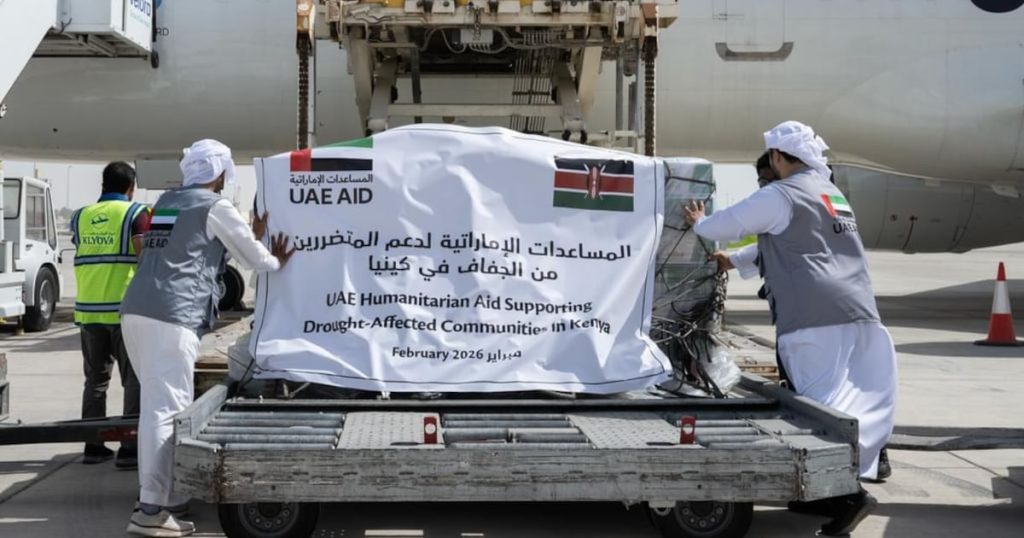
The UAE is exploring plans to establish an early warning hub to help humanitarian organisations respond rapidly to crises around the globe before they escalate.
A feasibility study is under way for the Humanitarian Aid Predictive Centre, which would use AI and advanced forecasting tools to bolster relief efforts.
The proposal was under discussion at the Humanitarian Aid Predictive Landscape Roundtable in Abu Dhabi, organised by the Office of Development Affairs at the Presidential Court.
The round-table brought together humanitarian organisations, aid agencies, philanthropic foundations and forecasting experts to explore how data, AI and predictive tools could help humanitarian actors move from reacting to disasters to acting before they become emergencies.
Efforts to harness advanced technology in relief operations come as humanitarian challenges mount and emergency support funding is slashed around the world. For the UAE, the goal is not only to improve the delivery of aid but also to mitigate the impact of crises through proactive measures.
Rashed Al Hemeiri, executive director of Strategic Planning at the UAE Aid Agency, said the country’s strengths in logistics, artificial intelligence, philanthropy and international partnerships positions it well to contribute to preventive humanitarian action.
“The biggest challenge is that we will not be able to prevent man-made disasters,” he said.
Using technology for good
Simon Winter, who leads food systems work under the Rockefeller Foundation’s Build the Shared Future initiative, said technology could become increasingly important as aid organisations face significant funding pressures.
Official development assistance fell by 23 per cent between 2024 and 2025, with further declines expected, he said. “We have to find ways to use more scarce resources much more efficiently,” Mr Winter said.
Mr Winter said a future humanitarian prediction centre could help expand successful projects and strengthen forecasting systems globally.
The Rockefeller Foundation is supporting pilot programmes in Haiti, Somalia and the Bangsamoro region of the Philippines that use market data, nutrition indicators and satellite imagery to identify emerging food-security risks.
One initiative uses satellite data and machine learning to monitor agricultural production and identify emerging risks to food security, helping humanitarian organisations understand where shortages may be developing.
The technology has already been used to analyse agricultural production in Sudan, helping humanitarian organisations understand where food insecurity risks may be increasing.
Focus on people, not politics
Mr Al Hemeri, said the UAE’s humanitarian assistance is guided by need rather than politics.
“The main driver, and the only driver, is humanitarian need,” Mr Al Hemeiri told The National. “We don’t politicise any foreign assistance or humanitarian action. We intervene based on need and based on our capability to deliver.”
He said the UAE’s humanitarian model is built around co-ordination between government entities, humanitarian organisations, logistics providers and private-sector partners, allowing the country to deliver aid quickly and at scale.
“There is not a single country, probably a single nation, that did not receive our foreign assistance in one way or another,” he said, referring to the UAE’s response during the Covid-19 pandemic and other international crises.
Preparing to weather the storm
Leonardo Milano, Humanitarian Affairs Officer at the UN Office for the Co-ordination of Humanitarian Affairs, said humanitarian agencies are already monitoring the potential impacts of an emerging El Nino weather pattern. “We are looking at the next three to six months to anticipate the different impacts,” Mr Milano said.
El Nino is a natural Pacific weather pattern that causes a spike in global temperatures.
The US National Oceanic and Atmospheric Administration (NOAA) said earlier this month that El Nino conditions are already under way in the tropical Pacific, with rises in sea surface temperatures having already been recorded.
He said climate change remains one of the biggest long-term concerns facing the humanitarian sector and requires governments and aid organisations to think beyond traditional emergency-response cycles.
“It’s extremely high,” he said when asked about the level of concern surrounding climate change. “We should really change our mindset and look beyond that and start working with development actors and governments to plan for these crises because it’s not something we have experienced before.”
Ebola highlights frailties
Mr Milano said the Ebola outbreak in West Africa exposed weaknesses in surveillance systems and highlighted how difficult it can be to translate forecasts into action. “What was clear was that there was no clear process for how you go from the warning to actual action on the ground,” he said.
He said studies show that every $1 spent on anticipatory action can save between $3 and $7 in response costs. Since then, humanitarian organisations have increasingly focused on anticipatory action frameworks that connect forecasts directly to pre-agreed responses. The discussions also focused on the role AI could play in improving humanitarian forecasting.