
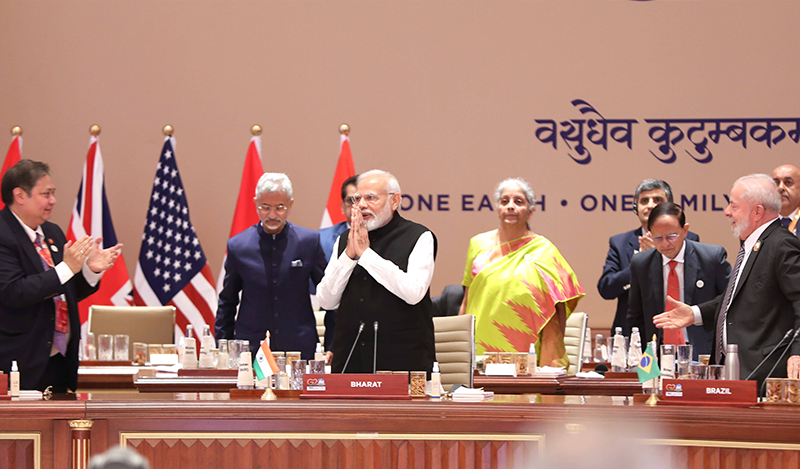
While India has always viewed itself as a paragon of international law and a proponent of strong, multilateral international organizations, this too often leads India to punch below its weight on the global stage.
On June 10, 2026, Prime Minister Narendra Modi became India’s longest serving elected Prime Minister, overtaking Prime Minister Jawaharlal Nehru for length of tenure. Historians will acknowledge how consequential both men’s legacies have been. Nehru solidified India’s democracy, a stunning achievement given how quickly other newly-independent countries from the period—most notably Pakistan—backslid into dictatorship and economic morass. Nehru also charted India into non-alignment, making it the leader of Global South for decades in the 20th century.
Modi’s achievements are as momentous. He has infused new pride into Indians and promoted their civilizational legacy. Economically, he has overcome decades of bureaucratic stagnation to ensure India has an infrastructure befitting a 21st century superpower. It is no coincidence and should be no surprise that India may soon surpass Germany as the world’s third largest economy. The caricatures of India that persisted outside the country for years today reflect racism rather than reality and reflect more on those who would lecture or dismiss India.
For too long, however, India’s power abroad has failed to match its progress at home. India’s Ministry of External Affairs remains sclerotic. Old guard officials resent and impede reforms and remain too often trapped in a Cold War mindset that favours relitigating the struggles of the 20th century over positioning India to lead in the 21st century.
Indian diplomacy certainly remains valuable as a force to raise the voice of those too often ignored on the global stage. Africans, for example, appreciate India’s support for helping the African Union join the G20. But while Africa deserves a seat, the episode also reinforces some of the problems in India’s global outlook.
Just as Arabs mock the Arab League for ineffectiveness, so too do Africans criticize the African Union for its inefficiencies. South Africa’s Cyril Ramaphosa, Nigeria’s Bola Ahmed Tinubu, Kenya’s William Ruto, and even host nation Ethiopia’s Abiy Ahmed will never subordinate their own egos and ambitions to African Union diktats.
While India has always viewed itself as a paragon of international law and a proponent of strong, multilateral international organizations, this too often leads India to punch below its weight on the global stage. Influence and conformity to international law need not be mutually exclusive but, when advocating for international law, India must recognize that the United Nations is both a legacy of the immediate post-World War II-era. The United Kingdom has a permanent Security Council seat because it still maintained an empire that included India and spanned the globe. Today, India’s population is 21 times that of the United Kingdom and its economy is now slightly larger in terms of gross domestic product, though New Delhi will likely broaden the gap over the next decade. By any objective standard, India deserves the Security Council seat, not the United Kingdom. At a minimum, the British seat should be transformed into a seat for the Commonwealth with veto power but a rotating leadership.
Debates about the power of the Security Council over the General Assembly and the composition of the Security Council are important, but India must go beyond them. For decades, Western states dominated the leadership of UN agencies such the World Food Programme, the United Nations High Commissioner for Refugees, the World Health Organization, the United Nations Educational, Scientific and Cultural Organization, and the United Nations International Children’s Emergency Fund (UNICEF). Only over the past 25 years did the People’s Republic of China begin to compete for these slots, not only for prestige but also for influence. Both during the SARS bird flu epidemic and Covid-19, Beijing leveraged its influence to institutionalize its hostility to Taiwan or prevent diplomatic embarrassment. India has held a few minor deputy director positions but deserves much more.
India’s influence should go beyond the United Nations, though. The post-World War II liberal system is in flux as revisionist states challenge the global order. Here, too, India faces a choice: It can figuratively stand on the sidelines, wring its hands and tut-tut those who violate the rules, or it can help shape the new order.
This will mean a far greater willingness to project force. Military action has historical baggage in India, especially after the 1987 Indian Peacekeeping Force in Sri Lanka. But while India participates in UN peacekeeping operations, these bring salaries and remittances but do not necessarily further specific Indian interests. While many Indians ideologically resist unilateralism, Indians should consider if they do not lead, China might fill the gap and how that could undermine India’s broader agenda and interests. This might mean, in the future, Indian peacekeeping forces in Bangladesh or Myanmar.
While India has begun setting a broader footprint in the Indian Ocean Basin, it should be more forthcoming regarding non-UN deployments overseas. Seven countries, including China and the United States, have bases in Djibouti; India might consider nearby Somaliland, where the United Arab Emirates and Israel use the Berbera airfield. U.S. Marines maintain a small base in Darwin, Australia, precisely because it is out-of-range of Chinese aircraft. India might consider doing likewise on a bilateral basis, even if the Quad is not a military alliance.
The multilateral Exercises Malabar and Pacific Reach are important for Indian Navy interoperability with allies in the Indo-Pacific; IBSAMAR naval exercises with South Africa and Brazil give the Indian Navy broader reach. But these should become the tip of the iceberg. The Indian Navy should be a global presence, perhaps negotiating broader docking rights alongside U.S. facilities in Guam or Guantanamo.
Narendra Modi is already a growing figure on the world stage. India has transformed itself, but its external footprint has not kept pace. Just as Nehru became an international giant and made India a diplomatic heavyweight, growing India’s presence will be a benefit not only to Indians, but to the broader democratic world as well.