
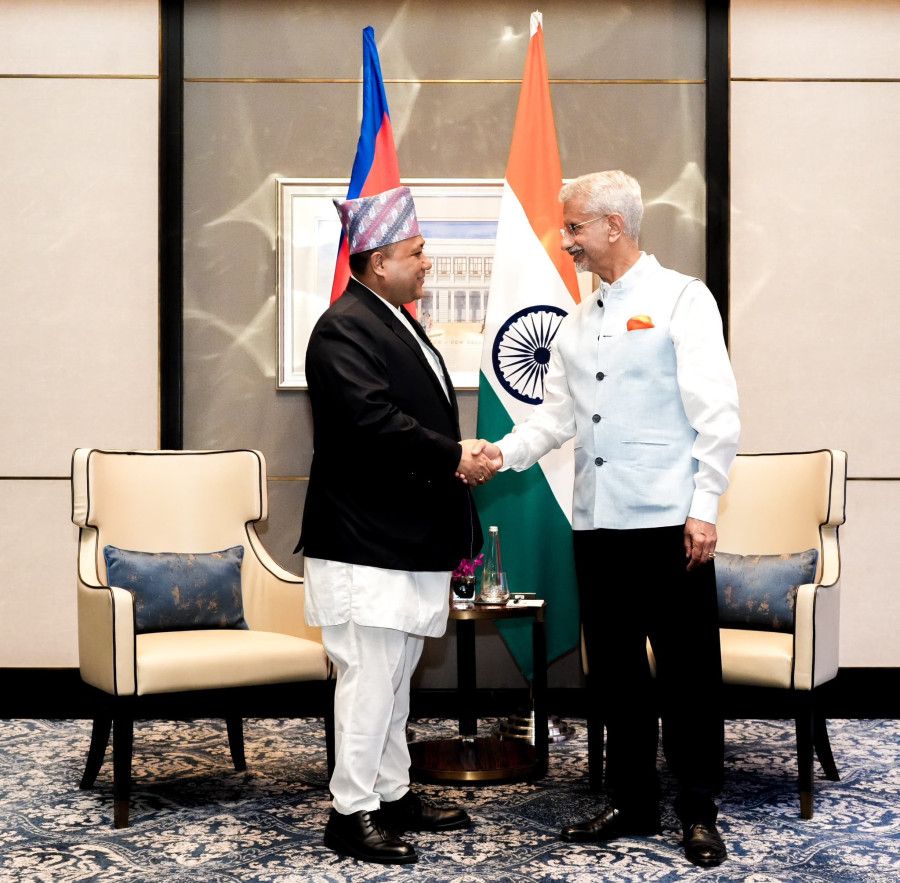
In politics, diplomatic activity is often mistaken for actual change. When it comes to Nepal, this is a scepticism that must be carefully guarded. We have recently witnessed a flurry of high-level visits, warm words from New Delhi, and ambitious statements from Kathmandu. Yet, recent developments have indicated that bilateral ties have quietly entered a new phase after the political upheavals of 2025. The relation is being fine-tuned, not reset—and a host of long-standing issues remain largely unresolved.
The signs of this recalibration are visible in the recent diplomatic itinerary. Following Rabi Lamichhane’s high-level meetings with top BJP leaders and Indian Prime Minister Narendra Modi in New Delhi, Foreign Minister Shisir Khanal embarked on his own official trip to the Indian capital. Meanwhile, momentum is already building for a state visit by Prime Minister Balendra Shah. Behind the scenes, bilateral mechanisms on trade, digital finance, connectivity, and border management mechanisms have quickly re-mobilised.
While meetings alone rarely yield results, they do signal what lies ahead. Foreign Minister Khanal’s emphasis on hydropower exports, payment systems through UPI, connectivity mechanisms, AI collaboration, start-up eco-systems and education, and the idea of action-oriented diplomacy represents perhaps the sharpest departure from Nepal’s historical strategy toward India. While asymmetric dependence remains woven into the bilateral relations, and they may very well remain, Kathmandu’s new-look government seems determined to bypass traditional political friction in pursuit of tangible economic outcomes. By focusing heavily on growth and performance, this ‘action-oriented diplomacy’ aims to de-escalate the knee-jerk nationalist tensions that frequently derail ties on both sides.
Naturally, energy cooperation sits at the heart of this shift. Hydropower has always been at the centre of Nepal’s development efforts, though historically choked by investment constraints, transmission capacity and weak market guarantees. Now, power trade with India is gaining unprecedented momentum. Nepal is on track to export up to 10,000MW of power over the next decade, a staggering leap from the mere hundreds of megawatts traded in the past. A recent trilateral energy pact involving Bangladesh further underscores Nepal’s growing role in the regional power market. Yet, even as an energy hub, Nepal’s economic future remains deeply tethered to India’s domestic demand and infrastructure capacity, a reality that cannot fully erase inherent political friction.
Indeed, while Nepal’s economy is structurally bound to India, its political identity has historically been forged in opposition to New Delhi’s dominance. This is where the unresolved border disputes of Kalapani, Lipulekh and Limpiyadhura resurface. Though the 1816 Treaty of Sugauli is the genesis of the conflicting interpretations, the claims hardened significantly after the 1962 Sino-Indian War and India’s 2019 unilateral map update. In New Delhi, Khanal firmly reminded his Indian counterpart that “nothing will be signed concerning disputed territories unless the issue is discussed and the government agrees”, reiterating Kathmandu’s preference for a bilateral resolution. It remains a high-wire act: Nepal is aggressively courting Indian economic partnership while remaining politically unable to sideline the fierce domestic nationalism that India’s footprint triggers.
Compounding this dynamic is Nepal’s fluid post-2025 domestic frontier. The anti-establishment movement that reshaped the government was fueled by public outrage over corruption, abysmal governance, and stagnation. However, the new regime has not dismantled old systemic dynamics. Rather, it has integrated politically adept new actors who understand statecraft far better than their predecessors.
Where older politicians and bureaucrats once ran a rigid, centralised establishment, today’s power-sharing arrangement features a volatile mix of coalition leaders, traditional politicians, and technocrat ministers. This fragmentation gives state entities more room to manoeuvre, but it also presents a strategic opening for New Delhi. For India, this new arrangement offers a pragmatic way to bypass the recurring headaches of Nepal’s domestic instability.
Ultimately, Nepal’s biggest vulnerability is its lack of a coherent, sustained strategic outlook—a flaw Khanal tacitly acknowledged through his emphasis on ‘implementation and accountability’. Foreign policy does not operate in a vacuum. It is an extension of good governance. For Kathmandu to execute successful diplomacy in New Delhi, it must first possess the state capacity to deliver on its promises. Hobbled by a sluggish bureaucracy, fragmented institutions, and chronic unpredictability, Nepal must shift its focus from merely securing access to India to sustainably implementing policies. Moving forward, the success of Nepal’s foreign policy will be judged by its speed of delivery, not its ideological posture.
Given its geopolitical position sandwiched between two nuclear powers, Nepal will always be subject to intense regional scrutiny. If Kathmandu wishes to be treated as a strategic ‘bridge’ rather than a passive ‘buffer state’, it must build institutional stability, robust infrastructure, and a predictable foreign policy—areas where it remains critically lagging.
A total rupture between the two neighbours is impossible. Deep-seated economic and cultural ties make a complete separation a fantasy. Instead, the real danger is a protracted strategic drift. While both capitals seem genuinely committed to digital, energy, and connectivity trade, these dynamic but fragmented activities will amount to little without structural resolution. Real change requires more than diplomatic discourse.
The evolution of Nepal-India relations will not be driven by tokenistic attempts to ‘reset’ ties through sheer force of leadership. Instead, it hinges entirely on Nepal’s internal capability to build a mature nation-state—one that can successfully balance interdependence against sovereignty, nationalism against pragmatism, and transitional politics against stability. Until Kathmandu learns how to act proactively relative to India, rather than just reacting to it, Nepal will remain stuck on its current trajectory: Trapped in a loop of intense diplomacy, high economic dependency, domestic vulnerability, and a fundamental lack of strategic commitment.