
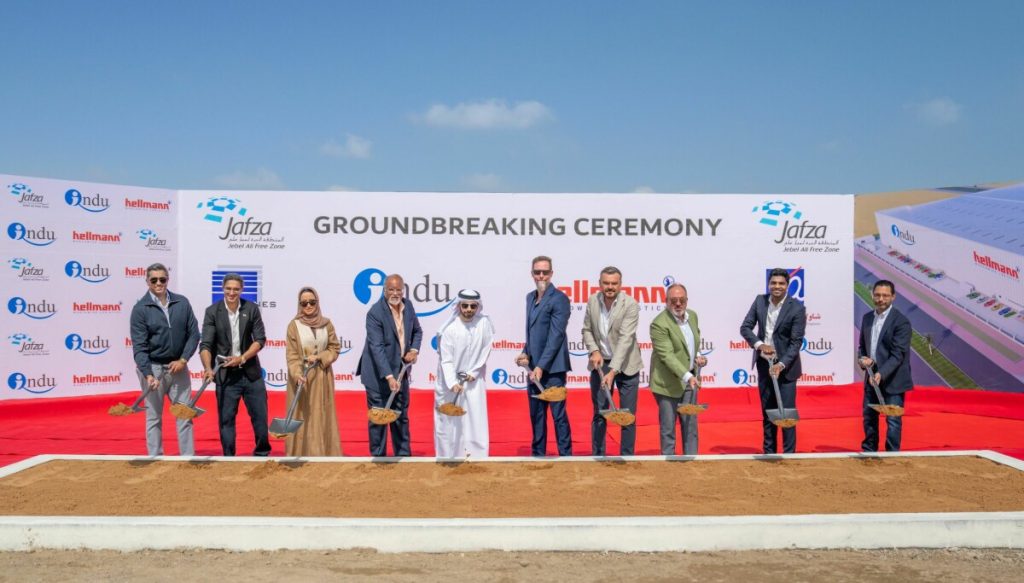
On June 8, 2026, Hellmann Worldwide Logistics confirmed it had broken ground on a new dedicated automotive logistics hub in Dubai, UAE. The hub will help Hellmann meet the expanding needs of its automotive customers in the Middle East as well as supporting future growth in the region.
The new 28,000 sq. m facility is situated in Jebel Ali Free Zone (Jafza) in the city of Dubai. It has been designed to manage the full spectrum of automotive spare parts logistics, combining high-density bin storage, pallet racking and specialised handling areas for oversized and bulky components.
“The UAE is a strategically important market within our global network,” said Lee I’Ons, regional CEO for India, Middle East and Africa (IMEA) at Hellmann Worldwide Logistics. “By establishing this dedicated automotive hub in Jafza, we are systematically expanding our regional capabilities and creating further scalable, industry-focused infrastructure.”
Developed by Indu Logistics, the built-to-suit facility will serve the automotive logistics market in the Middle East, which is forecast to grow by 4-6% by 2030. According to Hellmann, the site will provide scalable infrastructure to support efficient, high-volume distribution across the Gulf region, Africa and selected international markets.
“Hellman’s investment in Jebel Ali Free Zone reflects the rapid pace at which the automotive industry is growing in the Middle East, with customers looking for faster, more reliable access to critical spare parts across multiple markets,” added Abdulla Al Hashmi, global chief operating officer for parks and economic zones at DP World, which owns and operates Jafza. “By continuing to build specialised infrastructure in Dubai, we are supporting our partners in managing uncertainty and keeping their operations moving.”
Hellmann shared its belief that by investing in dedicated, industry-focused infrastructure, it can enhance its ability to deliver resilient logistics solutions in the Middle East. The scalability of this infrastructure is something Hellmann has highlighted as a priority, ensuring that its investments not only reflect today’s needs, but also future growth in volumes of automotive cargo distributed across the Gulf region as a key gateway between Europe, Asia and Africa.
Rahul Bhasin appointed global vice president of Hellmann Automotive Logistics

In March 2026, Hellmann Automotive Logistics – acknowledging the “profound transformation” the automotive logistics industry is currently undergoing as trends such as electrification, digitalisation and regionalisation reshape the sector – appointed Rahul Bhasin as its new global vice president.
Bhasin will lead Hellmann’s global automotive logistics activities as part of the company’s long-term strategy to “further strengthen its position as a reliable logistics partner for OEMs and tier 1 suppliers to drive sustainable, customer-centric growth in all regions”.
Bringing more than 15 years of strategic international leadership experience across the automotive industry to his new role, Bhasin also has experience working across a range of regions including Asia-Pacific, the Middle East and Europe.
“With Rahul’s international perspective, strategic mindset and proven track record, we are confident that he will play a key role in expanding our automotive footprint and supporting our customers as the industry continues to evolve,” commented Alexandra Olvera, chief commercial officer at Hellmann Worldwide Logistics.