
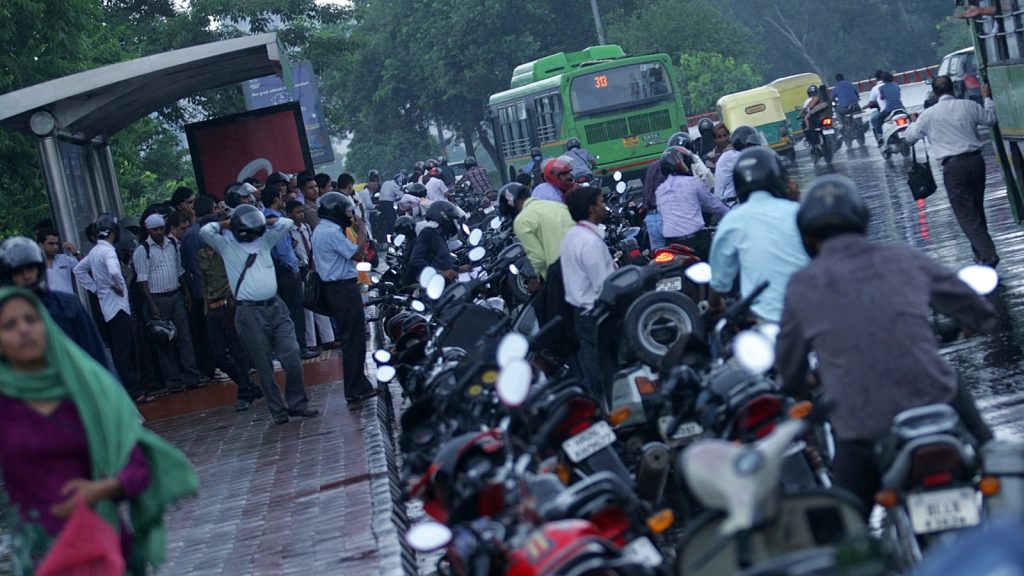
Delhi woke up to cooler air and rain on Friday after days of punishing heat. The timing, however, raised a question: how did the national capital cool down just as the emergence of El Niño, a climate phenomenon historically linked to weaker monsoons and hotter weather over parts of India, was confirmed?
To understand why Delhi’s weather has swung repeatedly between intense heat, dust storms and thunderstorms this pre-monsoon season, it is important to look at both the weather systems shaping conditions across north India and the broader climate signals emerging elsewhere.
The immediate reason was a fast-moving squall line, a chain of intense thunderstorms, that developed over Punjab on Thursday evening and travelled eastwards across Haryana into Delhi-NCR overnight.
The system brought light to moderate rainfall to many parts of Punjab and Haryana, accompanied by strong winds, including gusts reaching 111 kmph in Sangrur.
“This squall line started over Punjab on Thursday evening and travelled across Haryana, causing light to moderate rainfall at many places in central and eastern Punjab and Haryana, along with strong winds,” said Krishna Mishra, a senior scientist at the India Meteorological Department (IMD).
Mishra explained that a squall line is a fast-moving, continuous line of thunderstorms that can extend across hundreds of kilometres. Such systems are capable of producing intense but short-lived weather, including torrential rain, frequent lightning, damaging straight-line winds and, at times, hail.
Southeasterly winds gusting up to around 65 kmph, prevailed over Delhi during the period.
Story continues below this ad
How big was the temperature drop?
The squall had a direct impact on temperatures.
Safdarjung, Delhi’s base weather station, recorded a minimum temperature of 22.8 degrees Celsius on Friday, 5.2 degrees below normal and 7.2 degrees lower than the previous day.
Palam recorded 21.6 degrees Celsius, 6.5 degrees below normal, while Lodhi Road and Ridge recorded 22 degrees Celsius and 20.9 degrees Celsius respectively.
Across the city, minimum temperatures fell by around 7-8 degrees Celsius within 24 hours.
Story continues below this ad
Ayanagar recorded 12.4 mm of rainfall during the 24 hours ending 8.30 am Friday, followed by Safdarjung at 11.2 mm, Lodhi Road at 9.8 mm and Jafarpur at 8.5 mm. The combination of cloud cover, rainfall and rain-cooled winds contributed to the sharp drop in temperatures.
The latest spell of rain is part of what has been an active pre-monsoon season across north India.
Is this erratic weather unusual for this season?
In recent weeks, Delhi has experienced repeated episodes of heat, dust storms, thunderstorms and abrupt temperature fluctuations as western disturbances interacted with moisture-laden winds and intense surface heating.
Such conditions, however, are typical of the transition period before the monsoon which is expected to have an onset over Delhi on June 30.
Story continues below this ad
For Friday, the IMD has issued a yellow alert as it forecast generally cloudy skies with light to moderate rain, thunderstorms and lightning at isolated places in Delhi.
Wind speeds are expected to reach 40-50 kmph, gusting up to 60 kmph during thunderstorm activity. Similar conditions are likely to persist into Saturday before rainfall activity gradually reduces, it said.
So where does El Niño fit into all this?
Beyond the regional weather systems, the larger climate shift could play a role in coming months over Northwest India’s weather.
On June 11, the US National Oceanic and Atmospheric Administration (NOAA) said, “El Niño conditions developed over the past month” as above-average sea surface temperatures spread across the central and eastern equatorial Pacific Ocean. The agency added that El Niño conditions are “present and expected to strengthen into the Northern Hemisphere winter 2026-27”.
Story continues below this ad
NOAA’s assessment is based on a combination of oceanic and atmospheric indicators, including above-average sea surface temperatures across the equatorial Pacific, significantly above-average subsurface ocean temperatures, low-level westerly wind anomalies and negative Southern Oscillation Index values. The agency said, these signals indicate that the coupled ocean-atmosphere system has transitioned into an El Niño state.
The agency’s forecast models have indicated further strengthening in the coming months. According to NOAA, there is a 63% chance of a very strong El Niño during November-January, potentially placing the event among the strongest observed since reliable records began in 1950.
However, the agency cautioned that “even very strong El Niño events do not lead to the expected impact everywhere,” although stronger events can increase the likelihood of certain weather outcomes.