
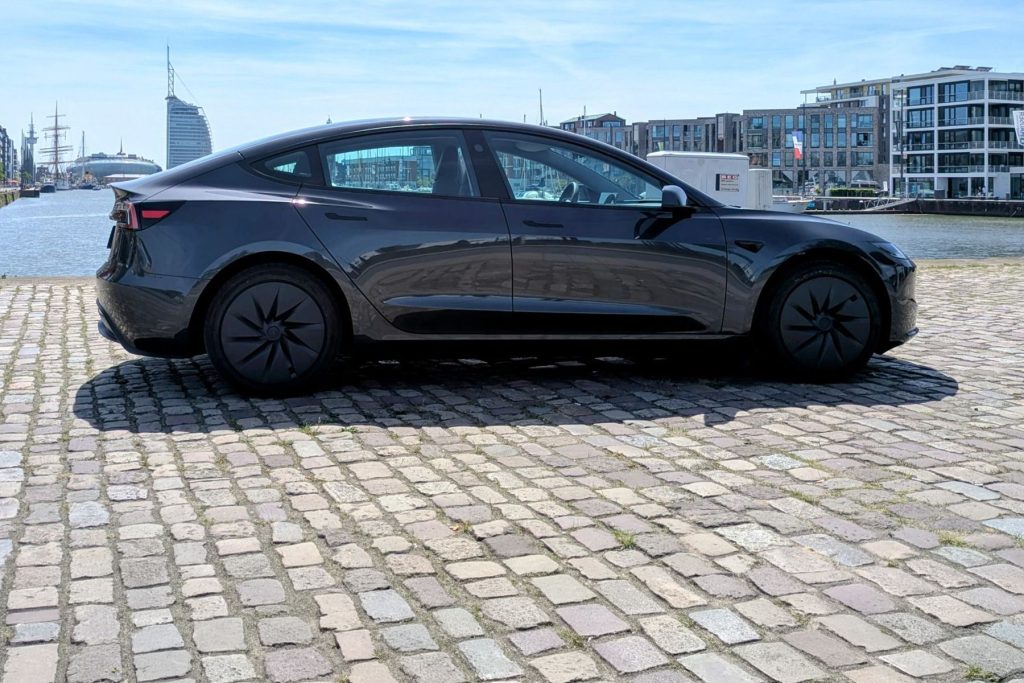
After 362 kilometres, the trip computer in the Model 3 indicated an energy consumption of 13.4 kWh/100 km – a figure that may initially seem difficult to believe. The route included Hamburg city traffic and a drive along federal roads towards Bremerhaven, but was dominated by motorway driving: from Bremerhaven via the A27 to Bremen and back to Hamburg on the A1.
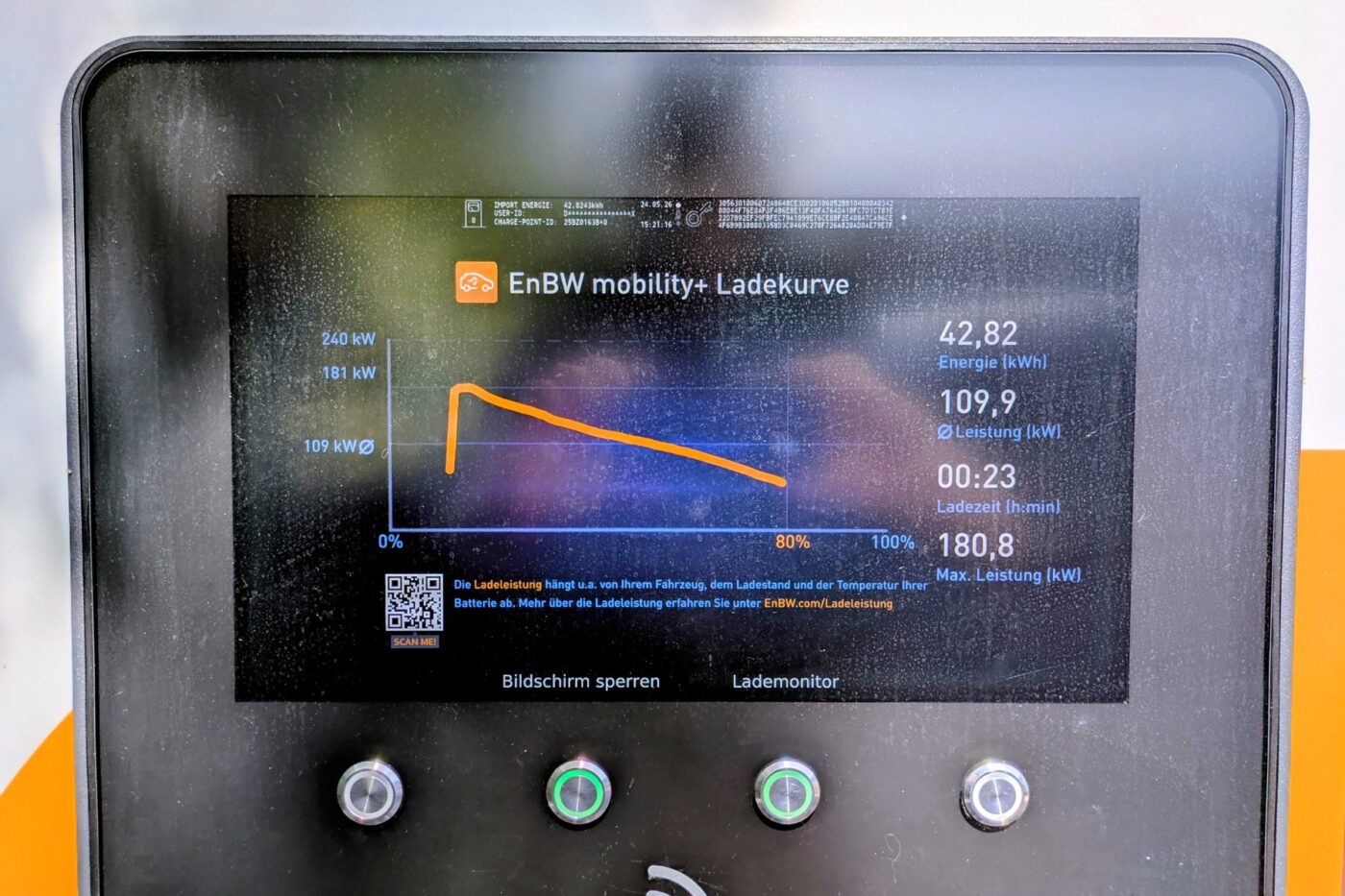
The reading at the DC charging station at the end of the journey confirmed the vehicle’s high efficiency. Including charging losses, consumption amounted to 15 kWh/100 km. That is an excellent result and highlights the Tesla Model 3 Rear-Wheel Drive’s efficiency in everyday driving conditions.
The Rear-Wheel Drive variant marks the entry-level version in Tesla’s two remaining model series. Following the discontinuation of the Model S and Model X in Europe, customers can currently only order the Model 3 and Model Y. The Model 3 Rear-Wheel Drive starts at €36,990, plus €980 in delivery charges. Tesla is also offering a zero-interest loan over 60 months, making the model particularly attractive for private buyers.
The panoramic roof stays
Tesla has implemented fewer cost-cutting measures in the Model 3 Rear-Wheel Drive than in the corresponding Model Y Rear-Wheel Drive. Although the Model 3 also comes with fabric seats – which are highly recommended – it retains the panoramic glass roof that Tesla has removed from the cheaper Model Y. The saloon’s frunk is also unchanged compared to the higher-spec versions, with the same size and no omitted trim elements. Another practical advantage is that tyre pressure can be checked without removing the largely enclosed wheel covers, a more cumbersome process in the Model Y.
Buyers may have to do without the LED light strip in the dashboard, and seat adjustments are controlled exclusively via the touchscreen—both of which are likely tolerable compromises. Rear passengers will also have to manage without direct control over the air conditioning.
Cornering fun up to the limits of grip
What sets the Model 3 apart from the Model Y is, first and foremost, the driving experience. The saloon is agile, with a noticeably lower centre of gravity. Its steering response in corners is sharper and more dynamic. Spoiler: why sporadic creaking noises still emanate from the steering column trim after so many years of production remains a mystery known only to Tesla. Nevertheless, the car is fun to drive.
The limits of high-speed driving are primarily defined by the low-rolling-resistance tyres from Bridgestone. They do not roll particularly smoothly, which may go unnoticed by those switching from a combustion-engine car but is noticeable compared to competitors like the Mercedes CLA.
Overall, Tesla has significantly improved the chassis of the Model 3 Highland introduced at the end of 2023 compared to the original version. However, the set-up still lacks refinement. Road noise insulation is solid, but not outstanding. At higher motorway speeds, the suspension feels too soft, while in urban driving the tuning can appear harsh and unsettled at low speeds. Several competitors manage this balance more convincingly.
Strong powertrain, outstanding efficiency
For those unfamiliar with other models, the Model 3 Rear-Wheel Drive is a quiet and comfortable electric car in its own right. It is also fast: it accelerates from 0 to 100 km/h in 6.2 seconds and reaches a top speed of 201 km/h. This is more than sufficient for almost all everyday situations.
Do you need that? No. However, the overall travel speed remains high. And once again, regarding energy consumption: at 130 km/h, the trip meter shows only 15.8 kWh/100 km. With a heavy right foot at 160 km/h and above, the Model 3 consumed 28 kWh/100 km. In the city, it was 12.1 kWh/100 km, and in rural driving, the best value recorded was 10.3 kWh/100 km.
Admittedly, the external conditions were ideal, with a dry road surface, little wind, and mild outside temperatures of 18 to 25 degrees Celsius. However, these figures are directly from real-world use. Life with an electric car is not just about icy winters and caravan holidays.
Peak charging power of 180 kW, reasonable charging time
The exceptional efficiency enables a real-world range of around 450 kilometres (official WLTP value: 534 km). When it comes time to recharge, a spot check showed a waiting time of 23 minutes for a charge from 12 to 80 percent. The peak charging power was 180 kW, with the charging curve declining linearly.
The Model 3 Rear-Wheel Drive uses LFP battery cells (lithium iron phosphate), which are considered particularly durable, safe and robust. However, because the voltage curve of this cell chemistry remains relatively flat across wide operating ranges, accurately determining the battery’s state of charge is more difficult than with NMC cells (nickel manganese cobalt oxide). Tesla therefore recommends occasionally charging the battery to 100 per cent, as this improves calibration accuracy. This helps ensure that the state-of-charge display and route-planning predictions remain precise.
The FSD (Supervised) situation
Since 22 May, Tesla no longer offers the option to purchase Full Self-Driving (FSD) Supervised. Instead, it is now available as a subscription for €99 per month. This change will be particularly exciting if the trial operation in several EU countries (including the Netherlands) leads to full regulatory approval. For Germany, FSD remains irrelevant—for now.
It is likely that general approval will be granted, though not as quickly as the Tesla community might hope. It could take until 2027, and the exact details of the legislation remain unclear. Following a class-action lawsuit by a Tesla owner with the outdated Hardware 3, the manufacturer has become cautious and now phrases its statements conditionally: FSD *could* be approved, as stated on the website. There is no absolute certainty.
The Model 3 is pure Tesla
General approval is likely, though probably not as quickly as many Tesla supporters expect. Approval may not arrive before 2027, and key details of the legislation remain unclear. Following a class-action lawsuit filed by a Tesla owner with the older Hardware 3 system, the manufacturer has adopted more cautious wording and now states on its website that FSD could receive approval. There is no guarantee at this stage.
Regardless of the political controversies surrounding Elon Musk, the Tesla Model 3 remains one of Europe’s most successful electric cars. The Model Y offers greater versatility thanks to its large tailgate and 1,600-kilogram towing capacity, whereas the Model 3 features a smaller boot and can tow up to 1,000 kilograms. Buyers who do not require these practical advantages receive an efficient electric sports saloon at an attractive price with the Model 3 Rear-Wheel Drive – a car that embodies the core Tesla experience.
Competitors such as the Mercedes CLA offer higher perceived quality and stronger charging performance, but at a significantly higher price point. The Mercedes starts at €46,949.67, around €10,000 more than the Model 3 Rear-Wheel Drive.