
Introduction
In response to the military strikes on Iran by the United States (U.S.) and Israel on February 28, 2026, Iran declared on March 2 that it would close the Strait of Hormuz and then intensified its strikes on the energy facilities of the Arab gulf countries. At a time when the Ukraine war, which has entered its fifth year, is having a major impact on the international energy situation, the destabilization of the situation in the Middle East is intensifying shocks to the global energy supply system even more. For Japan, which has low energy self-sufficiency, the impact of international political and security trends on securing a stable supply of energy resources continues to be a long-standing and ever-relevant problem.
In recent years, there has been growing interest in “energy geopolitics,” which focuses on the relationship between energy and geopolitical trends, and the geopolitical risks to the stable supply of energy. However, the meaning of this term is ambiguous, and it has tended to be misused because there is no clear shared understanding of its underlying assumptions. In addition, the elements shaping energy geopolitics are becoming more complex as the energy transition is leading to renewable energy and hydrogen becoming increasingly important in addition to traditional fossil fuels such as oil and natural gas.
Based on the above, this paper presents a clear definition of the concept of “energy geopolitics” and analyzes energy as a dependent variable in geopolitical trends. Furthermore, it points out the importance of the Middle East in changing energy geopolitics and examines the challenges for Japan.
The modern significance of energy geopolitics
Simply defined, energy geopolitics can be described as an analytical concept and perspective that considers international political trends and international relations pertaining to the supply, demand, and transportation of energy resources.
Andreas Goldthau of the University of Erfurt in Germany, who specializes in energy security, defines energy geopolitics as the domain at the intersection of energy security, foreign policy, and international relations, which handles issues concerning control of and access to energy resources and infrastructure in particular. [1] Furthermore, Ken Koyama of the Institute of Energy Economics, Japan focuses on the point that historically energy issues and international politics and economics have had an impact on each other, positioning energy geopolitics as a way of understanding this reciprocal relationship. [2]
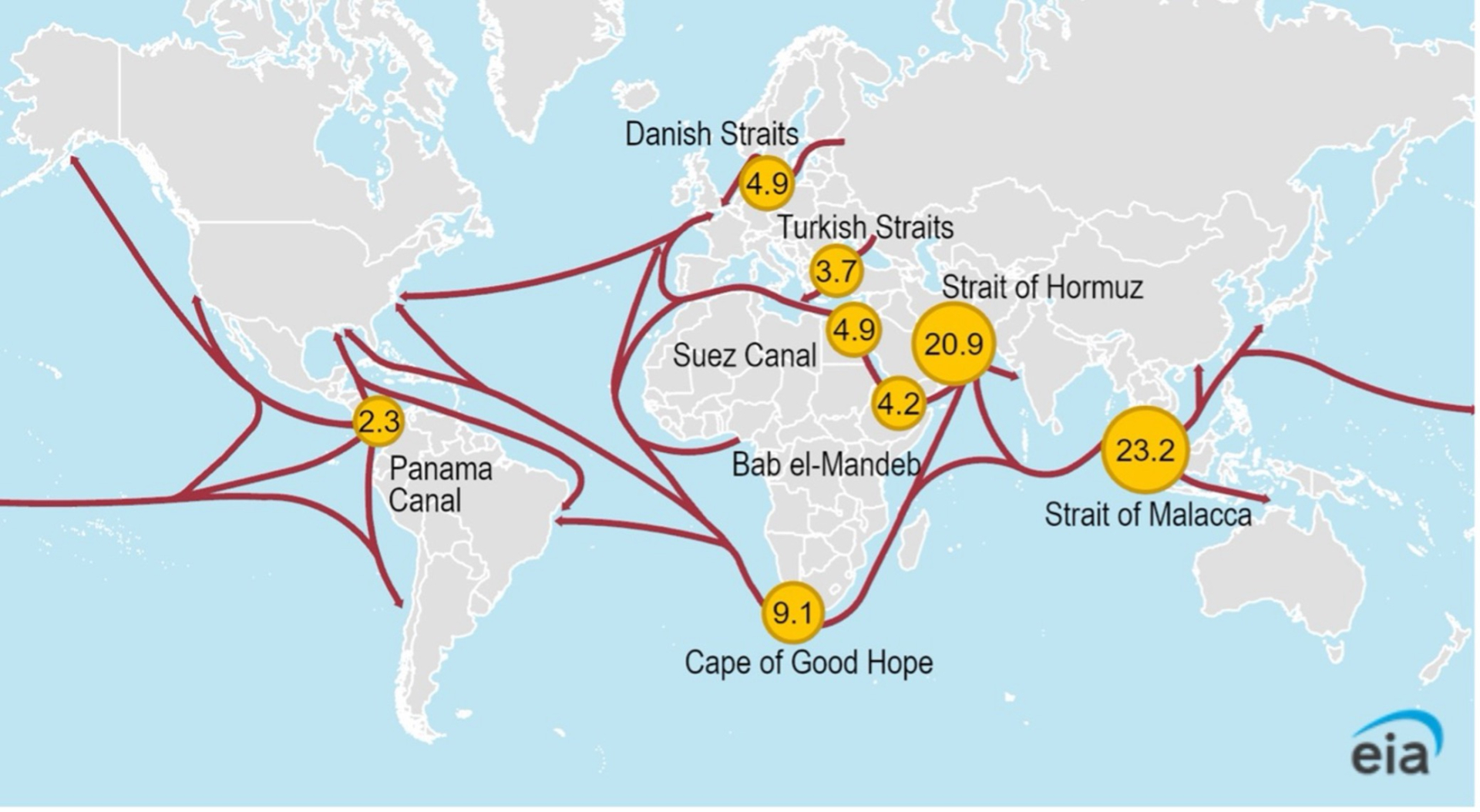
Energy resources are unevenly distributed across the globe, and geographical conditions, chokepoints along transportation routes, and the political and security trends of surrounding countries have a large impact when transporting energy resources from suppliers to consumers (Figure 1). For example, in order for Japan and South Korea to stably import oil from the Middle East, it is necessary for them to pay attention to relations with major supplying countries and to their local political and security trends, and also pay attention to trends surrounding chokepoints and sea lanes such as the Strait of Hormuz, the Strait of Malacca, and the Taiwan Strait. [3] Not only maritime transportation routes, but also land routes such as oil and natural gas pipelines and power grids are important. Furthermore, historically, energy resources have been used by nations as a means of achieving geopolitical goals and ensuring security, so it is important to consider the supply, demand, and transportation of energy resources not only from a business perspective, but also in combination with geopolitics, security, and national strategies.
In addition, in recent years, major powers such as the U.S., China, and Russia have been strengthening their moves to control neighboring countries, so there has been an increase in discussions analyzing the securing of energy resources in terms of the geopolitical concept of “spheres of influence.” [4] As demonstrated by the discussion concerning the military operation by the U.S. Trump administration in Venezuela, [5] securing resources is regarded as an important element in building spheres of influence.
Melvin Conant, who founded the international journal Geopolitics of Energy and served as a senior official in the U.S. Federal Energy Administration (later the U.S. Department of Energy), pointed out that the access to resources, especially energy, is a major challenge in international politics. The ability to obtain important resources depends on geographical factors and the political decision-making of governments based on different political conditions. Countries which control resources control countries which depend on resources, and that can bring about fundamental transformations in international relations. [6]
This observation in 1978 was made with the U.S.-Soviet confrontation during the Cold War era and the 1978 oil crisis in mind, but even now, nearly 50 years later, we should recognize the fact that the weaponization of energy resources continues to destabilize international relations.
Figure 1. Map of daily transit volumes of petroleum and other liquids through world maritime oil chokepoints (million barrels per day) (1H25)
Energy as a dependent variable in geopolitical competition
Tensions between Russia and the European countries due to the Ukraine war, and the recent military conflict in the Middle East, have once again highlighted how developments concerning countries which supply and consume diverse energy sources, including not only oil and natural gas but also nuclear power and renewable energy, as well as developments concerning their transportation routes and technologies, are significantly impacted by geopolitical competition, and that energy resources are an important tool for countries to achieve their proactive and defensive geopolitical goals.
As this author also pointed out in a previous paper, it is necessary to consider not only the political and security situation in the oil and gas producing countries of the Middle East but also the various other risks which threaten the supply chain, including disruption of transportation routes, large-scale natural disasters, conflicts. [8] In the Middle East region, there are multiple chokepoints which have an impact on the supply of crude oil and liquefied natural gas (LNG), including the Strait of Hormuz, the Bab el-Mandeb Strait, and the Suez Canal, so political upheavals and conflicts in the Middle East region increase the risks of supply disruptions. It has been pointed out that when the spare capacity with which producing countries guarantee a rapid increase in production at such times is insufficient, or when there is no international system of cooperation such as the release of stocks and mutual assistance upon supply disruptions, these risks may lead to a rapid rise in prices. [9] This risk scenario has become apparent with the closure of the Strait of Hormuz.
As stated above, Koyama points out that energy issues and international politics and economics have an impact on each other, and the aspect of “energy being dependent on geopolitical competition” has become apparent, as seen in the Ukraine war and closure of the Strait of Hormuz. This is by no means a new phenomenon, but in recent years it has become even more complex due to the rise of the Global South, the energy transition, and increasing concern about supply chains for critical minerals.
It is necessary to note the point that clean energy such as renewable energy and hydrogen is also strongly impacted by geopolitical competition over supply networks, technologies, infrastructure, and the securing of resources. In particular the mineral resources essential for the introduction of clean energy are very unevenly distributed, and smelting and refining facilities are concentrated in China and a few other countries, creating asymmetry between suppliers and consumers. Moreover, resources (for example, cobalt, lithium, and tantalum) produced in regions which have unstable politics and security, for example Africa, are at risk of unstable and unpredictable supply, potentially posing new risks to energy security.
Before the Ukraine war, importance was placed on market logic and the trend toward decarbonization in the supply, demand, and development of energy. However, it can be pointed out that this trend is changing given the rise of concepts such as economic security and geoeconomics. It is becoming increasingly important to understand (changes in) the production, supply, transportation, consumption, and securing of energy resources as elements of geopolitical competition and carry out analyses of them from the perspectives of international politics and regional politics.
The importance of the Middle East in changing energy geopolitics
The recent closure of the Strait of Hormuz and strikes on the energy facilities of the Gulf countries have had an enormous impact on the global energy market. Approximately 20 million barrels of oil and almost 80 million tons of LNG pass through the Strait of Hormuz daily, each equivalent to approximately 20% of the global supply. Although Saudi Arabia has an East-West Pipeline that allows it to export crude oil from the Red Sea side of the country, the carrying capacity of the pipeline is extremely limited, at around five million barrels per day. Alternative transportation of LNG is essentially impossible should the Strait of Hormuz be closed. Furthermore, no country in the world possesses sufficient spare production capacity to replace the oil or LNG which cannot be carried through the Strait of Hormuz. [10]
On March 4, QatarEnergy, the state-owned energy company of Qatar, one of the world’s leading gas producing countries, declared a Force Majeure to relieve itself of its obligation to supply its buyers. [11] Even supposing President Trump were to declare an end to the war or order the U.S. military to cease strikes by the time of writing this paper (the middle of March 2026), it would be extremely difficult for the Middle East and the energy situation to return to the state it was in before February 28. Looking beyond the course of the war in the Persian Gulf, the current situation is significantly destabilizing the energy supply of countries around the world, including Japan, and the impact is likely to be long-term and widespread. [12]
For example, countries in Southeast Asia and South Asia have few reserves of crude oil and natural gas, and their purchasing power for securing increasingly expensive fossil fuels is limited, so the blow to their economies and industries will be serious. The destabilization of the energy supply in the Indo-Pacific, a crucial hub for global manufacturing and supply chains, is raising concerns that the supply of more sophisticated and strategic goods will be threatened, as seen in the case of semiconductor manufacturing. [13]。
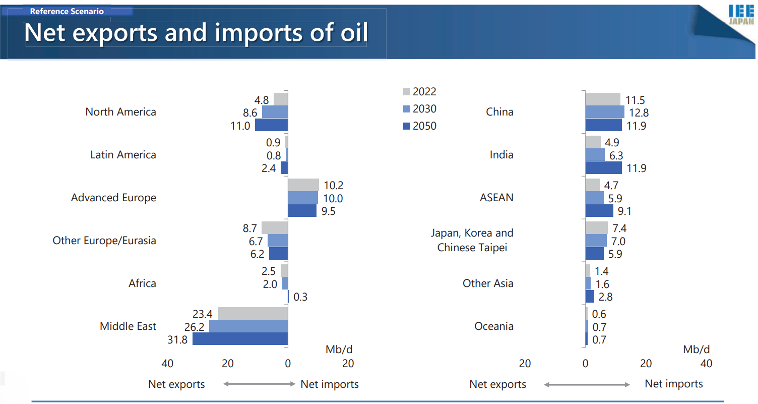
These developments in the Middle East countries are extremely important in the context of expanding global energy demand and the ongoing energy transition. This region has one of the world’s greatest fossil energy reserves and at the same time has attracted attention for its renewable energy and hydrogen development in recent years. Particularly since the outbreak of the Ukraine war in February 2022, the European Union (EU) has strengthened its efforts to secure energy resources from this region with the aiming of reducing its reliance on Russian fossil fuels. In a Reference Scenario by the Institute of Energy Economics, Japan (the scenario assuming that no radical energy conservation or low-carbon policies are implemented), the oil imports of Asian countries are projected to increase from 29.9 million barrels to 41.6 million barrels a day between 2022 and 2050. Only the Middle East (with an estimated export volume of 31.8 million barrels per day in 2050) can cover this enormous demand (Figure 2).
Figure 2: Estimates of oil export and import volumes
Furthermore, the Middle East countries have increased their presence in forums for discussions of climate governance and decarbonization. The holding of the 27th session of the Conference of the Parties to the United Nations Framework Convention on Climate Change (COP27) in Egypt and COP28 the following year in the United Arab Emirates (UAE) were important developments. Moreover, it was decided that COP31 in 2026 would be held in Turkey. The Headquarters of the International Renewable Energy Agency (IRENA) is in Abu Dhabi, the UAE since its foundation in 2009.
Even given disruptive factors such as the inauguration of the second Trump administration in the U.S., the importance of the Middle East as a hub (or a chokepoint) in the global supply chain for hydrogen energy development and critical minerals will likely increase as the energy transition progresses.
Conclusion
The Sanae Takaichi administration has positioned raising Japan’s energy self-sufficiency and strengthening its resources and energy security as one of its major policies. In addition to initiatives for next-generation technologies such as nuclear fusion, the administration has presented a stance of continuing to import Russian LNG. Furthermore, following the Japan-U.S. Summit Meetings in October 2025 and March 2026, the administration’s policy is to strengthen energy cooperation with the U.S. going forward.
Japan is importing approximately 94% of its crude oil from the Middle East as of 2025, with approximately 90% of that crude oil passing through the Strait of Hormuz. The recent closure of the strait demonstrates that the risks of Middle Eastern energy dependence and the need for diversification of supply sources—issues that have persisted since the first oil crisis—remain unresolved. In addition, the closure of the strait once again highlights the currently growing need to address the stable securing of energy as a geopolitical issue and integrate it into security strategies and specific policies.
Since Russia’s invasion of Ukraine, Europe has launched REPowerEU—linking the expansion of renewable energy to energy security, and strengthening its policies and investments in order to promote renewable energy. Furthermore, it has expanded LNG imports from Qatar and North America and built alternative pipeline routes in order to reduce its dependence on Russian energy. However, due to its geographical constraints and political relations with its neighboring countries―which are perfect examples of geopolitical factors―it is difficult for Japan to introduce the policies of Europe without any changes; it is necessary for Japan to make complex calculations to design energy policies suitable for its own needs.
The Takaichi administration is keen to revise the National Security Strategy of Japan as soon as possible. The 2022 edition of the strategy stated policies including advancing ties with resource-rich countries, diversifying supply sources, and enhancing energy self-sufficiency, and emphasized building a robust energy supply system that can withstand contingencies. [15] In the volatile global security environment, building a robust supply chain system has become even more important. It is important for Japan to understand the complex political and security dynamics in the Middle East and, with the perspective of energy geopolitics, work with the relevant countries and actors to prevent disruptions to the supply of resources.
(2026/06/11)
Notes
- 1 “The Role of Rules and Institutions in Global Energy: An Introduction,” in Andreas Goldthau and Jan M. Witte, eds., Global Energy Governance: The New Rules of the Game, Brookings Institution Press, 2009, pp. 1–10.
- 2 Ken Koyama, Energy Geopolitics, Asahi Shimbun Publications Inc., 2022, pp. 17-22.
- 3 Robert D. Kaplan, “The Geopolitics of Energy,” Forbes, April 4, 2014.
- 4 Council of Councils, The World Reorders: The Complications of a Return to Spheres of Influence, January 30, 2026; William A. Gatson, Ryan Hass, Patricia M. Kim, Melanie W. Sisson, Constanze Stelzenmüller, Thomas Wright, and Miles Yu, Redrawing global boundaries? The United States, China, and the viability of spheres of influence in the 21st century, Brookings Institution, February 18, 2026.
- 5 International Crisis Group, U.S. Snaps up Venezuela’s Oil and Rare Minerals in Race for Supplies, March 6, 2026.
- 6 Melvin A. Conant and Fern Racine Gold, The Geopolitics of Energy, Westview Press, 1978, pp. 1-3.
- 7 U.S. Energy Information Administration, “World Oil Transit Chokepoints,” last updated on March 3, 2026.
- 8 Ken Koyama, “The Geopolitical Impact of the Gaza Situation on Energy Supply― Escalation Risks in the Middle East and Destabilization of the Red Sea Region,” International Information Network Analysis (IINA), April 2, 2024.
- 9 The National Institute for Defense Studies, “The Security Implications of Climate, Energy, and Food Issues,” East Asian Strategic Review 2009, pp. 41-66.
- 10 Ken Koyama, “Significant Volatility in Global Energy Landscape Amid Large-Scale Military Strikes on Iran,” The Institute of Energy Economics, Japan, March 2, 2026.
- 11 QatarEnergy, “QatarEnergy Declares Force Majeure,” March 4, 2026.
- 12 Kohei Toyoda, Amane Kobayashi, and Masahide Takahashi, “Emergency Dialogue: Closure of the Strait of Hormuz and the Energy Security of Japan and the Middle East,” Research Center for Advanced Science and Technology Open Laboratory for Emergence Strategies (ROLES), University of Tokyo, March 16, 2026.
- 13 Darcie Draudt-Véjares and Tim Sahay, “The Iran War Is Also Now a Semiconductor Problem,” Carnegie Endowment for International Peace, March 13, 2026.
- 14 The Institute of Energy Economics, Japan, IEEJ Outlook 2025: How to Address the Uncertainties Surrounding the Energy Transition, Slide 72, October 2024.
- 15 The National Security Strategy of Japan states that “in addition to advancing ties with resource-rich countries, diversifying supply sources, and enhancing procurement risk assessment and other methods, Japan will maximize the use of energy sources that contribute to its energy self-sufficiency, such as renewable energy and nuclear power, and will strategically develop and solidify energy sources for this purpose. In cooperation with its ally, like-minded countries, and international organizations, Japan will drive forward measures to improve Japan’s energy self-sufficiency ratio and build a robust energy supply system that can withstand contingencies.” Cabinet Secretariat, “National Security Strategy of Japan,” December 16, 2022, p. 26.