
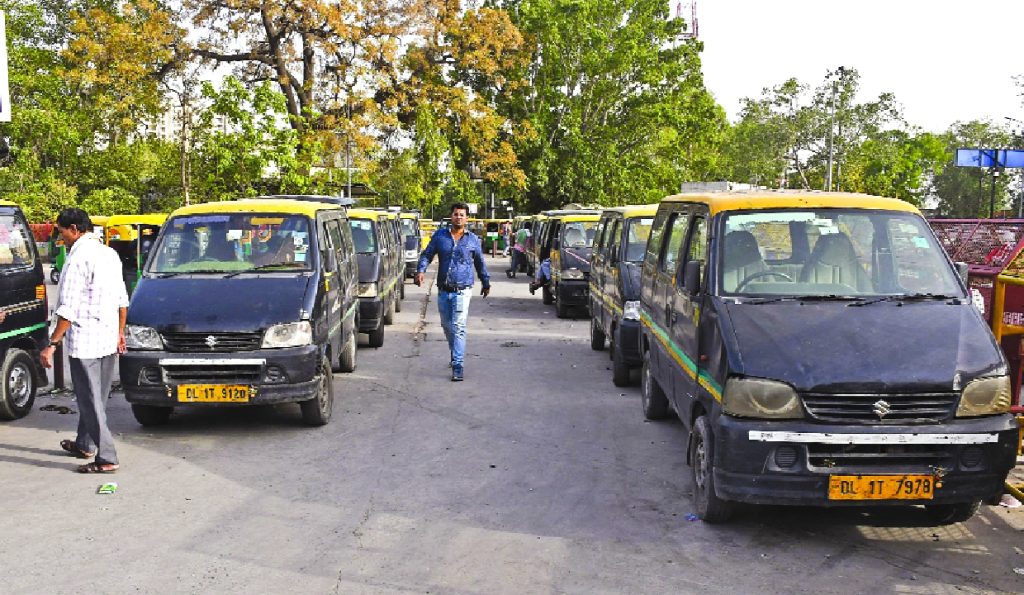
On the first morning of the three-day shut down by 68 commercial vehicle unions in Delhi-NCR, most roads in the Capital looked no different from any other day. As app-based ride-hailing services continued to take bookings throughout the day and six auto unions, along with the Delhi Taxi and Tourist Transport Association, distancing themselves from the strike, citing national interest, the shutdown that was meant to bring the Capital to its knees began, instead, with a whimper. But the unions say, give it time.
The most visible disruption on day one was concentrated at the New Delhi Railway Station in the early morning hours, where the usual swarm of autos and app cabs was noticeably thinner than normal. Passengers arriving on early trains found themselves waiting longer than usual, refreshing apps that showed limited availability or higher-than-standard prices. By mid-morning, however, even that had eased as app-based services resumed normal operations across most of the city.
A family that had arrived from Lucknow on an early morning train stood outside the exit of the New Delhi Railway Station for nearly half an hour before securing a ride. A retired Government employee with luggage said he had tried three different apps before one responded. “In the morning, it was bad. Maybe by afternoon it got better, but we were stuck for a while,” he said.
For most Delhi commuters with access to app-based ride hailing services, Thursday was normal at best and slightly inconvenient at worst. A commuter at Connaught Place metro station said she had barely noticed anything unusual during her morning commute. “I booked a Rapido, and it came in four minutes. I did not even know there was a strike until someone told me at the office,” she said.
A cab driver near Paharganj, who had parked his vehicle for the day said he understood why many of his colleagues were still running. “If you have an EMI due this week, you cannot park your car for three days. Everyone’s situation is different.” He said he expected more drivers to stay off the road on Friday and Saturday as solidarity builds.
Anuj Kumar Rathore, vice-president of the Chalak Shakti Union, said the strike was called because taxi and auto fares in Delhi-NCR have not been revised for nearly 15 years despite a continuous rise in CNG, petrol, and diesel prices.’He said the unions expect participation to strengthen on days two and three as more drivers join.
The demands behind the action are substantial.
The cess on light commercial vehicles was raised from Rs 1,400 to Rs 2,000 from April 19, while charges for three-axle vehicles went up from Rs 2,600 to Rs 4,000, with a 5 percent annual hike built in going forward.’ Unions are also opposing the proposed ban on BS-4 and older commercial vehicles from entering Delhi-NCR from November 2026, arguing the restriction is based on vehicle registration category rather than actual tailpipe emissions.
The All India Motor Transport Congress (AITMC) has warned that if demands are not addressed, the three-day symbolic action could escalate into an indefinite shutdown. The Government has not announced any talks with the unions so far.
For now, Delhi has absorbed day one without significant disruption. Whether that holds through Friday and Saturday, with unions actively working to consolidate participation, is the question that commuters across the city will be watching closely when they step out tomorrow morning.