
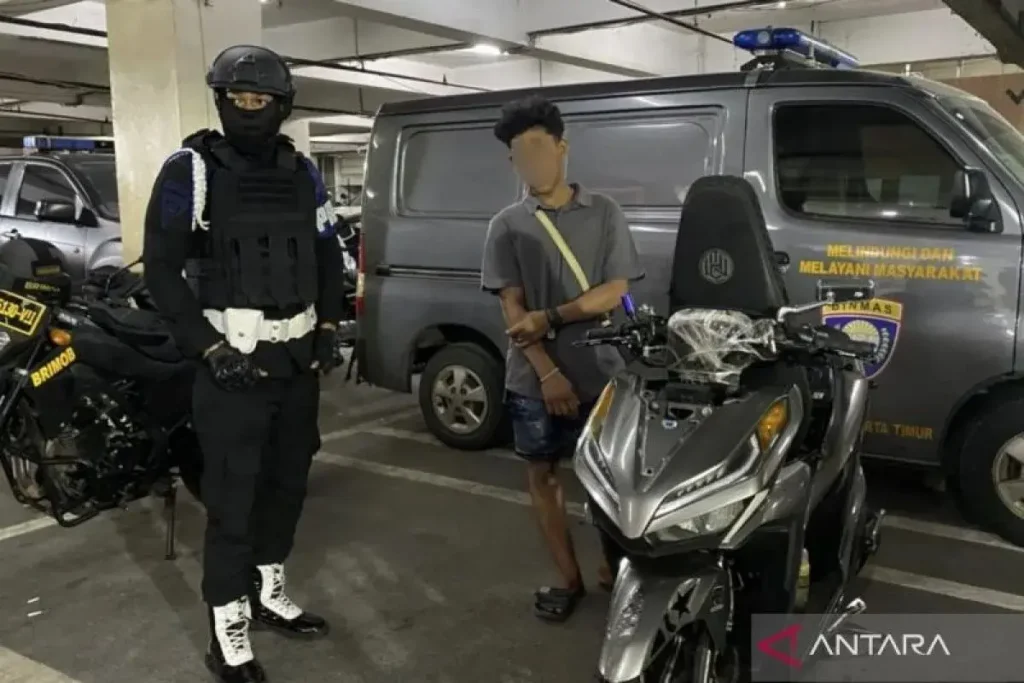
inp.polri.go.id – Jakarta. A joint patrol by the Mobile Brigade Corps of the Jakarta Regional Metropolitan Police and the Precision Pioneer Team of the East Jakarta Sub-regional Metropolitan Police seized a motorcycle suspected of being used for illegal street racing on Pinang Ranti street, Makasar District, East Jakarta, early Monday morning.
The action was carried out by officers while combing several vulnerable areas where youths often gather during busy hours, around 3:11 a.m.
The Head of the Mobile Brigade Corps of the Jakarta Regional Metropolitan Police, Senior Superintendent Henik Maryanto, stated that routine patrols are being stepped up as a preventative measure to anticipate potential disturbances to public order and security.
“The presence of our personnel in the field is a form of service to the community to ensure security remains maintained. We anticipate any potential disturbances early through routine and ongoing patrols,” explained Henik on Monday (6/8/2026).
He explained that the discovery of the vehicle began when officers were conducting an inspection of a group of suspicious youths in the Pinang Ranti area.
“During the inspection, a vehicle was found that strongly indicated it was connected to illegal racing,” said Henik.
To prevent potential disturbances to public order and reduce the risk of traffic accidents, officers immediately secured the vehicle and its owner at the East Jakarta Sub-regional Metro Police for further investigation and investigation.
Based on police evaluations, findings related to alleged illegal racing are still frequently encountered during night patrols in several areas of East Jakarta.
Therefore, the police urge the public, especially youth, not to use public roads as an arena for illegal racing, as it can endanger their safety and that of other road users.
“The public is asked to actively report any potential security disturbances in their neighborhoods through the 110 hotline service,” said Henik.
(ad/ndt/pr/rs)