
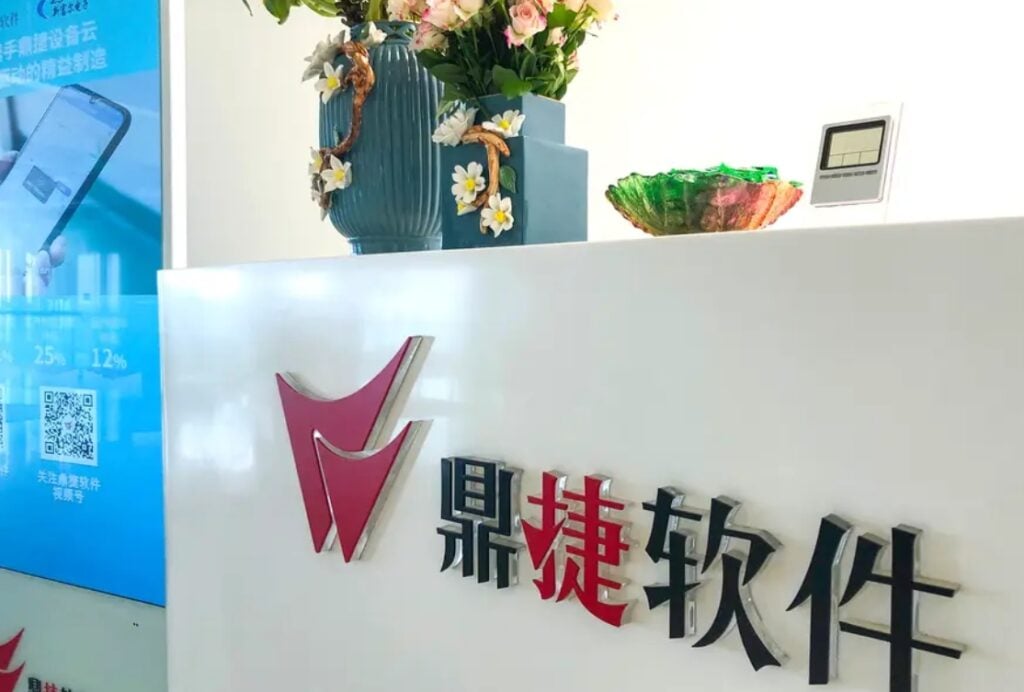
The maker of enterprise resource planning solutions for manufacturers has applied to list in Hong Kong, seeking funds to expand its Athena Digital and Intelligent Platform
image credit: Bamboo Works
Key Takeaways:
- Digiwin has filed for a Hong Kong IPO to complement its current Shenzhen listing, reporting stable but unimpressive profit growth over the last three years
- The company’s valuation isn’t cheap, including a P/E ratio of more than 70 for its Shenzhen-traded shares
Born in Taiwan in 1948, Sun got degrees in physics and information management before founding Dingxin Computer in 1982. The company initially focused on enterprise resource planning (ERP) products, and went on to list in Taiwan as its operations grew. It began to develop the Mainland China market after 2000, and at one point even established a joint venture with Digital China, the IT services spinoff of PC giant Lenovo.
Winning bet on the Mainland
As the 21st century began, Sun saw how China’s economy was rapidly developing and the many business opportunities that presented. In response, he decided to concentrate his company’s focus entirely on the Mainland. Reflecting that shift, he delisted his company from the Taiwan Stock Exchange in 2008 and later renamed it as Digiwin.
That decision turned out to be the right one, as rapidly developing Mainland enterprises readily gobbled up Digiwin’s ERP software. That growth led Digiwin to seek a new financial home on the Shenzhen Stock Exchange’s then-young ChiNext board for growth companies in 2014.
The company’s current main business is providing digital and intelligent solutions for key business processes in the manufacturing industry, allowing enterprises to improve their efficiency through digital and intelligent transformation. Its business lines include provision of digital and intelligent software products, integrated digital and intelligent software and hardware solutions, and digital and intelligent technical services.
Hon Hai, the world’s leading contract manufacturer for electronics, has long been a Digiwin supporter. Its Foxconn Industrial Internet subsidiary currently holds 12.37% of Digiwin’s shares, and is part of an “acting-in-concert” group that collectively holds 20.12% of the company’s stock and includes Sun, as well as Digiwin Chairman Yeh Tzu-chen.
After more than 40 years in its space, Digiwin has carved out a comfortable place in China’s industrial manufacturing sector as a leading software supplier. According to third-party market data in its prospectus, Digiwin was the largest domestic provider in the Chinese manufacturing digital and intelligent solutions market in 2025, based on revenue. It ranks fifth in that market overall, with 1.4% share.
Slow growth
Despite its steady advancement and top-tier status in the manufacturing digital and intelligent solutions market, Digiwin lacks an explosive growth story to dangle in front of potential Hong Kong investors.
Those metrics all rose far more quickly than the company’s revenue, though the underlying reason isn’t directly stated. Could it be due to a deliberate decision to relax customer payment terms to maintain the company’s sales volume?
Additionally, Digiwin’s impairment losses on financial assets have been growing steadily in the last three years, rising from 26.45 million yuan in 2023 to 57.79 million yuan last year. The losses owe mainly to increased provisions for expected credit losses on trade receivables, reflecting rising bad debt.
High valuation
When compared to industry peers, both Kingdee International (0268.HK) and Yonyou Network Technology (600588.SH) boast higher visibility and greater customer usage volumes in the ERP market than Digiwin. Last year, revenue for each of those companies was also two to three times higher than Digiwin’s, and they were both far larger in terms of market cap.
In terms of valuation, Kingdee’s price-to-earnings (P/E) ratio exceeds 300 times, and Yonyou Network remains money-losing, showing how difficult it is to make big profits in this area. The P/E ratio for Digiwin’s Shenzhen-listed shares is lower at 72 times, though even that level seems high. Unless the company’s profit can improve significantly, the risk-reward ratio at the valuation level of its Shenzhen stock appears unattractive.
To subscribe to Bamboo Works weekly free newsletter, click here
Benzinga Disclaimer: This article is from an unpaid external contributor. It does not represent Benzinga’s reporting and has not been edited for content or accuracy.