
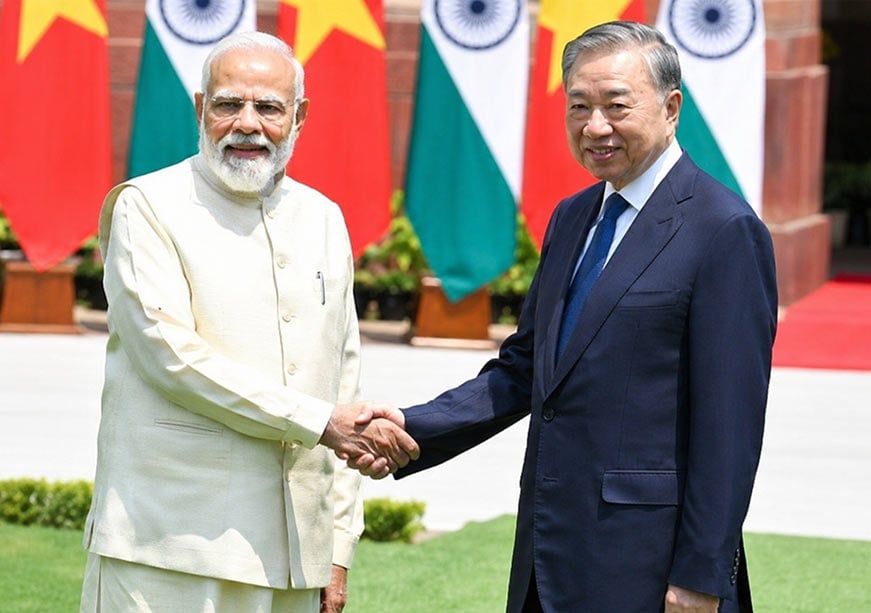

In the weeks preceding Tô Lâm’s visit to New Delhi, Hanoi was the focal point of an unusually intense phase of high-level diplomacy. In April 2026, Tô Lâm travelled to Beijing for a summit with President Xi Jinping, during which he described ties with China as a “strategic choice” and “top priority” in Vietnam’s foreign policy. This was followed by South Korean President Lee Jae-myung’s visit to Hanoi, accompanied by the heads of Samsung, SK, Hyundai, and LG. Japanese Prime Minister Takaichi Sanae also chose the Vietnamese capital to unveil Japan’s updated Free and Open Indo-Pacific (FOIP) strategy. Within days of Takaichi’s departure, Tô Lâm flew to New Delhi.
Vietnam has become the nodal point of the Indo-Pacific’s overlapping strategic geometries, with major regional powers—from Beijing to Seoul, Tokyo, and New Delhi—now treating it as indispensable to their own strategic positioning.
This diplomatic sequence is not coincidental. It is the most vivid recent illustration of a structural reality that analysts have long noted but that the current conjuncture has brought into sharp relief: Vietnam has become the nodal point of the Indo-Pacific’s overlapping strategic geometries, with major regional powers—from Beijing to Seoul, Tokyo, and New Delhi—now treating it as indispensable to their own strategic positioning. The state visit to India on 5–7 May 2026, which produced the Joint Statement on Enhanced Comprehensive Strategic Partnership (ECSP), must be read within this larger frame.
Bamboo Diplomacy in a Multipolar Stress Test
Vietnam’s ‘bamboo diplomacy’—the doctrine of deep roots, flexible branches, and refusal of hard alignment—has been tested by the post-Trump tariff environment and disruptions to global energy markets arising from the Iran war. Critics have argued that Hanoi’s balancing act is approaching a breaking point as it deepens economic integration with both Beijing and Washington simultaneously. The Beijing visit amplified this concern: Vietnamese imports from China surged 22.4 percent last year, leaving Hanoi with a bilateral trade deficit approaching US$ 100 billion—the largest in Southeast Asia. Tô Lâm’s call for railway connectivity and “strategic infrastructure corridors” with China suggests a deliberate bet on deeper economic enmeshment with Beijing as a hedge against the volatility of US trade policy.
Tô Lâm’s Beijing visit did not signal an abandonment of strategic autonomy. Rather, it underscored Hanoi’s pursuit of what analysts have described as “omni-enmeshment”: overlapping partnerships designed to prevent dependence on any single partner.
Yet Tô Lâm’s Beijing visit did not signal an abandonment of strategic autonomy. Rather, it underscored Hanoi’s pursuit of what analysts have described as “omni-enmeshment”: overlapping partnerships designed to prevent dependence on any single partner. Lee Jae-myung’s visit to Hanoi, explicitly framed around supply chain resilience and reducing dependence on China, came immediately after his trip to India. Takaichi’s choice of Hanoi as the setting for Japan’s updated Indo-Pacific doctrine was a deliberate signal that Vietnam’s non-alignment makes it a more credible host for such messaging than any US ally in the region. The FOIP speech was as much about Vietnam’s centrality as it was about Japan’s strategy. This is the context in which India’s ECSP must be assessed: not as one more partnership in a crowded diplomatic calendar, but as a structurally significant link in a web that Vietnam is consciously weaving.
The Logic of the India Node
Among the major powers currently deepening engagement with Hanoi, India occupies a distinctive position. Unlike China, India brings no territorial disputes, no debt-financed infrastructure leverage, and no ideological expectations. Unlike the United States (US), India operates outside a formal alliance system and has maintained its own tradition of strategic autonomy—a posture that Vietnam finds both familiar and reassuring. Unlike Japan’s more FOIP-oriented Indo-Pacific framing, India’s approach places greater emphasis on inclusivity and alignment with the ASEAN Outlook on the Indo-Pacific (AOIP). This combination positions India, in Vietnam’s strategic assessment, arguably the least contentious of its major partners.
The ECSP joint statement reflects this complementarity. Vietnam joined India’s Indo-Pacific Oceans Initiative (IPOI), with both sides committing to synergies between IPOI and AOIP—enabling Hanoi to engage with India’s maritime architecture without aligning against China. A new 2+2 Strategic Diplomacy–Defence Dialogue was established. Defence systems procurement, naval vessel port calls, and co-production of new technologies were approved. A trade target of US$ 25 billion by 2030 was set, along with Memoranda of Understanding (MoUs) on digital technology and pharmaceuticals, among other areas. Speaking at the Indian Council of World Affairs (ICWA) under the theme “Vietnam–India Enhanced Comprehensive Strategic Partnership in a New Era”, Tô Lâm was explicit: he called for defence cooperation to grow better and deeper, and for the two sides to move beyond frameworks into delivery. The contrast with the previously aspirational language of earlier joint statements was deliberate.
Prime Minister Narendra Modi, for his part, described Vietnam as “a key pillar” of India’s Act East Policy and Vision MAHASAGAR, placing the ECSP squarely within India’s own strategic architecture for the Indo-Pacific.
Prime Minister Narendra Modi, for his part, described Vietnam as “a key pillar” of India’s Act East Policy and Vision MAHASAGAR, placing the ECSP squarely within India’s own strategic architecture for the Indo-Pacific. That Vietnam had just hosted Japanese Prime Minister Takaichi’s FOIP relaunch days earlier, and maintains deep economic ties with China that India also manages carefully, was not an obstacle but a feature: both capitals value a partner that can sustain relationships across strategic divides.
Hanoi in a Post-American Indo-Pacific
The deeper logic binding this diplomatic sequence together is Washington’s growing unpredictability. Trump’s tariff policies have created structural anxieties not only in Vietnam, which secured a reduced 20 percent tariff rate, down from an initially proposed 46 percent, through difficult negotiations, but across the Indo-Pacific. The disruption of shipping through the Strait of Hormuz amid the Iran–US conflict has heightened both energy and trade insecurity. The result is a regional realignment in which middle and major powers alike are diversifying their strategic ties, not to replace the United States but to build an ‘insurance architecture’ against uncertainty over Washington’s reliability.
For Vietnam, this means that each link in its partnership network—Beijing for supply chains and infrastructure, Seoul for investment and technology, Tokyo for energy security and industrial upgrading, New Delhi for defence and maritime order—performs a distinct function. The ECSP with India addresses a gap that none of the others can fill: a defence partnership with a democratic major power that shares Vietnam’s interest in freedom of navigation, a rules-based South China Sea order, and United Nations Convention on the Law of the Sea (UNCLOS)-based dispute resolution, while making no demands on Vietnam’s non-alignment doctrine. The joint statement’s reiteration of South China Sea positions—calling for full implementation of the Declaration on Conduct and an early conclusion of a Code of Conduct consistent with UNCLOS—is, under current conditions, a diplomatically measured but strategically meaningful signal.
Structural Constraints and Unrealised Potential
The ECSP also inherits persistent structural deficits, but the New Delhi visit produced the most concrete movement in years toward closing them. On the defence line of credit, Indian officials confirmed that projects worth US$ 300 million have now been identified under the existing US$ 500 million facility, encompassing 14 high-speed patrol boats and three to four offshore patrol vessels, with the remaining US$ 200 million directed towards naval ship upgrades and submarine battery procurement. Prime Minister Modi additionally offered maintenance, repair, and overhaul (MRO) support for Vietnam’s Sukhoi Su-30 fighter jets and Kilo-class submarines—platforms India knows well—in a move that embeds New Delhi more deeply into Hanoi’s defence maintenance architecture. Thirteen MoUs were signed, spanning digital technology, cybersecurity, pharmaceuticals, rare earths, and cultural exchange.
On BrahMos, discussions progressed: Vietnam formally conveyed its interest in the shore-based anti-ship variant, and both sides exchanged notes on a potential package valued at approximately US$ 629 million, including training and logistical support. No contract was signed—negotiations on pricing, delivery timelines, and related technical details continue—but the public acknowledgement by India’s Ministry of External Affairs that BrahMos is one of the platforms being actively discussed marks a shift from studied ambiguity to cautious confirmation. If concluded, Vietnam would become the third Southeast Asian nation to induct the Indo-Russian supersonic cruise missile, following the Philippines and Indonesia.
Vietnam’s approach offers a model not of passive balancing but of active network construction. The ECSP is one of its most consequential additions.
Bilateral trade, though growing, still lags far behind Vietnamese trade with China, South Korea, or Japan; the ASEAN–India Trade in Goods Agreement (AITIGA) review remains a necessary but slow-moving lever. The ECSP’s institutional innovations—particularly the 2+2 dialogue and the Joint Vision Statement for Defence Partnership 2030—represent a structural attempt to convert declared ambition into operational delivery.
Conclusion
Tô Lâm’s visit to India was not a ‘pivot’ away from China or toward a US-aligned camp. It was the addition of a strategically significant node to an increasingly dense network of partnerships that Vietnam is constructing with deliberate care. What makes India distinctive, and what the ECSP formalises, is its ability to support Vietnam’s maritime security, defence-industrial modernisation, and technology needs without the political conditions associated with either major power. In a region where a historically reliable guarantor is now unpredictable, where great-power competition is intensifying, and where every major capital is recalibrating, Vietnam’s approach offers a model not of passive balancing but of active network construction. The ECSP is one of its most consequential additions.
Dr Do Khuong Manh Linh is a Fellow at the Centre for India Studies, Ho Chi Minh National Academy of Politics, Vietnam.
The views expressed above belong to the author(s). ORF research and analyses now available on Telegram! Click here to access our curated content — blogs, longforms and interviews.