
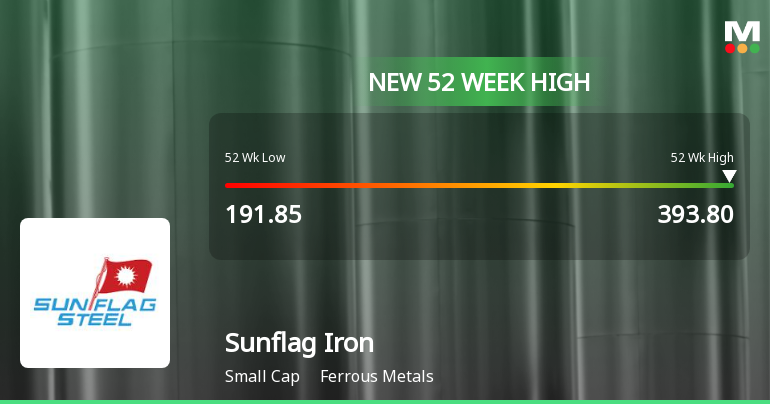
Price Milestone and Market Context
The stock’s journey from its 52-week low of Rs 191.85 to the current peak represents a significant appreciation in value, outpacing the Sensex which has declined by 4.3% over the same period. Today’s session saw Sunflag Iron & Steel Company Ltd open with a 2.81% gap up and close with an intraday gain of 11.95%, outperforming its ferrous metals sector by 11.32%. The stock has also recorded three consecutive days of gains, accumulating a 34.1% return in this short span. Meanwhile, the broader market showed mixed signals with the Sensex opening higher but trading below its 50-day moving average, highlighting the stock’s relative strength amid a cautious market environment. What factors are enabling this stock to buck the broader market’s subdued trend?
Technical Indicators: A Clear Momentum Story
The technical landscape for Sunflag Iron & Steel Company Ltd is predominantly bullish, especially on the weekly and monthly timeframes. The Moving Average Convergence Divergence (MACD) indicator is bullish on both weekly and monthly charts, signalling sustained upward momentum. Complementing this, Bollinger Bands also show bullish readings on these timeframes, indicating that price volatility is supporting the uptrend rather than signalling exhaustion.
On the weekly chart, the Relative Strength Index (RSI) remains neutral with no clear signal, suggesting the stock is not yet overbought despite the recent rally. The monthly RSI also shows no definitive signal, which may imply room for further price appreciation without immediate risk of a pullback. The Know Sure Thing (KST) oscillator presents a mildly bullish stance on the weekly timeframe but turns mildly bearish on the monthly chart, hinting at some caution in longer-term momentum that investors should monitor.
Dow Theory confirms bullish structure on both weekly and monthly charts, reinforcing the positive trend. The On-Balance Volume (OBV) indicator is bullish across both timeframes, reflecting strong volume support behind the price advances. However, the daily moving averages show a mildly bearish signal, which could be a short-term correction or consolidation phase within the broader uptrend. How might these mixed signals on shorter timeframes influence the stock’s near-term trajectory?
Moving Averages and Volatility
Sunflag Iron & Steel Company Ltd is currently trading above its 5-day, 20-day, 50-day, 100-day, and 200-day moving averages, a hallmark of strong technical momentum. This alignment of moving averages typically signals a robust uptrend and investor confidence. The stock’s intraday volatility today was 5.43%, reflecting heightened trading activity and investor interest. Such volatility often accompanies breakouts to new highs, as market participants adjust positions in response to fresh price levels.
Quarterly Results and Earnings Momentum
While the focus here is on technical momentum, it is notable that Sunflag Iron & Steel Company Ltd has delivered three consecutive quarters of improving earnings power, which provides a fundamental underpinning to the price action. Net sales growth has been positive, supporting the stock’s upward trajectory. This earnings consistency often aligns with the bullish technical signals observed, reinforcing the sustainability of the rally. Does the earnings momentum fully justify the current price premium, or is the market pricing in additional factors?
Key Data at a Glance
52-Week High
Rs 393.8
52-Week Low
Rs 191.85
1-Year Return
72.69%
Sensex 1-Year Return
-4.32%
Intraday Volatility
5.43%
Consecutive Gain Days
3
Outperformance vs Sector
11.32%
Market Cap
Small-cap
Data Points and Valuation Insights
The stock’s price-to-earnings and other valuation ratios are consistent with a small-cap ferrous metals company experiencing strong momentum. The PEG ratio, while not explicitly stated, is likely to reflect the rapid price appreciation relative to earnings growth, which has been positive but moderate. This dynamic suggests that the rally is not purely speculative but has some earnings support. However, the mildly bearish daily moving averages and the monthly KST indicator’s cautionary tone highlight that investors should remain attentive to potential short-term volatility. At a fresh 52-week high with strong earnings growth but moderate return ratios, should you buy, sell, or hold Sunflag Iron & Steel Company Ltd? The detailed multi-parameter analysis has the answer.
Momentum in Focus: What Lies Ahead?
The technical alignment here is striking, with multiple indicators confirming the strength of the uptrend. The stock’s position above all major moving averages and the bullish MACD and OBV readings on weekly and monthly charts underscore robust buying interest. Yet, the neutral RSI readings and mildly bearish signals on daily moving averages and monthly KST suggest that some consolidation or short-term correction could occur before the next leg higher. This nuanced picture invites investors to weigh the strong momentum against these subtle caution flags. With Sunflag Iron & Steel Company Ltd at a new 52-week high, is there still room to enter — or has the easy money been made?
Overall, the stock’s recent performance reflects a powerful technical breakout supported by improving fundamentals and relative strength versus the broader market. The volatility and mixed signals on shorter timeframes warrant close monitoring, but the prevailing momentum remains firmly positive.
Get Started for only Rs. 16,999 – Get MojoOne for 2 Years + 1 Year Absolutely FREE! (72% Off) Start Today