
CHONGQING/SHENZHEN – Office executive Xu Tanji was contemplating buying a gold pendant for her mother’s birthday at a neighbourhood jewellery store near her house in Chongqing when she saw news reports about counterfeit gold.
State broadcaster China Central Television (CCTV) reported on April 26 that fraudsters had been mixing rhenium – a silvery rare metal that costs a fraction of the price of gold – with the precious metal to make fakes that are hard to detect.
Worried she might fall prey to the scam, Ms Xu, 32, decided to take her mum shopping at a more reputable mall instead.
“It will be more expensive, but I feel more assured that I won’t be cheated,” said Ms Xu, who works in the hotel industry.
Gold mixed with rhenium has emerged in the retail market as the prices of the safe-haven asset hit record highs amid growing global uncertainty. Previously, gold mixed with other cheaper substances, such as copper and tungsten, has also made headlines.

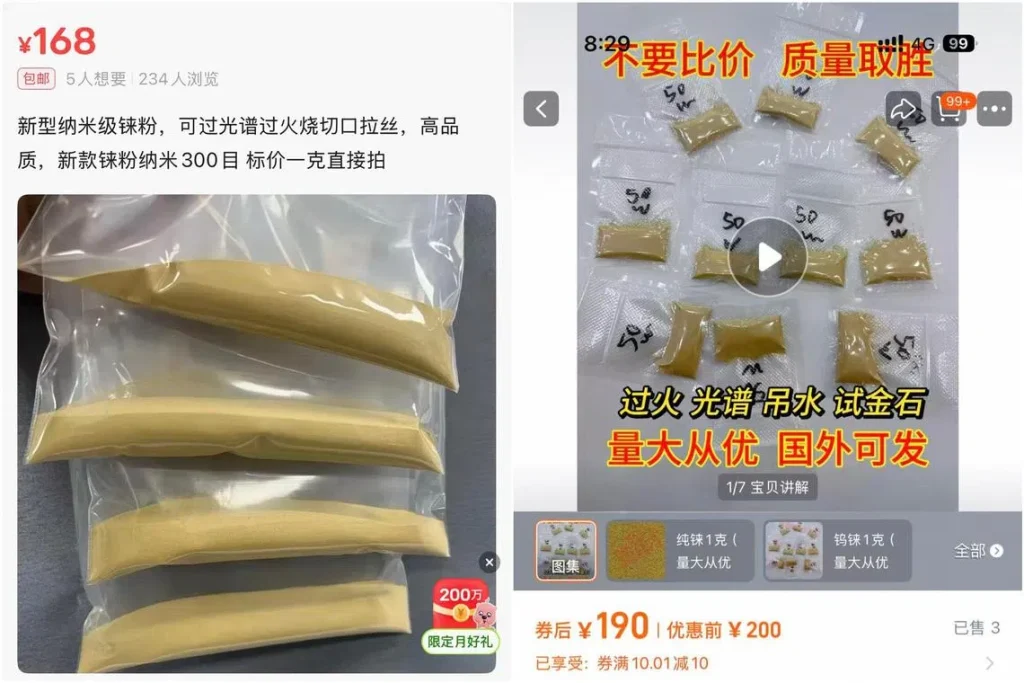
On shopping platform Taobao, rhenium powder is sold at 170 yuan (S$32) per gram.
PHOTO: TAOBAO
Rhenium is used to refine petroleum, among other industrial uses. On shopping platform Taobao, rhenium powder is sold at 170 yuan (S$32) per gram. Each gram of genuine gold can cost more than 1,000 yuan.
The authorities sounded the alarm on rhenium-gold as early as August 2025, when the police in eastern Zhejiang province busted a crime ring that was adding rhenium powder to gold to cheat customers, including retailers, of up to 800,000 yuan.
Investigations revealed that the syndicate had received money transfers from jewellery store owners all over the country.
The police cracked down on the crime ring after a jewellery store owner bought a rhenium-gold necklace from a seller who said the piece was made from older gold pieces.
The owner had bought the necklace at 800 yuan per gram, as was the market price at the time, after checking that it did not discolour under high heat.
The ruse was uncovered when a shop employee noticed that the necklace’s cross-section was coarse rather than smooth, unlike real gold. The owner then reported the case to the police.
The issue came to the fore again in 2026 after CCTV reported on the rhenium-gold scam, as advertisements for rhenium powder were popping up on online marketplaces. Some advertised that mixing up to 20 per cent of rhenium powder with gold could evade regular testing methods.
It is unclear how widespread the scam is, or the damage incurred so far. A person who works at a wholesaler in Shenzhen’s gold trading district of Shuibei said his company had encountered two instances of rhenium-laced gold in old jewellery.
In 2026, the firm tightened its internal procedures to guard against fakes by upgrading its testing machinery, subjecting the material it receives to more layers of tests, and thoroughly logging the details and origins of each piece it receives, he said. He declined to be named as he was not authorised to speak to the media.
The scam – and the ensuing need for more rigorous tests – has increased the cost of doing business, especially for bigger brands with reputations to protect, he said. “There are so many nodes in the supply chain… and if even a tiny bit of (rhenium) ends up in your product, there would be huge damage to your reputation.”
Gold experts told local media that the scam is difficult to detect because gold and rhenium are very close on the periodic table, meaning they have similar chemical and physical properties.
Their peaks in spectrometer tests – used to verify gold – overlap significantly as well.
Experts urged consumers to shop at reputable stores, and always ask for official invoices and quality inspection certificates when buying gold pieces to avoid falling prey to scams.
They also advised customers to opt for products priced by weight rather than fixed-price items to reduce the risks of buying counterfeits, as buyers may feel that they are getting a good deal and not realise they are being cheated.
Mr Chen Zou, who was shopping at a well-known gold chain retailer in Chongqing, told The Straits Times that he avoids buying jewellery at neighbourhood shops because he is “afraid of being cheated”.
He said his purchases are recorded on the store’s app, which acts as a form of assurance if he chooses to resell the items in the future.
“Furthermore, these well-known shops have more to lose if it is known that they sell fakes,” said Mr Chen, 43, who works in finance.
But some customers still choose to trust the small shops in the neighbourhood they grew up with.
Ms Lu Zhen, 52, said she trusts the owner of a jewellery shop near her home because “we are old neighbours and have a good relationship”.
The workmanship costs at luxury stores can also be “much more expensive” compared with the one she frequents, she added.
She has not yet come across any instances of customers being cheated, although she is aware that gold scams exist.
“I don’t have that many pieces, to be honest, and I buy them because I like their designs,” said Ms Lu, who declined to reveal her occupation for privacy reasons.
“I don’t think I’ll sell them, so maybe I won’t know if the gold is fake.”