
As the world reels from the economic toll of Iran’s blockage of the Strait of Hormuz, concern is rising over China’s potential cutoff of another critical waterway.
The Taiwan Strait, a narrow, 110-mile-long channel between Taiwan and mainland China, is a lifeline not just for Taiwan, but for Asia and the rest of the world.
One-fifth of the world’s maritime trade flows through the Taiwan Strait, compared with about 8% through the Strait of Hormuz, according to research by the Center for Strategic and International Studies, a Washington think tank.
Why We Wrote This
In its quest to unite the self-governing island of Taiwan with mainland China, Beijing has considered – and practiced – a blockade of the Taiwan Strait, a critical waterway on which global trade relies. Is the world prepared?
Yet China has considered – and recently practiced – a military blockade of Taiwan as part of its long-term goal of taking over the self-governing island, which would include restricting access to the strait. Such a blockade, if it lasted a year, could slash world gross domestic product by more than 5%, a February report by Bloomberg Economics found.
Beijing is closely watching how the Iranian regime has wielded its leverage over the Strait of Hormuz, which Chinese leader Xi Jinping says he wants reopened. “The Strait of Hormuz should maintain normal passage,” Mr. Xi told Saudi Crown Prince Mohammed bin Salman in a phone call last week.
Controlling the flow of microchips
Iran’s ability to withstand tremendous pressure to open the Strait of Hormuz underscores how much power China could gain by seizing control of Taiwan and the Taiwan Strait – a more significant waterway.
Whereas the Strait of Hormuz is a transit route primarily for crude oil – channeling 20% of global oil consumption before the Iran war – one of the most important commodities exported from Taiwan is advanced semiconductor chips. The island produces more than 90% of the global supply of the most sophisticated chips, which are vital to industries ranging from artificial intelligence to smartphones.
Even a temporary disruption of the flow of chips – much like Middle East oil shipments in the Strait of Hormuz – would impact production and prices of goods around the world.

Ann Scott Tyson/The Christian Science Monitor
Yet in recent years, China has ramped up actions to temporarily restrict traffic in the strait, and has rehearsed a military blockade of Taiwan as part of a pressure campaign to bring the island under Beijing’s control.
Mr. Xi has stressed that China’s “reunification” with Taiwan, which Beijing considers a renegade province, is inevitable. China’s Communist government has never ruled Taiwan, but claims the island of 23 million people as its territory and has vowed to take it over, by force, if necessary.
“No matter how the international landscape or the situation in the Taiwan Strait may evolve,” Mr. Xi told a visiting pro-Beijing politician from Taiwan last month, the “great tide of compatriots on both sides of the strait … coming together will not change. This is the verdict of history.”
In the gray zone
To that end, Beijing is practicing a spectrum of potential moves against Taiwan, ranging from bombardment and invasion to a blockade or quarantine, in which China would seize control over what comes and goes from the island. All these options would restrict traffic through the Taiwan Strait to some degree – as have their practice drills.
In December, the People’s Liberation Army waged war games called Justice Mission-2025 to encircle the island. Dozens of Chinese warplanes and ships staged live-fire drills and simulated cutting off the island and its ports. The drills – the largest such exercise to date – forced dozens of flight cancellations and risked disrupting maritime activities in the strait.
“China has already shut down flows from Taiwan for periods of time,” says Eyck Freymann, a Hoover Institution fellow at Stanford University and author of “Defending Taiwan: A Strategy to Prevent War With China.”
“It’s not a question of whether or when Xi Jinping chooses to enter the gray zone,” he says, using “gray” to describe coercive actions that fall short of war. “We are already in the gray.”
This spring, Beijing abruptly and without explanation announced a huge airspace restriction zone located about 250 miles northeast of the island, in the East China Sea and Yellow Sea, to last from late March until early May. During this 40-day period, aircraft can’t travel there without coordination with China’s aviation authorities.
Using such tactics, China can slowly tighten its grip on Taiwan, or even assert administrative control overnight, says Dr. Freymann.
Costs of a blockade
To be sure, China’s control of trade in and around Taiwan could backfire, by slowing the global economy and lowering countries’ demand for Chinese exports. A quarantine, blockade, or imposition of a customs territory around Taiwan would disrupt the maritime shipping and trading system that China itself relies heavily upon.
The U.S. government recently assessed that Beijing does not plan to attack Taiwan in 2027, and most experts agree that China would prefer to assert its sovereignty over the island without triggering a war.
Nevertheless, like Tehran, Beijing may calculate that it is better positioned to withstand some economic pain than the United States and its allies. Under Mr. Xi, who has prioritized national security, China has been stockpiling food, energy, key technology, and other resources to sustain the country even if it is cut off from seaborne trade.
In Taiwan, meanwhile, concern is rising over Beijing’s aggression in the strait – making ordinary citizens more wary of China.
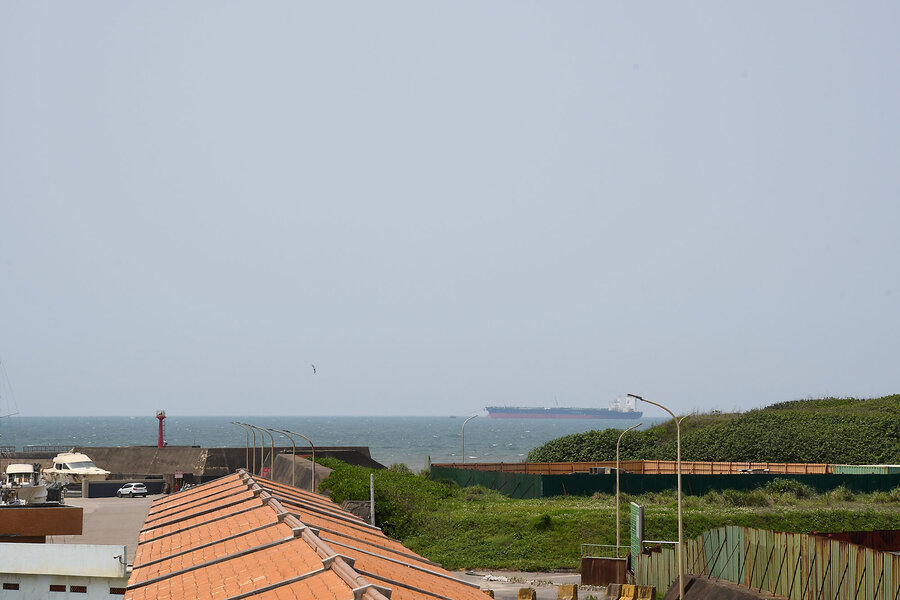
From the windy fishing port of Chuwei on Taiwan’s northwest coast, fishmonger Wang Ch’iu-chieh can see a steady stream of international cargo ships and fishing vessels passing in the Taiwan Strait.
For the past 30 years, Ms. Wang has sold fresh catches of local seafood at the nearby market, and she depends on the hauls of Taiwan’s fishing fleets. She worries what would happen if China were to take control of the waterway.
“If you blockade Taiwan, what will happen to our lives?” she says. “It’s not right.”