
Close Menu
Simply Invest Asia
  • Home
  • About us
  • Explore industries/sectors
    • Automobile
    • Aviation
    • Banking
    • Biotechnology
    • Chemical & Fertilizer
    • Entertainment and Media
    • Food Processing
    • Healthcare
    • Iron and Steel
    • Leather
    • Mining
    • Oil and Gas
    • Pharmaceutical
  • Explore by countries
    • China
    • Dubai / UAE
    • Hong Kong
    • India
    • Indonesia
    • Japan
    • Malaysia
  • Explore cities
    • Bangkok
    • Beijing
    • Chongqing
    • Delhi
    • Dubai
    • Guangzhou
    • Jakarta
    • Kuala Lumpur
  • Why Asia
Facebook X (Twitter) Instagram Threads
Trending:
  • Open for Business: 'Turning resources into shared prosperity': Papua New Guinea courts Chinese investment – news.cgtn.com
  • Iron and Steel Tax Evasion Crackdown in Punjab: Over Rs 5 Crore of Goods Seized
  • China sets out position on Palestine and Strait of Hormuz at UN
  • India general insurers forecast double-digit growth in premiums to 2030
  • Indonesia explores legal strategies to boost revenue from Malacca Strait
  • Match Centre – Transfermarkt
  • Dubai’s Emir is so wealthy that he bought a 63,000-acre estate in the pristine Scottish Highlands, built ten luxury mansions, three helipads, and a luxury hunting lodge on it, yet has visited only five times in twenty years because it supposedly lacks adequate accommodation
  • Prabowo at Monas May Day: Dancing, Shirt-Tossing, and More
  • Yen jumps sharply as Japan warns it is ready to intervene again
  • Hong Kong head coach calls on young players to support team at table tennis championships
  • AirTrunk Expands in Malaysia with Two New Hyperscale Sites
  • Disruption hits bank holiday flights in Inverness
  • Hemab Therapeutics sets terms for $200 million IPO
  • Stalemate in Strait of Hormuz has oil & gas prices soaring to record heights – WPLG Local 10
  • What Dubai's Work from Park initiative reveals about the future of construction – facilitiesmanagement-now.com
  • Heartbroken Families Face Huge Structural Barriers When Trying To Prove Medical Negligence In India
  • Heavy rain floods Bangkok roads and slows traffic after midday
  • Update: China firmly opposes U.S. restrictions on test and certification, telecom sectors
Friday, May 1
Facebook X (Twitter) Instagram
Simply Invest Asia
  • Home
  • About us
  • Explore industries/sectors
    • Automobile
    • Aviation
    • Banking
    • Biotechnology
    • Chemical & Fertilizer
    • Entertainment and Media
    • Food Processing
    • Healthcare
    • Iron and Steel
    • Leather
    • Mining
    • Oil and Gas
    • Pharmaceutical
  • Explore by countries
    • China
    • Dubai / UAE
    • Hong Kong
    • India
    • Indonesia
    • Japan
    • Malaysia
  • Explore cities
    • Bangkok
    • Beijing
    • Chongqing
    • Delhi
    • Dubai
    • Guangzhou
    • Jakarta
    • Kuala Lumpur
  • Why Asia
Simply Invest Asia
Home»Explore by countries»Indonesia»Deadly train crash signals urgent need to modernize Indonesia’s railways
Indonesia

Deadly train crash signals urgent need to modernize Indonesia’s railways

By IslaMay 1, 20264 Mins Read
Share
Facebook Twitter Pinterest Threads Bluesky Copy Link


A deadly collision exposes the human cost

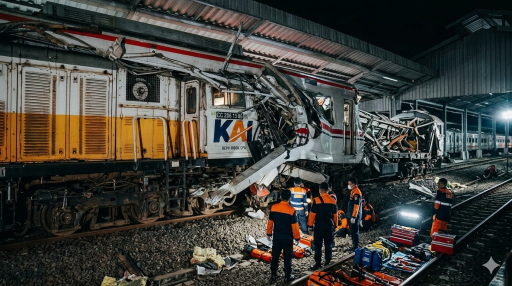
A deadly train crash near East Bekasi on April 28, 2026, which claimed 16 lives and injured more than 80 people, has laid bare the human cost of Indonesia’s aging railway system. The collision, reportedly triggered by a taxi obstructing a level crossing, quickly escalated into a devastating impact between the Argo Bromo Anggrek locomotive and a Commuter Line train.

The force of the crash was concentrated on the last carriage of the commuter train, a women-only compartment. Within seconds, the carriage was crushed under the impact, its structure collapsing inward as metal folded into itself. Passengers inside were trapped, many unable to escape before rescuers arrived.

Emergency teams worked through the wreckage in a complex and painstaking operation. Parts of the locomotive had penetrated deep into the carriage, turning what had been a routine commute into a confined space of destruction. Indonesia’s National Search and Rescue Agency (Basarnas) deployed specialized teams to cut through twisted steel, carefully extracting victims and survivors.

“We will thoroughly examine every carriage to ensure all victims are evacuated,” said Basarnas chief Mohammad Syafii, as crews continued to search the debris.

A chain of events behind the crash

While the immediate focus remained on rescue and recovery, the circumstances leading to the crash point to a broader and more troubling reality.

Initial findings indicate that the accident began at a level crossing (JPL 85), where a Green SM electric taxi, operated by the Vietnamese firm GSM (Green and Smart Mobility), stalled on the tracks. The obstruction forced an approaching Commuter Line train to collide with the vehicle and come to a halt. Moments later, the Argo Bromo Anggrek, traveling at speed, was unable to stop in time and collided with the rear of the stationary commuter train.

This sequence was not unusual. It reflects a persistent vulnerability in Indonesia’s rail system: the continued reliance on level crossings, where road traffic and trains intersect without physical separation. When even a brief disruption occurs, the consequences can escalate rapidly.

Structural weaknesses in Indonesia’s rail system

Beyond the immediate cause, the Bekasi crash has reignited concerns over deeper structural weaknesses. Rail transport remains one of Indonesia’s most efficient mobility solutions, especially in densely populated areas. Yet investment in the sector continues to lag far behind road infrastructure.

In 2026, the government allocated around Rp46 trillion (US$2.7 billion) for road development, compared to just Rp5 trillion (US$288 million) for railways, a disparity that reflects long-standing underinvestment.

Coordinating Minister for Infrastructure and Regional Development Agus Harimurti Yudhoyono has acknowledged the imbalance, as calls grow for a shift in priorities following the accident.

The consequences of this gap are visible across the network. Of Indonesia’s roughly 12,000 kilometers of railway tracks, only about 7,000 kilometers remain operational. The rest, around 5,000 kilometers, are inactive, largely due to funding constraints. Development is also heavily concentrated on Java, leaving other regions with limited or no connectivity.

Even where tracks exist, safety risks persist. Data from the Ministry of Transportation shows that many railway accidents are linked to infrastructure issues, particularly derailments and outdated systems. The Bekasi crash now stands as one of the most severe reminders of how these vulnerabilities can translate into loss of life.

A system in urgent need of modernization

Experts have long warned about the dangers of level crossings. According to transportation specialist Hera Widyastuti from the Sepuluh Nopember Institute of Technology, such crossings are inherently flawed. Differences in elevation between roads and tracks can cause vehicles to stall, while trains, often traveling at speeds of up to 110 km/h, cannot stop quickly enough once an obstacle is detected.

In Bekasi, that margin of error disappeared entirely.

The tragedy underscores that improving rail safety is not only about responding to individual accidents, but about addressing systemic design and investment gaps. Experts argue that modernization must be comprehensive, covering not only new track construction but also signaling systems, station infrastructure, electrification, and, critically, the elimination of level crossings through flyovers and underpasses.

Indonesia’s long-term plans reflect this ambition, with projects to expand rail networks beyond Java and develop new corridors across Sumatra, Kalimantan, and Sulawesi. However, the scale of funding required, estimated at Rp60–65 trillion (US$3.5–3.8 billion) annually, remains far above current allocations of Rp5 trillion (US$288.8 million).

Until those gaps are addressed, progress will remain slow, and risks will persist.

The Bekasi crash is more than a tragic event. It is a stark illustration of what happens when infrastructure, safety systems, and investment fail to keep pace with demand.

As Indonesia moves toward more sustainable and efficient transport, the urgency to modernize its railway system, both physically and operationally, has never been clearer.


Source link

Related Posts

Indonesia explores legal strategies to boost revenue from Malacca Strait

May 1, 2026

Indonesia to cap ride-hailing’s driver commissions at 8 pct

May 1, 2026

Annual meeting reaffirms strength of Australia-Indonesia livex partnership

May 1, 2026
Add A Comment
Leave A Reply Cancel Reply

Top Posts

Abandoned malls, whispers of nuclear war and young foreigners detained. This is what’s REALLY going on in Dubai… and the chilling warning one taxi driver gave to the Mail’s IAN BIRRELL

April 11, 2026

Chongqing Aims To Build Hub Role

April 15, 2026

US trade chief says tech restrictions to block Chinese autos

April 10, 2026
Don't Miss

Open for Business: 'Turning resources into shared prosperity': Papua New Guinea courts Chinese investment – news.cgtn.com

By IslaMay 1, 2026

Open for Business: ‘Turning resources into shared prosperity’: Papua New Guinea courts Chinese investment news.cgtn.com Source…

Iron and Steel Tax Evasion Crackdown in Punjab: Over Rs 5 Crore of Goods Seized

May 1, 2026

China sets out position on Palestine and Strait of Hormuz at UN

May 1, 2026

India general insurers forecast double-digit growth in premiums to 2030

May 1, 2026
SUBSCRIBE TO OUR NEWSLETTER

Get our latest downloads and information first. Complete the form below to subscribe to our weekly newsletter.


I consent to being contacted via telephone and/or email and I consent to my data being stored in accordance with European GDPR regulations and agree to the terms of use and privacy policy.

Stay In Touch
  • Facebook
  • YouTube
  • TikTok
  • WhatsApp
  • Twitter
  • Instagram
Top Trending

Hemab Therapeutics sets terms for $200 million IPO

By IslaMay 1, 2026

Stalemate in Strait of Hormuz has oil & gas prices soaring to record heights – WPLG Local 10

By IslaMay 1, 2026

What Dubai's Work from Park initiative reveals about the future of construction – facilitiesmanagement-now.com

By IslaMay 1, 2026
Most Popular

Foster family under police remand till April 25 after Kuala Terengganu toddler dies from injuries

April 19, 2026

Daughter of senior official raped, killed at South Delhi home by former help; fired 6 weeks ago | Delhi News

April 23, 2026

Tether Buys 8.2% Stake in Bitcoin Mining Lender Antalpha

April 20, 2026
Our Picks

2-month-old among 64 nationalities carrying UAE flag as Abu Dhabi sets world record

April 12, 2026

IPL | DC 179/4 (19.5) vs RCB 175/8 (David Miller 22(10) Tristan Stubbs 60(47)) | Royal Challengers Bengaluru vs Delhi Capitals, 26th Match, Indian Premier League 2026 Live Cricket Stream, live scores, ball-by-ball commentary, highlights, videos, news, and – Cricbuzz

April 19, 2026

China to double non-fossil energy by 2035 amid global volatility – news.cgtn.com

April 18, 2026
SUBSCRIBE TO OUR NEWSLETTER

Get our latest downloads and information first. Complete the form below to subscribe to our weekly newsletter.


I consent to being contacted via telephone and/or email and I consent to my data being stored in accordance with European GDPR regulations and agree to the terms of use and privacy policy.

© 2026 Simply Invest Asia.
  • Get In Touch
  • Cookie Policy
  • Privacy policy
  • Terms & Conditions

Type above and press Enter to search. Press Esc to cancel.

SUBSCRIBE TO OUR NEWSLETTER

Get our latest downloads and information first.

Complete the form below to subscribe to our weekly newsletter.


I consent to being contacted via telephone and/or email and I consent to my data being stored in accordance with European GDPR regulations and agree to the terms of use and privacy policy.