
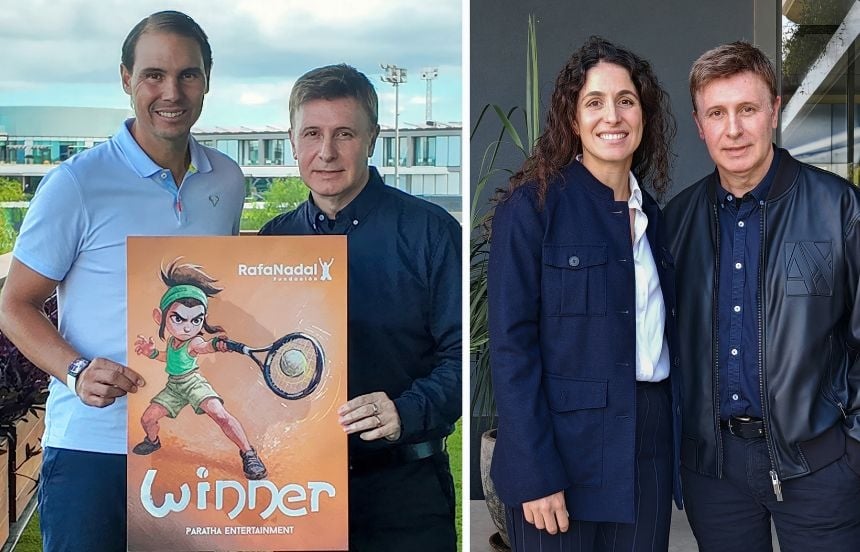
Montreal- and Madrid-based international sales and distribution company Pink Parrot Media (PPM) has boarded the upcoming 3D animated feature “Winner”—a fictional English-language comedy-adventure produced by Paratha Entertainment in collaboration with the Rafa Nadal Foundation. The film follows a young girl and her journey to rise above her circumstances and become one of the best tennis players in history. PPM is handling worldwide sales (excluding Spain and India) and is set to introduce the project at the upcoming 79th edition of the Cannes Film Festival, where the company will present a script and visuals.
The film brings together values of overcoming challenges, social integration, and personal development championed by the Rafa Nadal Foundation, an organization created by legendary Spanish tennis player Rafael Nadal. It draws inspiration from NETS (Nadal Educational Tennis School), a flagship project of the Foundation launched in 2010 in southern India with the mission of improving the lives of vulnerable children through tennis, education, and nutritional support. “Winner” is planned for release in 2028, with production slated to begin in the coming months. Animation is being developed across Spain and India in collaboration with Grangel Studio (“Corpse Bride”, “Guillermo del Toro’s Pinocchio”), La Tribu Animation (“Wish Dragon”, “Red Shoes and the Seven Dwarfs”), Amuse Animation (“Car City”, “Increditales”), and Digitoonz (“Smurfs”, “Ozi: Voice of the Forest”), the latter also handling the film’s release in India.
Uma is 12, quick, smart, and cautious. She lives with her aunt Kiara, a “meditation guru” more into social media than caring for her niece. To get by, Uma sells her irresistible pancakes at the market. One day, when a group of wealthy kids led by the arrogant Ravi tries to drive her away, Uma fights back—her frying-pan aim leaves everyone stunned. Naya, director of a school for underprivileged children, spots her talent.
What Uma doesn’t know is that Ravi is the nation’s top junior tennis player—and his father, Mr. Gupta, plans to close Naya’s school to build an elite club. With help from Simon, a former tennis player facing his own demons, and her new friends, Uma trains to face Ravi in the national tournament. “Winner” is a universal story of perseverance, friendship, and second chances—because sometimes the real trophy isn’t a cup, but finding your place in the world.
“Winner” is being developed in Spain with screenwriter and director Jaime Maestro (“Animal Crackers”) and Bartolomé Blaya, CEO of Paratha Entertainment and Producer/Composer (Universal, Warner, Sony, and BMG US Latin), in collaboration with the Rafa Nadal Foundation. Blaya is also composing the film’s soundtrack, performed by the London Symphony Orchestra and mixed in Dolby Atmos in Los Angeles. Maria Bonaria Fois from Digitoonz Spain is the Executive Producer, alongside Tania Pinto Da Cunha and Marie Claude Beauchamp from Pink Parrot Media.
Tania Pinto Da Cunha, Partner/Vice President and Head of International Sales & Acquisitions at Pink Parrot Media, expressed: “It is a true honor for Pink Parrot Media to join this feature and support Paratha Entertainment and the Rafa Nadal Foundation in bringing its values to audiences around the world. We are proud to be part of a project that combines strong universal storytelling with a meaningful message of resilience and overcoming adversity. “Winner” has all the ingredients to connect with family audiences and tennis fans globally, and we are confident in its potential to inspire through an authentic and emotionally engaging journey.”
Also, Bartolomé Blaya, CEO of Paratha Entertainment, added: “From the very beginning, we understood that “Winner” is not just a film, but a story with purpose—an opportunity to connect with young audiences through values such as self-improvement, resilience, and self-belief. For us, it is a privilege to help shape this universe, and we look forward to collaborating with Pink Parrot Media, whose commitment to high-quality family entertainment and strong international vision makes this project even more solid and ambitious.”
Finally, Maria Francisca Perelló, Director of the Rafa Nadal Foundation, stated: “At the Rafa Nadal Foundation, we have been working for years to promote the development of young people through education and sport, striving to instill in them a series of important positive values for their growth. Being able to reflect these values in an audiovisual production with international reach offers us an extraordinary opportunity. It will be an important tool to spread our message and inspire more people.”
PPM’s slate for the Cannes Film Festival also includes “Tistou”, a CG animated feature adaptation of Maurice Druon’s classic French children’s novel “Tistou les Pouces Verts”, as well as 3D CG animated films produced by Canada’s CarpeDiem Film & TV: the whimsical adventure-comedy “Unstable”, co-produced with UK-based Cantilever Productions (“The Amazing Maurice”), and the magical comedy-adventure “The Bottanix”—both currently in production and set for delivery by 2027. Additionally, PPM will present “Emma & Thomas” (“Lotte & Totte”), a Danish 3D CG animated feature based on the bestselling Scandinavian book series by Gunilla Wolde, and “MoMonsters: The Movie”, the first film featuring the beloved characters and gentle lessons from the Spanish “Momonsters” series.