

Japan’s landmark warship deal with Australia, formalised in April 2026, represents one of the most consequential defence-industrial agreements in the Indo-Pacific in recent years. The agreement should not be seen as another procurement decision, but as a shift in how power, industry, and partnerships are evolving in the Indo-Pacific. It has not been marked by dramatic announcements or sweeping rhetoric. Instead, it is unfolding through practical steps—contracts, shipbuilding arrangements, and growing confidence between the two countries. At one level, it is a straightforward exchange of ships for capability. However, its significance goes well beyond the vessels themselves, pointing to deeper changes in how regional security cooperation is taking shape.
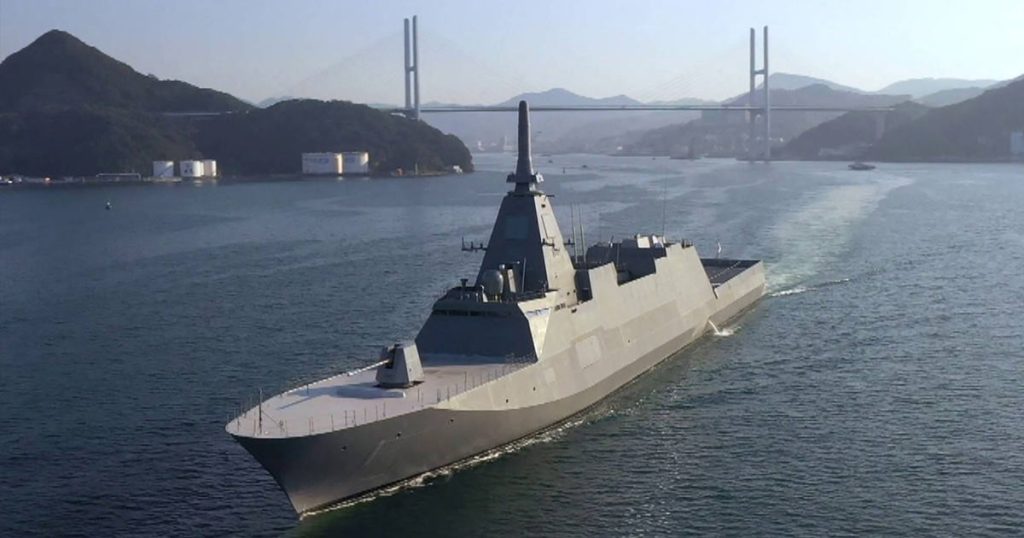
The agreement, valued at roughly AUD 10 billion (US$ 6.5–7 billion), commits Australia to acquiring eleven next-generation multi-role frigates based on Japan’s upgraded Mogami (New FFM) design. Three will be built in Japan by Mitsubishi Heavy Industries, with delivery beginning in 2029, while the remaining eight will be constructed in Western Australia, marking a phased transfer of industrial capability. This hybrid production model is the strategic focal point of the arrangement and not merely incidental. It signals a transition from buyer–seller dynamics to co-production and shared industrial ecosystems.
The agreement should not be seen as another procurement decision, but as a shift in how power, industry, and partnerships are evolving in the Indo-Pacific.
The ships themselves reflect the changing character of maritime competition. Derived from the Mogami-class frigate, the upgraded design is built for multi-domain operations: anti-submarine warfare, surface strike, and air defence. They incorporate a 32-cell vertical launch system, long operational range, and high automation, enabling crews of around 90, which is low for ships of this size. With fewer sailors, more sensors, and integration with US-compatible systems, their design philosophy is telling. This is not simply about replacing Australia’s ageing Anzac-class vessels; it is about embedding the Royal Australian Navy within a broader networked battlespace.
To understand why this deal matters, it is necessary to situate it within Japan’s gradual but unmistakable strategic evolution. For decades after the Second World War, Japan’s defence posture was defined by restraint—constitutional, political, and normative. That posture has been steadily recalibrated since the 2014 relaxation of arms export restrictions. The deal with Canberra represents the most significant milestone in that trajectory, marking Japan’s largest defence export and a clear signal that it is prepared to act as a supplier of security, not merely a consumer.
Yet this is not a wholesale abandonment of Japan’s post-war identity. Rather, it is an adaptation. Tokyo is not seeking autonomy from the US so much as diversification within that framework, by building parallel lines of strategic connection with Australia, Southeast Asia, and other partners. In this sense, Japan’s trajectory mirrors that of other Indo-Pacific actors: wary of overdependence, but not inclined toward rupture.
The reasoning is more obvious for Australia. A constantly changing threat environment, ageing frigates, and delays in next-generation platforms present the Royal Australian Navy with a capability gap. The Mogami-class ships are designed to serve as a bridge, given their rapid acquisition timelines, adaptability in deployment, and compatibility with other systems. The agreement is being described as one of Australia’s fastest peacetime navy acquisitions. But speed is only part of the story. A deeper concern with sovereign capability—the ability to maintain and modify platforms, not merely operate them—is reflected in the decision to construct eight of the eleven ships domestically.
The geopolitical backdrop, too, is unmistakable. Both Tokyo and Canberra are responding to the same structural pressure: the steady expansion of China’s maritime assertions across the Western Pacific and into the eastern Indian Ocean. The new frigates are explicitly intended to protect sea lines of communication and Australia’s northern approaches, areas of increasing strategic contestation. Yet neither country frames the deal in overtly confrontational terms. Instead, it is presented as a contribution to “stability,” a word that has become the lingua franca of Indo-Pacific security discourse.
Both Tokyo and Canberra are responding to the same structural pressure: the steady expansion of China’s maritime assertions across the Western Pacific and into the eastern Indian Ocean.
It is in this context that the relationship between the Japan–Australia deal, AUKUS, and the Quad becomes particularly revealing. At first glance, AUKUS and the frigate deal occupy different domains: one centred on high-end capabilities such as nuclear-powered submarines and advanced technologies, the other on conventional surface combatants. But the distinction is less important than the complementarity. AUKUS operates at the apex of the capability spectrum—expensive, technologically demanding, and long-term. The deal with Tokyo fills the middle layer: scalable, deployable, and near-term.
In effect, Australia is constructing a tiered force structure through multiple partnerships. The Japanese frigates offer operational presence and adaptability, while AUKUS offers strategic depth and deterrence. Industrial cooperation is part of this dispersion. The agreement thus creates a parallel axis of cooperation in Northeast Asia, whereas AUKUS prioritises integration with the US and the UK. Instead of redundancy, the outcome is resilience, including diversification of industrial dependencies and sources of capability.
The Quad, by contrast, operates less as a defence arrangement and more as a political-strategic framework. It lacks the formal commitments and integrated planning of AUKUS. Yet the Japan–Australia deal can be seen as an operationalisation of Quad convergence. It translates common perceptions of threat into concrete capability development. In this way, bilateral agreements like this one provide the material substance of a “free and open Indo-Pacific,” while the Quad offers the strategic narrative.
The proliferation of such agreements suggests that the Indo-Pacific is moving towards what might be called a lattice-like security architecture. Rather than a single alliance system, the region is characterised by overlapping networks: bilateral, trilateral, and minilateral. These networks are not identical in membership or purpose, but they are increasingly interoperable.
There is also a subtler dynamic at play. The proliferation of such agreements suggests that the Indo-Pacific is moving towards what might be called a lattice-like security architecture. Rather than a single alliance system, the region is characterised by overlapping networks: bilateral, trilateral, and minilateral. These networks are not identical in membership or purpose, but they are increasingly interoperable. The frigate deal strengthens one strand of this lattice, linking industrial capacity with operational capability.
For India, the implications are significant, as the cumulative effect of these partnerships shapes the strategic environment in which it operates. A more capable and interconnected set of maritime forces in the eastern Indo-Pacific contributes to a form of distributed balancing—one that aligns, albeit indirectly, with its own interest in maintaining open sea lanes and preventing regional dominance by any single power.
The significance of the Japan–Australia warship deal lies less in grand strategy than in its apparent routine character. What is emerging is not a formalised structure, but rather a diffuse and potentially resilient configuration, one in which states are increasingly able to build together, deploy together, and, if required, operate in concert.
Pratnashree Basu is an Associate Fellow at the Observer Research Foundation.
The views expressed above belong to the author(s). ORF research and analyses now available on Telegram! Click here to access our curated content — blogs, longforms and interviews.