
Over the past decade, images of Dubai became ubiquitous online. They sell a fantasy, one where fast cars take you and your model girlfriend to an endless series of exceptionally clean malls shielded from the heat, and then party on rooftops once the sun goes down. Safety is always emphasized, with the implication that Dubai will keep “those kinds of people” from bothering you. It’s a fantasy of what living in a society should be like, where you never have to actually exist with the trade-offs that life entails.
That fantasy was built by an army of influencers, either directly paid off by the Dubai government or latching on the city’s image to try to build their own online empires. Even as Iranian drones and missiles pound skyscrapers, Dubai’s influencers persist in projecting the image that the city wants to see. Now China is attempting that same playbook—with surprising success.
Over the past decade, images of Dubai became ubiquitous online. They sell a fantasy, one where fast cars take you and your model girlfriend to an endless series of exceptionally clean malls shielded from the heat, and then party on rooftops once the sun goes down. Safety is always emphasized, with the implication that Dubai will keep “those kinds of people” from bothering you. It’s a fantasy of what living in a society should be like, where you never have to actually exist with the trade-offs that life entails.
That fantasy was built by an army of influencers, either directly paid off by the Dubai government or latching on the city’s image to try to build their own online empires. Even as Iranian drones and missiles pound skyscrapers, Dubai’s influencers persist in projecting the image that the city wants to see. Now China is attempting that same playbook—with surprising success.
“Chinamaxxing” has emerged as a social media trend in the past couple of years, with Westerners taking on significant interest in content about life in China and perpetuating the trend back home by attempting to “be Chinese” by doing things such as squatting, drinking hot water, and smoking. Much of the Chinamaxxing phenomenon can be traced back to American streamer IshowSpeed’s trip to China in early 2025, which was a viral sensation both in the United States and China.
It’s good content—a freewheeling trip through the country that was full of the kind of people-to-people content that the Chinese government encourages, and full of the kinds of clippable and shareable moments that play well on an internet of short-form video.
It’s also the kind of content that systems in China struggle to produce. Top-down media—including China’s traditional outlets, such as CGTN television and the China Daily newspaper—produce predefined results, but the Internet of the mid-2020s thrives on supposed spontaneity and authenticity. The central role of a content creator is to create moments and content that appear authentic, however choreographed they are behind the scenes.
Sure, China has a thriving marketplace for this kind of content, but the Great Firewall and language barriers keep it largely locked into China, which is why Chinamaxxing has come through Western influencers. Influencers are also great soft-power tools because their job is to function as cultural amplifiers. Brands know this well—it’s why influencers with under 10,000 followers can sometimes still make $1,500 a video.
Leveraging influencers this way is a new strategy, even though China has long tried to burnish its global image. The world remembers the 2008 Summer Olympics, and we’ve lived through decades of think pieces by Western pundits who have taken the train from Beijing to Shanghai or visited some factories and witnessed the future. Those are top-down influence operations, with the fingerprints of the government or PR pushes by large Chinese corporations visible because they have access to spaces that no regular person would be able to have access to. It’s an echo of the old, Soviet style of propaganda, with its endless lists and numbers.
Chinamaxxing doesn’t have the same easily identifiable marks. Even previous efforts, such as the attempts in the early 2020s to whitewash human rights abuses, gave influencers a script to work from and dictated their travels. It’s a shift from the old model to the Dubai one, where the zone is flooded with posts from “relatable” individuals experiencing the world like normal people instead of through choreographed moves from state organs, and it’s working for a much larger audience.
Chinamaxxing is defined not on its own terms, but as a response to life in Western cities. It’s less of the idea that Dubai or Shanghai are a desirable place to live on their own, but more that these places are an alternative to the problems that Western viewers are noticing in their own backyards. If the income tax in your home country bothers you, or you don’t want your money going to people who you think don’t deserve it, then you can move to somewhere where power is guaranteed to be on your side. That’s always been the promise of Dubai.
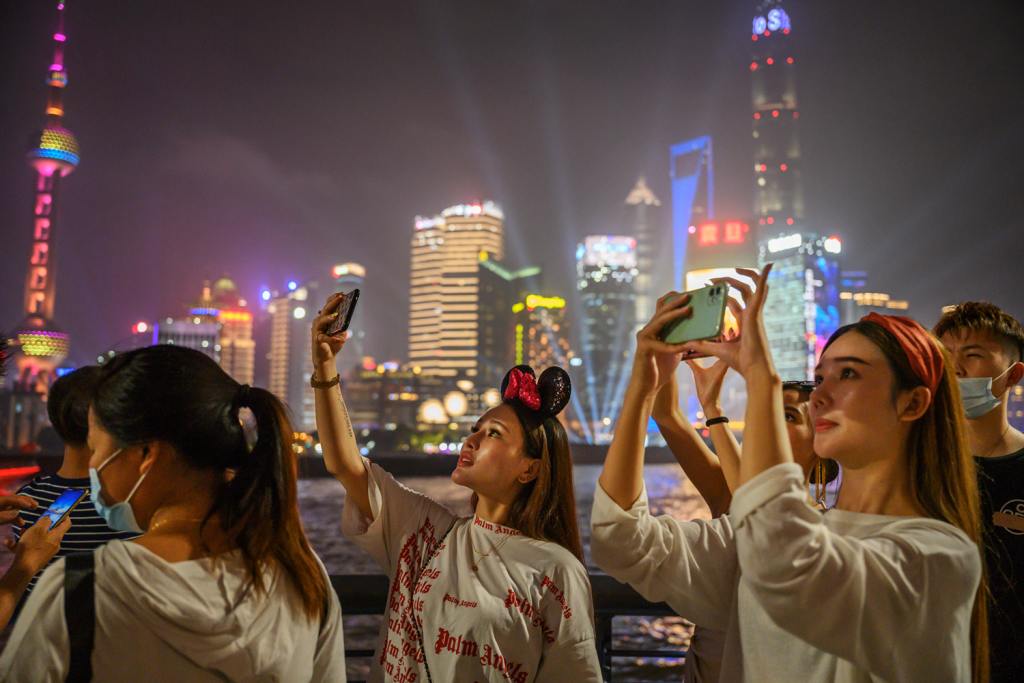
The Chinese city of Chongqing is similarly very popular online because it makes an incredible backdrop for content—all towering apartment buildings going up the banks of the river that play perspective tricks like a cabin built onto the side of a hill, with shining new buildings across the river that light up at night. It’s like it was made for the camera.
More importantly, it’s the opposite of what a U.S. city looks like. China doesn’t have to be a real place in the world of Chinamaxxing, with people and problems and politics. Chinamaxxing isn’t about what China is. It’s about constructing something in the mind of Americans that is everything that the United States isn’t, similar to the warped mirror created by influencers in Dubai. It’s not a real place; it’s a backdrop for the anxieties of Americans.
You don’t see the Chongqing that has elderly farmers riding the subway into the city to sell their produce on sidewalks to survive, or the hukou restrictions that have put them in that situation. You see Hongyadong and Chaotianmen because they look like the future, not rural Hebei, unless there are enough smiling faces there eager to interact with a foreigner. You don’t have to think about the collapse of the real estate market—just look at how much cheaper their rent is than yours in these sleek new apartments.
In both Dubai and China, cheap labor plays a role in building the fantasy world that gets projected. Dubai’s gleaming skyline was built by migrant labor, and the lifestyles of expats there are built on the backs of domestic labor. China doesn’t need foreign labor to build this fantasy because the hukou system—which shuts rural people out of access to the better services of the cities—and a population of 1.4 billion people ensures that there is a seemingly never-ending supply of internal migrants to build new skyscrapers, clean your apartment, and deliver food.
You might have your own Western anxieties about decline and downward mobility, and the balm is looking at a country such as China, where the GDP per capita is a sixth of what it is in the United States, or a country that imports labor from somewhere where that gap is even larger.
That’s the shared message of Dubai and China online. Whether it’s Dubai’s emphasis on safety and order or China’s tantalizing glimpse at the future, both propped up by cheap labor, the message from both is the same—look at what your political system can’t do. They’re the political equivalent of the influencers with perfect teeth and hair living a lifestyle that you can’t afford, who remind you of all the things you don’t like about your own life. Wouldn’t you be happier if you were more like them?
But as with any influencer, the reality is significantly different from the images on your phone. You don’t see what makes the content, or the country, happen, and you certainly don’t see the problems that they’re trying to hide.